
Digital transformation in business management is no longer about adopting the latest technology for visibility or branding. It is about rethinking how organizations make decisions, manage processes, engage people, and deliver value—consistently and at scale.
At Faber Infinite Consulting, we have worked closely with leadership teams across manufacturing, FMCG, logistics, infrastructure, and service organizations. A recurring pattern emerges: companies invest heavily in systems and tools, yet struggle to see measurable improvement in performance. The gap rarely lies in technology alone—it lies in how digital initiatives are integrated with business management, strategic management, and operational excellence.
This blog explores the real impact of digital transformation on business management, combining first-hand consulting experience with proven frameworks, industry standards, and practical insights.
Understanding Digital Transformation in Business Management
Digital transformation in business management refers to the structured use of digital technologies to improve how businesses are planned, governed, and operated. It goes beyond IT upgrades and focuses on business process improvement, decision-making speed, transparency, and accountability.
Key Elements of Digital Business Management
- Strategy-led digital adoption aligned with business strategy development
- Process optimization across core and support functions
- Data-driven strategic management
- Automation in management to reduce manual effort and errors
- Artificial intelligence in management for predictive and prescriptive decisions
According to a McKinsey study, companies that align digital transformation with core business processes are 1.5 times more likely to report above-average growth compared to peers.
Experience from the Field: What We See in Real Organizations
As a business management consultant, Faber Infinite Consulting has observed that digital transformation succeeds only when it starts with clarity on operational realities.
Example: From Fragmented Processes to Process Excellence
In a large manufacturing organization, multiple digital tools were in place—ERP, dashboards, reporting systems—yet productivity remained stagnant. Our on-ground assessment revealed:
- Non-standard processes across plants
- Manual workarounds despite automation
- Data available but not trusted by managers
By first stabilizing processes through lean principles and business process improvement, and then layering digital tools for monitoring and control, the organization achieved:
- Improved operational efficiency
- Faster decision cycles
- Higher ownership at middle-management levels
This reinforces a critical insight: digital transformation accelerates performance only when processes are already designed for efficiency.
The Role of Strategic Management in Digital Transformation
Digital initiatives without strategic management often turn into isolated technology projects. Effective digital transformation is rooted in clear strategic planning.
Strategic Planning Process for Companies
A structured strategic planning process typically includes:
- Defining long-term business objectives
- Identifying value-driving processes
- Assessing digital maturity and gaps
- Prioritizing initiatives based on business impact
- Establishing governance and review mechanisms
Harvard Business Review highlights that organizations with disciplined strategic planning and execution routines outperform competitors by up to 20% in profitability.
At Faber Infinite, digital transformation roadmaps are always linked to measurable business outcomes—cost, productivity, service levels, and growth.
Business Process Improvement as the Foundation
No amount of digital investment can compensate for broken processes. Business process improvement remains the foundation of sustainable transformation.
Process Improvement Techniques for Management
- Value stream mapping to identify waste
- Standard work and visual management
- Workflow digitization after process stabilization
- Performance dashboards linked to daily management
International standards such as ISO 9001 emphasize process-based management as a prerequisite for consistent performance. Digital tools strengthen these systems—but do not replace them.
Operational Excellence in the Digital Era
Operational excellence in business management focuses on doing the right things, the right way, every day. Digital transformation enhances this by enabling:
- Real-time performance visibility
- Faster root-cause analysis
- Better coordination across functions
Digital Enablers of Operational Excellence
- Automated KPI tracking
- Predictive maintenance systems
- AI-driven demand forecasting
- Digital daily management systems
According to Deloitte, organizations that integrate digital tools into operational excellence programs see 15–30% improvement in business efficiency.
Artificial Intelligence and Automation in Management
Artificial intelligence in management is shifting the role of leaders—from reacting to problems to anticipating them.
Practical Applications
- AI-based production and capacity planning
- Automated financial and operational reporting
- Intelligent quality monitoring
- Decision-support systems for strategic management
However, trustworthiness remains critical. AI outputs must be transparent, explainable, and aligned with business logic. Faber Infinite emphasizes human-in-the-loop models to ensure accountability and reliability.
Managing Organizational Change Effectively
One of the most searched questions today is how to manage organizational change effectively during digital transformation.
From experience, successful change management includes:
- Clear communication of purpose
- Capability building at all levels
- Aligning incentives with new ways of working
- Structured review and feedback loops
Prosci research indicates that projects with strong change management are six times more likely to meet objectives than those without.
Governance, Data, and Trust in Digital Transformation
Trustworthiness in digital business management depends on:
- Data accuracy and consistency
- Cybersecurity and compliance
- Clear ownership of systems and decisions
Global frameworks such as COBIT and ISO/IEC 27001 provide guidance on digital governance and information security, ensuring digital transformation is sustainable and reliable.
Conclusion: Turning Digital Transformation into Business Results
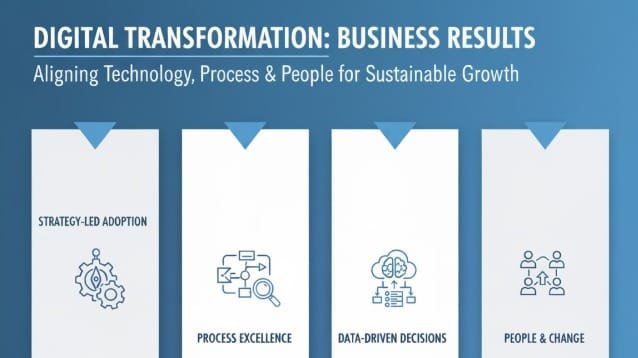
Digital transformation in business management is not a technology race—it is a management discipline. Organizations that succeed focus on:
- Strong business strategy development
- Robust business process improvement
- Operational excellence supported by digital tools
- Thoughtful change management
Actionable Takeaways
- Start with process excellence before digitalization
- Link every digital initiative to strategic objectives
- Invest in capability building, not just tools
- Use data for daily decisions, not only reviews
- Treat digital transformation as an ongoing journey
At Faber Infinite Consulting, we believe that when digital tools are aligned with people, processes, and purpose, transformation delivers results that last.
Frequently Asked Questions (FAQs)
1. What is the impact of digital transformation on management?
Digital transformation improves decision-making speed, transparency, and accountability, enabling managers to focus on value creation rather than firefighting.
2. How does digital transformation support business process improvement?
It enhances visibility, standardization, and control once processes are optimized, helping sustain improvements over time.
3. Is automation in management suitable for all businesses?
Yes, but it must be scaled and aligned with business maturity. Automation without process clarity often creates more complexity.
4. How can companies manage organizational change effectively during digital transformation?
Through clear communication, training, leadership involvement, and structured performance reviews.
5. What role does a business management consultant play in digital transformation?
A consultant brings structured frameworks, industry benchmarks, and execution discipline to ensure digital initiatives deliver measurable business results.
Contact us for Business Management Consultant