
Many companies invest heavily in strategy decks, new systems, and transformation programs, yet still struggle with delays, rising costs, and inconsistent results. The reason is often simple: business processes were never designed to support the strategy in the first place.
In today’s competitive environment, business process improvement is no longer a one-time initiative. It is a continuous discipline that directly impacts business management, operational excellence, and long-term performance. Companies that systematically improve how work flows across functions outperform those that rely only on strategic intent.
At Faber Infinite Consulting, our experience across multiple industries shows that organizations that focus on process excellence achieve faster decision-making, stronger execution, and more predictable outcomes. This blog explores practical business process improvement strategies, supported by real-world insights, industry standards, and proven management frameworks.
Understanding Business Process Improvement in Business Management
What Is Business Process Improvement?
Business process improvement (BPI) refers to the structured approach of analyzing, redesigning, and optimizing workflows to improve efficiency, quality, and business outcomes. Unlike isolated fixes, BPI focuses on end-to-end processes that cut across departments and directly influence customer value.
In business management, effective process improvement enables:
-
Better alignment between strategy and execution
-
Reduced operational waste and inefficiencies
-
Improved employee productivity and accountability
-
Consistent delivery of customer expectations
Why Business Process Improvement Matters for Strategic Management
Strategic management defines what an organization wants to achieve. Business process improvement determines how reliably those goals are achieved.
According to global operational benchmarks published by McKinsey and PwC, companies that embed continuous improvement into daily management practices can achieve:
-
20–30% improvement in operational efficiency
-
15–25% reduction in operating costs
-
Faster cycle times and improved service consistency
These gains are not driven by technology alone, but by disciplined process design and execution.
Core Business Process Improvement Strategies for Companies
1. Map and Diagnose End-to-End Processes
The first step in any improvement initiative is visibility. Many inefficiencies remain hidden because teams only see their individual tasks, not the full process.
At Faber Infinite Consulting, we begin with end-to-end process mapping, covering:
-
Inputs, outputs, and decision points
-
Handoffs between departments
-
Bottlenecks, rework loops, and delays
Real-world insight:
In a manufacturing client engagement, process mapping revealed that over 35% of lead time was consumed by internal approvals and information gaps rather than actual production. Addressing these issues delivered faster results than adding capacity.
2. Align Process Improvement with Business Strategy Development
Process improvement efforts fail when they are disconnected from business strategy development. Improving everything dilutes focus and impact.
Effective business management consultants prioritize:
-
Processes critical to customer value
-
Activities linked to strategic objectives
-
Areas with measurable financial or service impact
For example, a company pursuing market expansion must improve order fulfillment, demand planning, and customer onboarding processes before expecting growth results.
3. Standardize Before Automating
Automation in management delivers value only when applied to stable and well-defined processes. Automating inefficient workflows simply accelerates poor performance.
A structured approach includes:
-
Standard operating procedures (SOPs)
-
Clear role ownership and accountability
-
Defined performance metrics
Expert practice:
Industry standards such as ISO 9001 and Lean Management emphasize standardization as the foundation of operational excellence. Companies that skip this step often face higher system rework costs post-implementation.
4. Embed Continuous Improvement into Daily Operations
Continuous improvement is not a workshop or a project. It is a management habit.
High-performing organizations:
-
Track process KPIs daily or weekly
-
Encourage frontline teams to identify improvement opportunities
-
Review root causes, not just symptoms
At Faber Infinite Consulting, we help leadership teams integrate continuous improvement into daily management routines, ensuring that improvements sustain beyond initial gains.
Role of Digital Transformation in Business Process Improvement
Impact of Digital Transformation on Management
Digital transformation changes how decisions are made, monitored, and executed. However, technology must support management discipline, not replace it.
When aligned correctly, digital tools enable:
-
Real-time performance visibility
-
Faster decision-making
-
Reduced manual intervention
Artificial Intelligence in Management
Artificial intelligence in management is increasingly used for:
-
Demand forecasting
-
Predictive maintenance
-
Workforce planning
For example, AI-driven analytics can identify process deviations before they impact service or cost, enabling proactive management rather than reactive firefighting.
Automation in Management for Operational Efficiency
Automation in management is most effective in:
-
Transaction-heavy processes (billing, reporting, approvals)
-
Rule-based decision workflows
-
Data consolidation and analysis
According to Deloitte, companies that combine process optimization with automation improve productivity by up to 40% compared to automation alone.
Managing Organizational Change Effectively
Why Change Management Determines Process Improvement Success
Even the best-designed processes fail without adoption. Managing organizational change effectively is essential for business transformation.
Key change management practices include:
-
Clear communication of purpose and benefits
-
Leadership role modeling
-
Capability building and training
Practical insight:
In multiple client transformations, resistance reduced significantly when teams were involved in designing the new process rather than being handed a finished solution.
Building a Culture of Process Excellence
Process excellence is sustained when:
-
Employees understand how their work contributes to outcomes
-
Performance is measured transparently
-
Improvement efforts are recognized
This cultural shift strengthens business efficiency and long-term competitiveness.
Measuring Success in Business Process Improvement
Key Metrics for Operational Excellence
Effective measurement focuses on:
-
Cycle time reduction
-
Cost per transaction
-
First-time-right quality
-
Customer satisfaction
Strategic management teams should review these metrics regularly to ensure alignment with business objectives.
Linking Process Improvement to Business Outcomes
Improvement initiatives should always answer:
-
How does this impact revenue, cost, or customer experience?
-
How does it support strategic planning?
This ensures business process improvement remains a value driver, not a support activity.
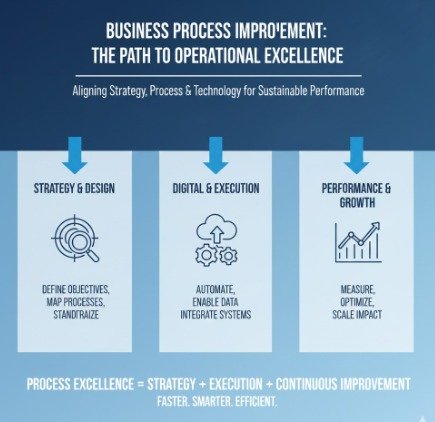
How Faber Infinite Consulting Supports Business Process Improvement
As a business management consultant, Faber Infinite Consulting brings hands-on experience across industries, focusing on:
-
Practical process redesign
-
Lean and operational excellence frameworks
-
Digital enablement aligned with management systems
Our approach combines strategic planning, process optimization, and execution discipline to deliver sustainable results rather than short-term fixes.
Conclusion: Turning Process Improvement into a Competitive Advantage
Business process improvement is not about incremental tweaks. It is about designing operations that consistently support strategic goals.
Companies that succeed:
-
Treat process excellence as a leadership responsibility
-
Integrate technology thoughtfully
-
Build continuous improvement into daily management
Actionable takeaway:
Start with one critical process, map it end-to-end, measure what matters, and improve systematically. Sustainable transformation begins with disciplined execution.
Frequently Asked Questions (FAQs)
1. What are the most effective business process improvement techniques for management?
Process mapping, root cause analysis, standardization, and continuous improvement systems are among the most effective techniques for improving management performance.
2. How does digital transformation impact business management?
Digital transformation enhances visibility, decision speed, and control, but delivers real value only when combined with strong process design and management discipline.
3. How can companies manage organizational change effectively during process improvement?
By involving employees early, communicating purpose clearly, and aligning leadership behavior with the desired changes.
4. What role does a business management consultant play in process improvement?
A consultant brings structured methodologies, cross-industry experience, and objective insights to accelerate improvement and avoid common pitfalls.
5. How does business process improvement support operational excellence?
It reduces waste, improves consistency, and enables organizations to deliver predictable performance aligned with strategic goals.