Across Saudi Arabia, manufacturers are under growing pressure to reduce operational costs while maintaining quality, compliance, and delivery performance. Rising energy prices, workforce nationalization goals, global supply chain volatility, and competitive regional markets are forcing factories to rethink how work is done on the shop floor.
Cost reduction in the manufacturing industry in Saudi Arabia is no longer about short-term cuts. It requires systematic, sustainable, and data-driven improvement. This is where lean manufacturing plays a critical role.
At Faber Infinite Consulting, we have worked closely with factories across the Middle East to improve manufacturing productivity, optimize processes, reduce waste, and build long-term operational resilience. Lean manufacturing, when implemented correctly, becomes a powerful engine for operational cost reduction without compromising output or safety.
Understanding Lean Manufacturing in the Saudi Manufacturing Context
What Is Lean Manufacturing?
Lean manufacturing is a structured approach focused on maximizing value while minimizing waste. It improves flow, reduces variation, and strengthens problem-solving at every level of the organization.
Core lean principles include:
-
Identifying value from the customer’s perspective
-
Eliminating non-value-adding activities (waste)
-
Improving process efficiency and flow
-
Standardizing work
-
Enabling continuous improvement
For Saudi factories, lean manufacturing aligns well with:
-
Vision 2030 productivity goals
-
Smart manufacturing initiatives
-
Sustainability and energy efficiency mandates
-
Workforce skill development
Why Lean Manufacturing Is Essential for Cost Reduction in Saudi Factories
Lean manufacturing cost reduction goes beyond labor savings. It addresses hidden costs that often remain unmanaged for years.
Key Cost Challenges in Saudi Manufacturing
-
High utility and energy costs
-
Excess inventory tied to working capital
-
Maintenance cost escalation due to reactive practices
-
Low equipment utilization
-
Process inefficiencies and rework
-
Supply chain disruptions
Lean manufacturing provides a structured way to control and reduce these costs, while improving manufacturing efficiency and stability.
Real-World Experience: Lean Cost Reduction in Action
Example 1: Process Optimization in a Saudi Industrial Plant
In one Saudi-based manufacturing facility, our diagnostic study revealed that only 55–60% of available machine time was being productively used. The remaining time was lost due to waiting, changeovers, and unplanned stoppages.
By applying:
-
Value Stream Mapping
-
Standard work definition
-
SMED (Single-Minute Exchange of Dies)
-
Daily performance management
The factory achieved:
-
22% improvement in throughput
-
18% reduction in operational cost
-
Lower maintenance cost through improved equipment care
This improvement was achieved without new machinery or capital expenditure.
Key Lean Manufacturing Strategies for Cost Reduction
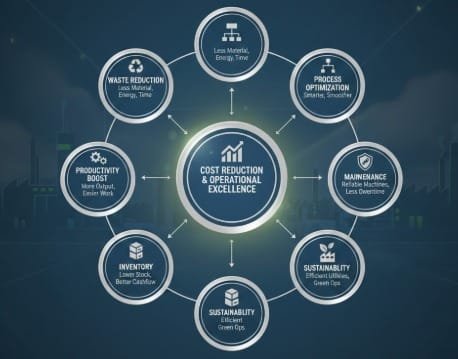
1. Waste Reduction in Manufacturing
Waste reduction is the foundation of lean manufacturing cost reduction.
Common wastes identified in Saudi factories include:
-
Overproduction
-
Excess inventory
-
Waiting time
-
Transportation losses
-
Rework and defects
-
Energy and utility wastage
Impact on Cost
-
Reduced raw material consumption
-
Lower storage and handling costs
-
Improved cash flow
-
Reduced utility expenses
Waste reduction methods in manufacturing directly support manufacturing cost control and operational cost reduction.
2. Process Optimization in Manufacturing
Process optimization focuses on improving flow, balancing workloads, and removing bottlenecks.
Lean tools used:
-
Process mapping
-
Line balancing
-
Takt time alignment
-
Bottleneck analysis
Results Observed
-
Faster order fulfillment
-
Lower work-in-progress inventory
-
Improved manufacturing efficiency
-
Better resource utilization
For factories aiming at manufacturing process improvement in Saudi Arabia, process optimization delivers quick and measurable results.
3. Manufacturing Productivity Improvement Through Lean
Productivity improvement does not mean pushing people harder. Lean improves productivity by making work easier, clearer, and more consistent.
Lean productivity drivers:
-
Clear work standards
-
Visual management
-
Reduced motion and handling
-
Skill-based workforce deployment
In Saudi manufacturing environments, this approach also supports workforce localization and skill development.
4. Maintenance Cost Reduction Using Lean Practices
Maintenance cost reduction is often one of the largest opportunities in Saudi factories.
Lean maintenance focuses on:
-
Preventive and predictive maintenance
-
Operator-led equipment care
-
Root cause problem solving
-
Reducing breakdown frequency
Typical Outcomes
-
15–30% reduction in maintenance cost
-
Improved machine availability
-
Lower spare part inventory
-
Increased equipment life
This directly supports manufacturing cost control and productivity improvement.
5. Inventory Management and Supply Chain Cost Reduction
Excess inventory hides inefficiencies and increases financial risk.
Lean inventory management includes:
-
Pull-based replenishment
-
Kanban systems
-
Supplier collaboration
-
Reduced batch sizes
For manufacturers seeking supply chain cost reduction strategies in manufacturing, lean inventory practices reduce:
-
Carrying costs
-
Obsolescence risk
-
Storage space requirements
6. Utility Cost Optimization and Sustainable Manufacturing
Energy and water costs are significant in Saudi factories.
Lean supports sustainable manufacturing cost reduction by:
-
Identifying energy-intensive processes
-
Improving equipment efficiency
-
Reducing idle running time
-
Encouraging operator ownership
This aligns with global sustainability standards such as ISO 50001 (Energy Management Systems) and supports Saudi Arabia’s environmental goals.
Authoritative Frameworks Supporting Lean Manufacturing
Lean manufacturing practices are supported by globally recognized standards and bodies, including:
-
Toyota Production System (TPS)
-
ISO 9001 – Quality Management Systems
-
ISO 14001 – Environmental Management Systems
-
ISO 45001 – Occupational Health & Safety
-
ISO 50001 – Energy Management
These frameworks reinforce the credibility, scalability, and trustworthiness of lean manufacturing initiatives.
Why Lean Manufacturing Builds Long-Term Trust and Results
Lean manufacturing is not a one-time project. It builds:
-
Transparency in operations
-
Data-driven decision-making
-
Consistent performance monitoring
-
A culture of continuous improvement
At Faber Infinite Consulting, we emphasize capability building, ensuring that improvements are sustained long after implementation.
Actionable Takeaways for Saudi Manufacturers
-
Start with a detailed operational diagnostic to identify hidden costs
-
Focus on waste reduction before capital investment
-
Improve process efficiency to unlock productivity gains
-
Integrate maintenance into daily operations
-
Align lean initiatives with sustainability and energy goals
-
Build internal problem-solving capabilities
Lean manufacturing, when applied correctly, delivers measurable cost reduction, improved productivity, and operational stability.
Frequently Asked Questions (FAQs)
1. How does lean manufacturing help with cost reduction in Saudi factories?
Lean manufacturing reduces waste, improves process efficiency, lowers maintenance costs, optimizes inventory, and improves productivity, leading to sustainable operational cost reduction.
2. Is lean manufacturing suitable for all types of manufacturing in Saudi Arabia?
Yes. Lean principles are applicable across sectors including FMCG, chemicals, pharmaceuticals, metals, packaging, and industrial manufacturing.
3. How long does it take to see results from lean manufacturing?
Most factories begin seeing measurable improvements within 8–16 weeks, with larger cost reductions achieved over 6–12 months.
4. Can lean manufacturing support sustainability goals?
Absolutely. Lean directly supports sustainable manufacturing cost reduction through energy efficiency, waste minimization, and resource optimization.
5. Does lean manufacturing require major capital investment?
No. Lean focuses on improving existing processes and systems, often delivering significant results without new capital expenditure.
About Faber Infinite Consulting
Faber Infinite Consulting partners with manufacturers to deliver practical, data-driven operational improvement across productivity, cost reduction, safety, and sustainability. Our hands-on approach ensures measurable results and long-term capability building.
Contact us