Indian businesses today operate in a high-pressure environment—tight margins, rising customer expectations, global competition, and constant cost challenges. Across manufacturing, FMCG, logistics, pharmaceuticals, and services, leaders are asking one crucial question:
How can we improve performance without increasing cost or complexity?
The answer for many successful organizations has been Lean Six Sigma—a proven methodology that blends speed, quality, and consistency into one powerful improvement engine.
At Faber Infinite Consulting, we have seen firsthand how Lean Six Sigma process improvement delivers measurable impact on shop floors, supply chains, and leadership decision-making across India.
What Is Lean Six Sigma Methodology?
Lean Six Sigma Explained (Simple & Practical)
| Aspect | Lean | Six Sigma |
|---|---|---|
| Core Focus | Waste reduction | Defect reduction |
| Objective | Faster flow | Consistent quality |
| Key Question | “What can we eliminate?” | “What causes variation?” |
| Tools | VSM, 5S, Kaizen | DMAIC, SPC, Root Cause |
| Outcome | Speed & efficiency | Accuracy & reliability |
Lean Six Sigma methodology combines both approaches to create stable, efficient, and scalable processes.
Why Lean Six Sigma Is Critical for Indian Businesses
Lean Six Sigma Benefits in India
| Business Challenge | Lean Six Sigma Impact |
|---|---|
| High operational costs | 10–30% cost reduction |
| Long lead times | 20–40% cycle time improvement |
| Quality issues | Up to 90% defect reduction |
| Inventory pile-ups | 15–35% inventory reduction |
| Low productivity | Sustainable productivity gains |
These outcomes are not theoretical—they are results delivered on Indian shop floors by experienced Lean Six Sigma consultants.
Real Experience: Lean Six Sigma in Action (India)
Case Insight from Faber Infinite Consulting
| Area Improved | Before | After |
|---|---|---|
| Delivery-in-Full | 75% | 94% |
| Lead Time | High variability | Reduced by 12 days |
| Defect Rate | Frequent rework | Reduced by 85% |
| Process Visibility | Fragmented | Standardized & visual |
What made the difference?
Not technology—but structured Lean Six Sigma process improvement, leadership involvement, and disciplined execution.
Lean Six Sigma Examples in Indian Companies
Where Lean Six Sigma Works Best
| Industry | Typical Use Case |
|---|---|
| Manufacturing | Waste reduction, OEE improvement |
| FMCG | Demand-supply alignment |
| Pharma | Deviation reduction, compliance |
| Logistics | Turnaround time reduction |
| Services | Process standardization |
Indian organizations adopting Lean Six Sigma for business improvement consistently outperform peers on cost, delivery, and quality.
Lean Six Sigma Tools and Techniques That Deliver Results
| Phase | Tools Used | Purpose |
|---|---|---|
| Define | SIPOC, VOC | Problem clarity |
| Measure | Process Mapping, Data Collection | Baseline creation |
| Analyze | Root Cause, Pareto | Identify gaps |
| Improve | Kaizen, Poka-Yoke | Sustainable fixes |
| Control | Control Plans, KPIs | Long-term stability |
This structured DMAIC approach ensures results don’t fade after the project ends.
Lean Six Sigma for Manufacturing Companies in India
Why Manufacturing Leads Adoption
| Manufacturing Pain Point | Lean Six Sigma Solution |
|---|---|
| Excess inventory | Pull systems |
| Machine downtime | Root cause analysis |
| Quality variation | Statistical control |
| Layout inefficiencies | Value stream redesign |
At Faber Infinite Consulting, Lean Six Sigma manufacturing projects typically deliver ROI within 3–6 months.
Why Businesses Choose Lean Six Sigma Consultants in India
Role of a Lean Six Sigma Consulting Company
| Consultant Contribution | Business Benefit |
|---|---|
| Structured roadmap | Faster execution |
| Data-driven insights | Confident decisions |
| Cross-functional alignment | Reduced silos |
| Capability building | Internal ownership |
Choosing the right Lean Six Sigma consultant India ensures results are practical, scalable, and sustainable.
Lean Six Sigma Consulting Services for Small Businesses
Small businesses often assume Lean Six Sigma is only for large enterprises. In reality:
| Small Business Need | Lean Six Sigma Advantage |
|---|---|
| Limited resources | Waste elimination |
| Fast growth | Process stability |
| Cost sensitivity | High ROI improvements |
Lean Six Sigma consulting services for small businesses focus on quick wins without heavy investment.
Future Scope of Lean Six Sigma in India
What Lies Ahead
| Trend | Impact |
|---|---|
| Industry 4.0 | Data-driven Six Sigma |
| ESG focus | Waste & energy reduction |
| Skill shortage | Certified practitioners |
| Global supply chains | Process consistency |
Lean Six Sigma is evolving—from a project tool to a strategic capability.
Why Faber Infinite Consulting?
Our Authority & Trust
-
Hands-on experience across 40+ industries
-
Proven Operational Excellence consulting expertise
-
Practical, India-focused implementation
-
Results measured in days, defects, and cash
We don’t just advise—we embed capability.
Actionable Takeaways
-
Lean Six Sigma is no longer optional—it’s a competitive necessity
-
Indian businesses gain faster results with expert consulting support
-
Manufacturing, FMCG, and services see the highest ROI
-
The future belongs to organizations that standardize, measure, and improve
Frequently Asked Questions (FAQs)
1. What is Lean Six Sigma methodology?
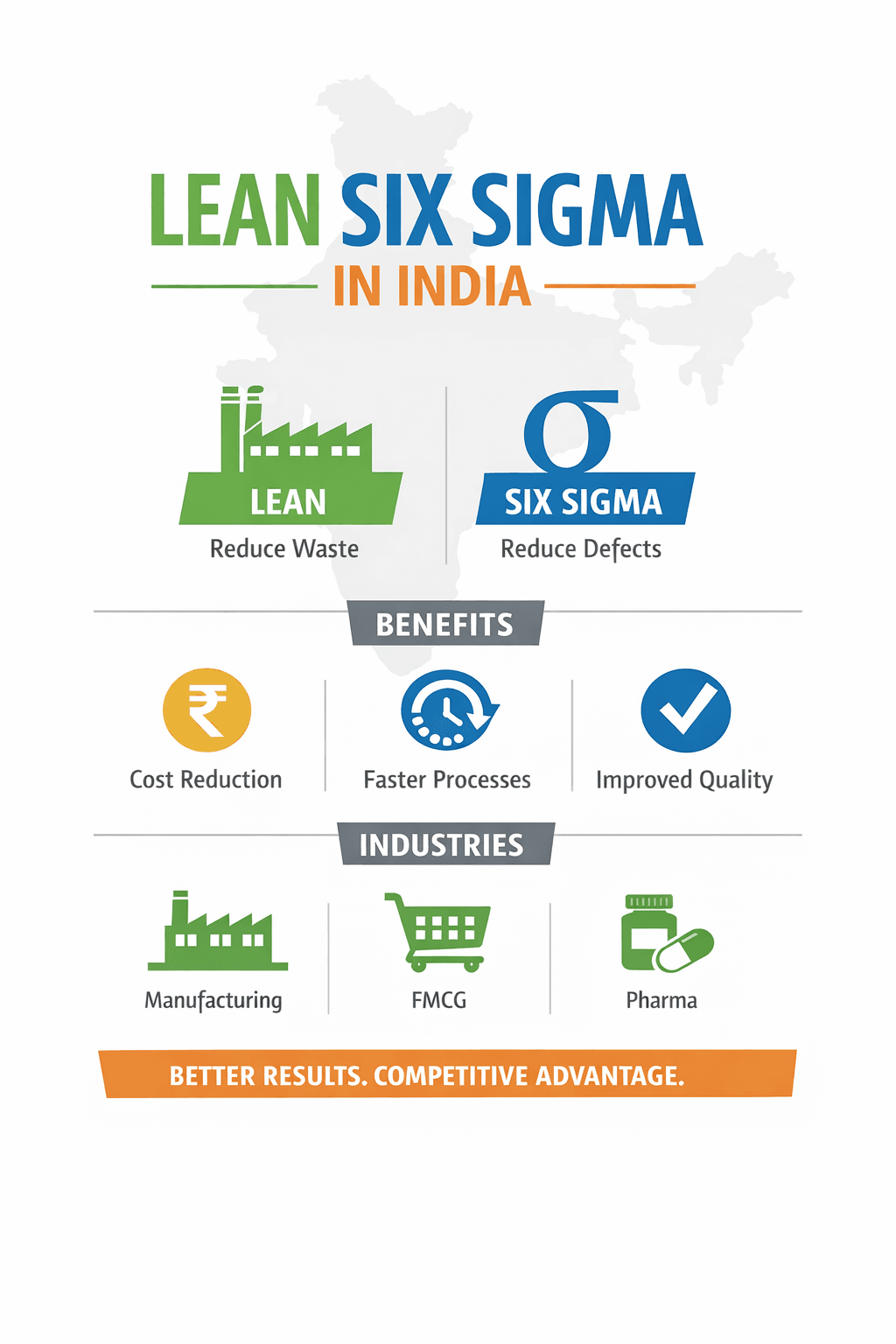
Lean Six Sigma combines waste reduction (Lean) with variation control (Six Sigma) to improve speed, quality, and cost.
2. Are there Lean Six Sigma examples in Indian companies?
Yes. Indian manufacturing, FMCG, pharma, and logistics companies widely use Lean Six Sigma for measurable improvements.
3. Is Lean Six Sigma suitable for small businesses?
Absolutely. Lean Six Sigma consulting services for small businesses focus on high-impact, low-investment improvements.
4. How long does a Lean Six Sigma project take?
Most projects deliver visible results within 8–16 weeks, depending on scope.
5. How do I choose the right Lean Six Sigma consultant in India?
Look for proven industry experience, measurable results, and capability-building—not just certifications.
Contact Us for Lean Six Sigma