The industrial landscape in Egypt is currently standing at a pivotal crossroads. As part of the national drive toward Egypt Vision 2030, the manufacturing sector has become a primary engine for economic structural transformation. With targeted investments in the manufacturing sector reaching approximately EGP 252.8 billion for the 2025/2026 fiscal year, a massive 154% increase over previous periods, the demand for high-efficiency production environments has never been more urgent.
In this context, factory layout design is no longer just about arranging machinery; it is about building a digital-physical ecosystem. A smart factory integrates advanced technologies to ensure that every square meter of a facility contributes to the bottom line. For Egyptian manufacturers, the transition to Industry 4.0 starts with a layout that is both flexible enough for automation and disciplined enough for lean operations.
How does factory layout design Egypt drive the transition to Industry 4.0?
As Egyptian firms move higher on the Smart Industry Readiness Index (SIRI), the physical configuration of the plant must evolve. Traditional layouts often suffer from “siloed” departments that hinder data flow and material movement. Modern factory layout design in Egypt focuses on creating “connected enterprises” where the physical path of a product matches its digital twin.
By aligning the physical floor with the requirements of Industrial IoT (IIoT), manufacturers can achieve real-time visibility. When sensors are integrated into a well-planned layout, they provide the data necessary for predictive maintenance and dynamic scheduling. Statistics from recent industrial upgrades in the region suggest that facilities utilizing smart layouts can see a significant boost in throughput simply by reducing the latency between production stages.
Why is industrial layout design in Egypt essential for achieving operational excellence?
Operational excellence is the ultimate goal for any manufacturer looking to compete in the global market. In Egypt, where input costs and currency fluctuations can impact margins, the efficiency of the industrial layout design becomes a critical competitive advantage.
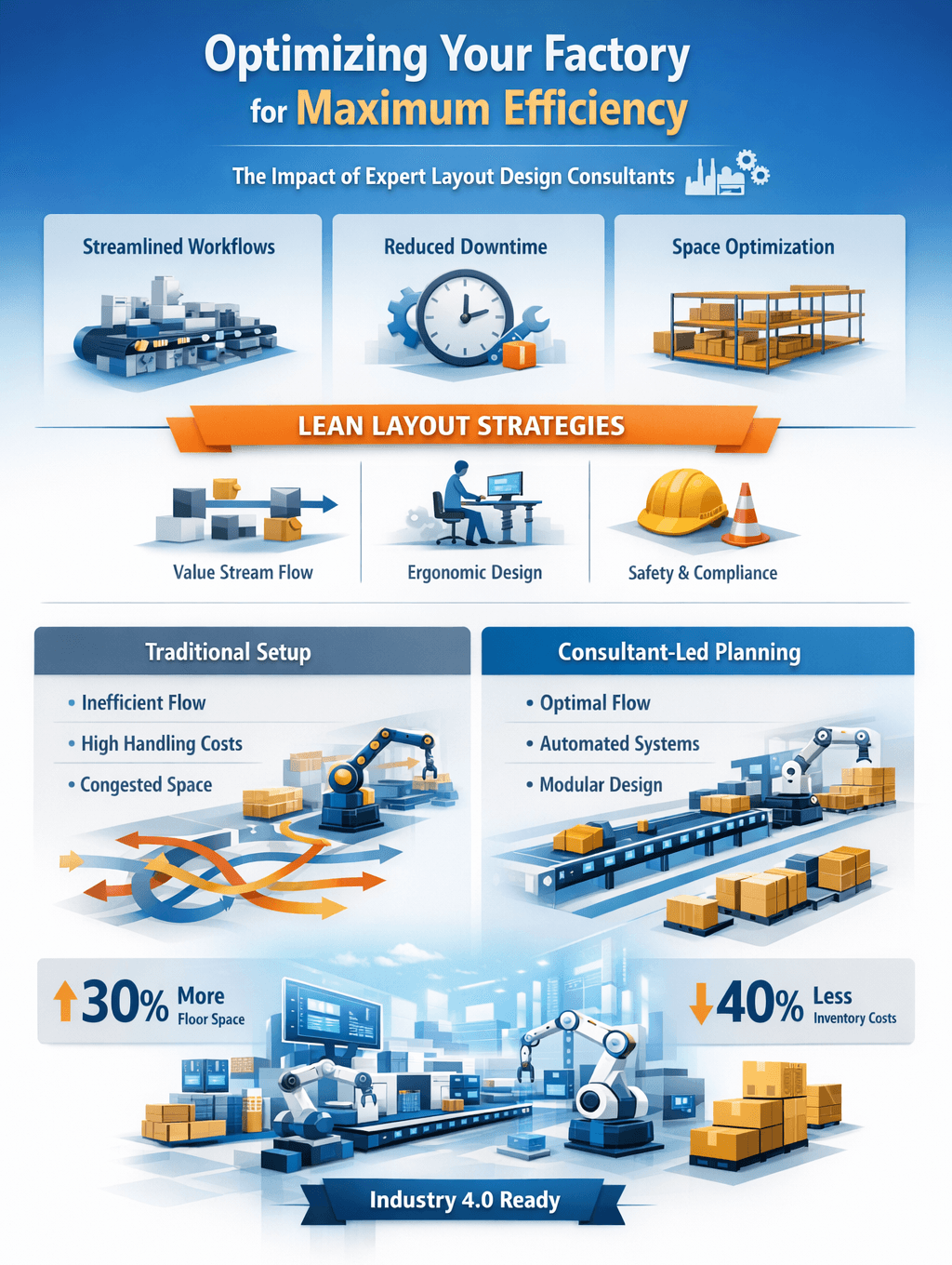
A layout designed for excellence eliminates the “hidden factory,” the extra work performed to correct errors or move materials unnecessarily. By optimizing the distance materials travel, companies can reduce material handling costs by up to 30%. This is particularly vital for the growing Egyptian export base, where speed-to-market is a deciding factor for international contracts. A strategic layout ensures that the flow is logical, visible, and easily managed.
What are the key benefits of factory layout planning in Egypt for scaling production?
For many Egyptian companies, growth is the primary challenge. Expanding production within an existing footprint requires meticulous factory layout planning. Without a plan, expansion often leads to “spaghetti flows,” convoluted paths that increase lead times and inventory.
Proper planning allows for:
- Scalability: Designing “modular” work cells that can be replicated as demand grows.
- Flexibility: Ensuring utility grids (power, compressed air, data) are accessible across the floor to allow for rapid machine reconfiguration.
- Resource Efficiency: Optimizing the use of floor space to delay or avoid the high capital expenditure of building new facilities.
Data indicates that optimized plant layouts can result in a 17% increase in space utilization, effectively allowing a company to grow its output without expanding its physical footprint.
How can a manufacturing plant layout in Egypt integrate lean and digital principles?
The most successful facilities in 2026 are those that combine lean manufacturing with digital manufacturing. A manufacturing plant layout serves as the foundation for this synergy. Lean principles focus on the “flow,” while digital tools provide the “visibility” to maintain that flow.
One of the most effective tools in this process is Value Stream Mapping (VSM). By mapping out the current state of a production line, designers can identify areas of waste reduction, such as excessive Work-in-Progress (WIP) or long waiting times. In an Egyptian case study involving high-volume assembly, the implementation of a lean-led layout redesign resulted in a 34% reduction in inventory holding and a 42% improvement in overall productivity. These results demonstrate that when the layout is designed to support the value stream, the technology on top of it performs significantly better.
Why is a smart factory layout in Egypt the future of sustainable manufacturing?
Sustainability is a core pillar of the current industrial strategy in Egypt. A smart factory layout contributes to green goals by optimizing energy consumption and reducing material waste.
- Energy Zoning: By grouping high-energy processes, factories can implement targeted HVAC and lighting controls, reducing utility costs.
- Waste Management: Layouts that include integrated recycling and scrap recovery zones at the point of generation minimize contamination and improve the circularity of materials.
- Real-time Audits: IoT-enabled layouts allow managers to conduct real-time resource audits, identifying leaks or inefficiencies immediately.
As Egypt seeks to increase the contribution of green industries to 5% of the sector’s GDP, the smart layout acts as a prerequisite for these environmental standards.
How does a lean factory layout in Egypt minimize “muda” or waste in production?
The concept of “Muda” (waste) is central to any lean factory layout. In the Egyptian manufacturing context, where logistics and labor costs are rising, eliminating non-value-added activities is essential.
A lean layout focuses on:
- Transportation: Minimizing the distance between processes.
- Motion: Ensuring tools and parts are within the ergonomic reach of the operator.
- Waiting: Balancing line speeds to ensure no station is idle while another is a bottleneck.
Frameworks from Lean Facility Design emphasize a 15-step approach to layout creation, moving from high-level “block layouts” to detailed “micro-layouts.” This systematic approach ensures that every piece of equipment is placed with a specific purpose, contributing to a seamless flow that naturally resists waste.
What impact does a lean manufacturing layout in Egypt have on long-term cost reduction?
Ultimately, a lean manufacturing layout is a financial strategy. By reducing the “throughput time,” the time it takes for a raw material to become a finished product, companies can significantly improve their cash flow.
| Metric | Impact of Optimized Layout |
| Throughput Time | Reduced by 25-40% |
| Inventory (WIP) | Reduced by 30-35% |
| Labor Efficiency | Improved by 15-20% |
| Setup/Changeover Time | Reduced by up to 32% |
In a market as dynamic as Egypt’s, these savings provide the necessary “buffer” to withstand global supply chain disruptions or local economic shifts. It allows manufacturers to maintain competitive pricing while still achieving the margins required for reinvestment in Industry 4.0 technologies.
FAQs
How does factory layout design improve productivity in Egypt?
By streamlining the flow of materials and reducing unnecessary movement, a professional layout ensures that workers spend more time on value-added tasks. In Egypt, where industrial growth is high, this optimization can lead to productivity gains of over 40% without increasing the workforce size.
What is the role of Industry 4.0 factory layout design in Egypt?
It involves designing a space that is ready for automation, robotics, and real-time data collection. This includes high-speed connectivity throughout the plant and flexible floor plans that can be easily updated as AI-driven insights suggest new optimizations.
Is reducing manufacturing costs through factory layout design in Egypt achievable for SMEs?
Absolutely. Layout redesign is often one of the most cost-effective ways for Small and Medium Enterprises (SMEs) to improve their bottom line. Unlike purchasing expensive new machinery, a layout redesign focuses on using existing assets more effectively, which can lead to immediate reductions in operational costs.
Are there any factory layout redesign case studies in Egypt?
Many companies in Egypt’s electronics, garment, and food processing sectors have reported significant success through layout redesign. For instance, some assembly lines have seen output per shift increase by 18% and unplanned downtime drop by 25% simply by applying lean and smart layout principles.
Conclusion
The evolution of the Egyptian industrial sector toward a “Smart” and “Lean” future is well underway. By focusing on the foundational element of factory layout design, manufacturers can ensure they are not just keeping pace with the 2026 targets but setting the standard for the entire region.