In the rapidly evolving industrial landscape of 2026, Kenyan manufacturers are facing a pivotal moment. As a business management consultant, I have seen that the difference between a thriving enterprise and one that struggles often lies in the physical foundation of the business: the plant layout. With the global shift toward more agile and data-driven production, the way we organize our floors must move beyond simple machine placement to a strategic, flow-oriented science.
To achieve true operational excellence, a facility must be designed to breathe, grow, and eliminate waste at every turn.
Is your current factory layout design Kenya-ready for the competitive 2026 market?
The strategic importance of factory layout design in Kenya cannot be overstated. In many regional facilities, material handling and unnecessary movement often consume up to 50% of total operational time. By focusing on a design that prioritizes “Straight Line” or “U-Flow” material movement, manufacturers are finding they can achieve an immediate productivity improvement.
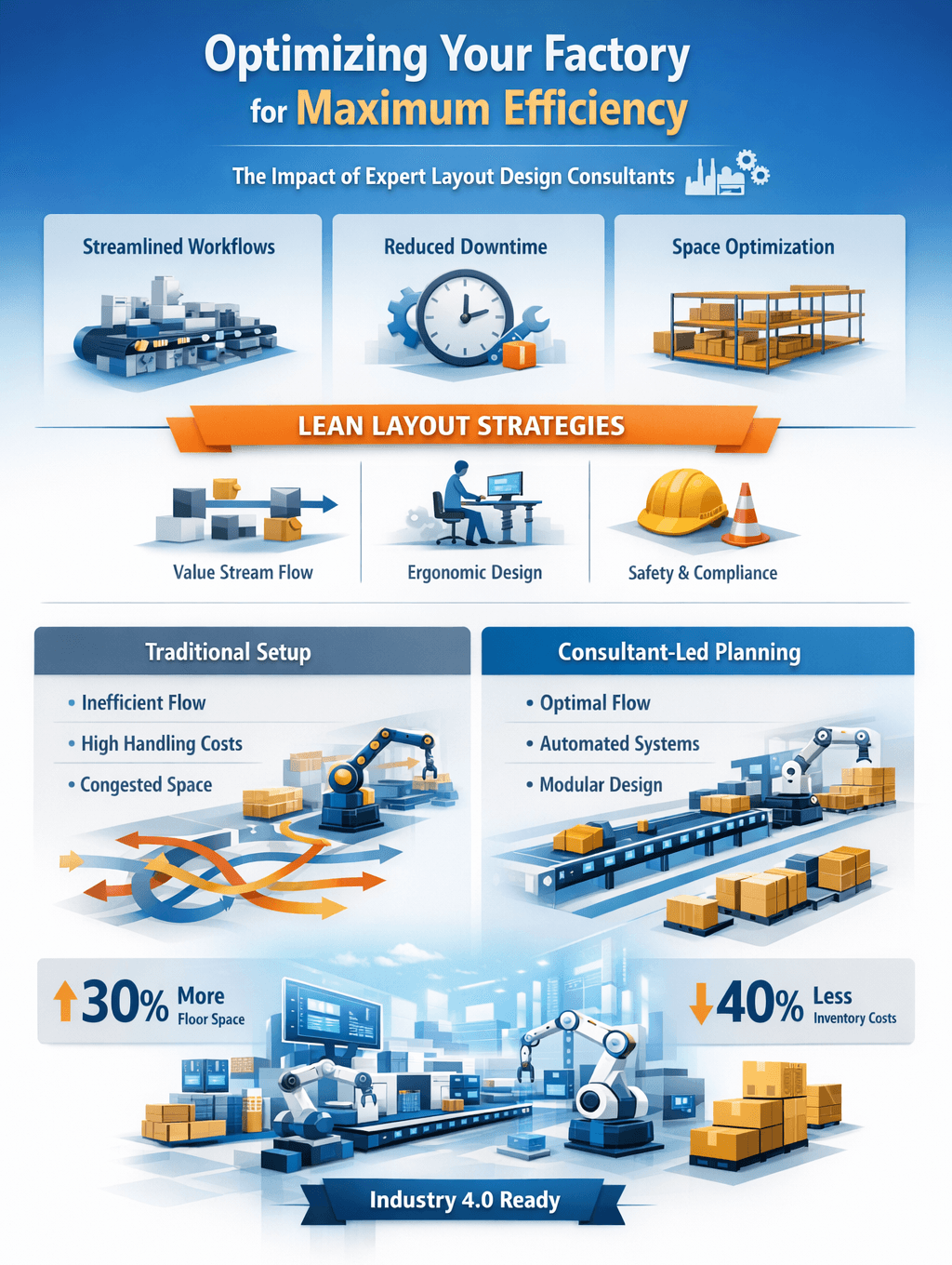
Data suggests that a well-executed redesign can lead to a 65.8% reduction in material travel distance. This isn’t just a metric on a page; it translates to less wear on equipment, lower energy consumption, and a workforce that spends their energy on assembly rather than logistics. By reclaiming as much as 13.2% of floor space through smarter density planning, businesses can expand their production capacity without the massive capital expenditure of a new building.
How can factory planning consultants in Kenya transform your operational cost structures?
The intervention of professional factory planning consultants in Kenya is often the catalyst for shifting from a “cost-center” mindset to a “value-generation” one. Consultants bring a methodical approach to facility design, moving away from guesswork and toward data-backed simulations.
When experts analyze a facility, they look for “hidden factories,” areas where waste is camouflaged by disorganized storage or inefficient staging zones. By implementing structured planning, regional players have realized:
- A 62% increase in revenue per square meter by maximizing high-value production zones.
- Operational cost reduction through the elimination of redundant handling steps.
- A 17% boost in overall production capacity within the existing physical footprint.
Why should industrial planning consultants in Kenya be your partners in long-term scaling?
As industries in Nairobi and Mombasa modernize, the role of industrial planning consultants in Kenya becomes critical in navigating the complexities of modern material flow. These specialists utilize value stream mapping to identify exactly where a product loses momentum.
This mapping process reveals that bottlenecks are rarely just about “slow machines”; they are often the result of poor proximity between interconnected departments. By realigning the shop floor based on the actual value stream, consultants help firms reduce their working capital requirements by as much as 50%. This is achieved because a smoother flow naturally reduces the amount of work-in-progress (WIP) sitting idle on the floor, effectively turning inventory back into cash.
What are the core advantages of transitioning to a smart factory layout in Kenya?
A smart factory layout in Kenya represents the fusion of physical lean principles with digital intelligence. In this environment, the layout is not static. It is equipped with sensors and digital tracking that provide real-time feedback on manufacturing efficiency.
In a smart facility, the arrangement of assets allows for “Plug-and-Produce” flexibility. If a production line needs to pivot to a new product variant, the smart layout facilitates this change with minimal downtime. Statistics from integrated facilities show that this digital-physical synergy can lead to a 40% reduction in production cycles. What used to take nine months to move from raw material to a finished, delivered good can now be accomplished in five, providing a massive competitive advantage in terms of market responsiveness.
Can a lean factory layout in Kenya provide a sustainable edge in waste reduction?
The primary objective of a lean factory layout in Kenya is the relentless identification and removal of “Muda” (waste). A lean layout is designed so that problems are impossible to hide. By creating high-visibility workstations and clear material paths, supervisors can spot a bottleneck the moment it begins to form.
When a facility adopts a lean arrangement, it often moves toward “one-piece flow.” This prevents the accumulation of large batches that often lead to quality issues and high storage costs. The result of this waste reduction is a much more disciplined environment where quality is built into the process rather than inspected at the end. In many instances, this shift alone has been responsible for significant cost savings and a much higher rate of first-time-right production.
Why is a lean manufacturing layout in Kenya the ultimate driver of manufacturing efficiency?
Implementing a lean manufacturing layout in Kenya is about more than just moving benches; it is about optimizing the relationship between people, machines, and materials. In a lean-optimized environment, every tool and component has a designated home, following the 5S methodology.
This organization drives manufacturing efficiency by:
- Reducing Search Time: Workers no longer waste minutes looking for tools, which directly boosts labor productivity.
- Improving Safety: Clear aisles and designated storage zones reduce the risk of accidents and material damage.
- Facilitating Standardization: A clean layout makes it easier to train new staff and maintain consistent work methods.
By fostering a culture of operational excellence, Kenyan manufacturers can ensure that their facility remains a high-performance asset for years to come. The transition to a lean layout is an investment that pays for itself through increased throughput and decreased overhead.
FAQs
How does factory layout improve productivity in Kenyan factories?
A strategic layout improves productivity by streamlining the “internal supply chain.” By minimizing the distance between the warehouse and the production line, and between individual workstations, a factory can significantly reduce non-value-adding time. In Kenya, this translates to faster order fulfillment and a more efficient use of expensive industrial floor space.
Role of factory planning consultants in Kenya?
Factory planning consultants in Kenya provide the technical blueprints and strategic roadmap needed to build or renovate a facility. They handle the complex mathematics of capacity planning and equipment balancing to ensure that the factory can meet its production targets without unnecessary bottlenecks or idle machinery.
Why are industrial planning consultants in Kenya vital for expansion?
When a business grows, its layout often becomes cluttered and inefficient. Industrial planning consultants in Kenya help manage this growth by designing modular layouts that can expand as the business scales. This prevents “layout drift” and ensures that the facility remains efficient even as new product lines are added.
What defines Industry 4.0 factory planning consultants in Kenya?
These consultants specialize in integrating digital infrastructure, such as high-speed data cabling, IoT sensor nodes, and automated logistics systems, into the physical factory design. They ensure that the plant is ready for the data-driven demands of the modern era, allowing for predictive maintenance and real-time output tracking.
Is reducing production cost through factory layout design in Kenya effective?
Absolutely. Relayout projects are often the most cost-effective way to improve the bottom line because they focus on optimizing existing assets. By reducing material handling and reclaiming floor space, companies can achieve significant cost savings without the need for large-scale equipment investment.
Who should use lean factory layout design consultants in Kenya?
Any manufacturer, from small-scale enterprises to large industrial groups, can benefit from lean design. Lean factory layout design consultants in Kenya tailor their approach to the specific volume and variety of the business, ensuring that even high-mix, low-volume operations can achieve peak efficiency.
How did Kenyan factories improve productivity through layout design?
By applying Systematic Layout Planning (SLP) and lean principles, many local firms have reduced their production lead times by up to 40%. They have transformed cramped, disorganized spaces into streamlined production cells that allow for higher output with fewer resources and less waste.
Conclusion
The path to industrial leadership in East Africa is paved with efficiency and intelligence. Your factory floor is more than just a place of work; it is a tool that, when sharpened through proper layout design, can drive unprecedented growth.