
In the rapidly evolving industrial landscape of North Africa, staying competitive requires more than just high-speed machinery; it requires an airtight strategy for flow and synchronization. As organizations seek to modernize, value stream mapping consultants in Egypt have become pivotal in helping business leaders visualize their entire operation, from raw material receipt to the final delivery at the customer’s doorstep. By utilizing this lean management method, manufacturers can transition from reactive troubleshooting to proactive process improvement.
Why should you engage value stream mapping consultants in Egypt for your facility?
The primary challenge in many Egyptian production environments is the presence of “hidden” operations. Often, what is perceived as a standard production step is actually a series of fragmented movements, unnecessary handoffs, and stagnant inventory. VSM consultants in Egypt provide an objective, third-party perspective that cuts through the internal bias of “the way we’ve always done it.”
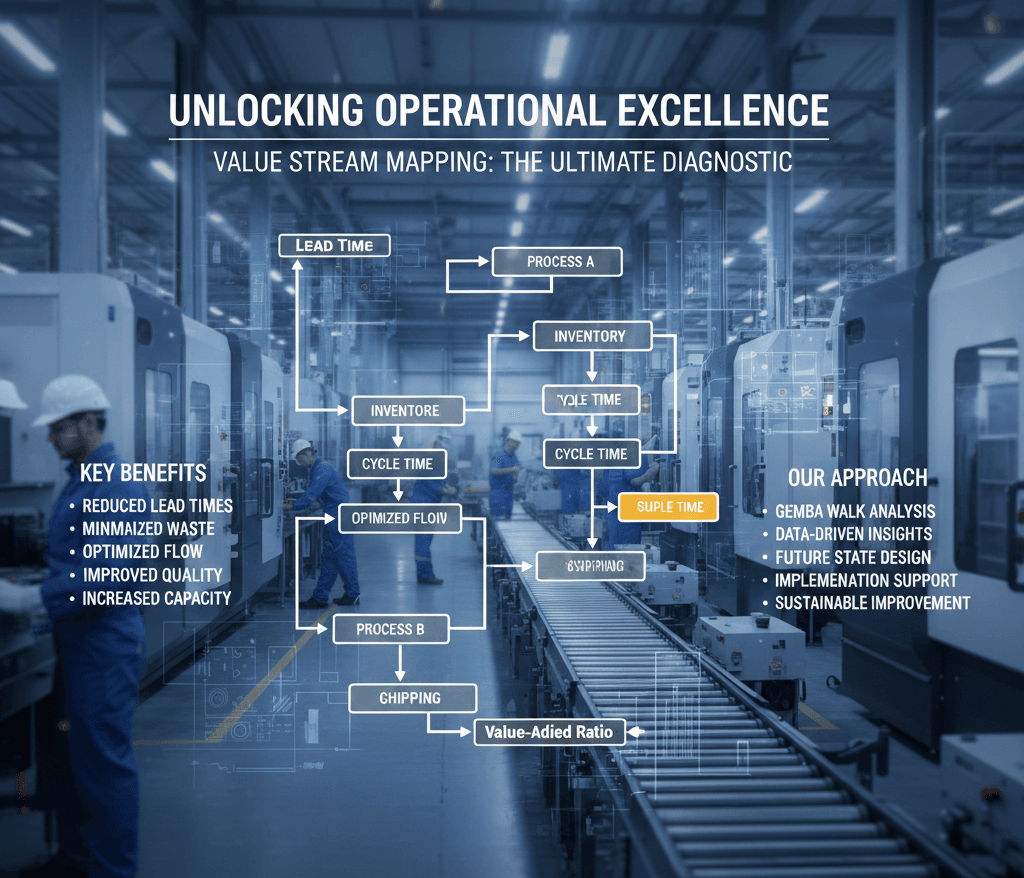
A consultant’s role is to facilitate the creation of a visual representation of the material and information flow. This is not a mere technical drawing but a strategic blueprint. By documenting every touchpoint, value stream mapping in Egypt identifies where value is being added and, more importantly, where it is being leaked through waste. In a market where fuel costs and material overhead are rising, the ability to pinpoint these leaks is the difference between a profitable year and a stagnant one.
How does value stream mapping in Egypt identify hidden bottlenecks in production?
Identifying a bottleneck is often more complex than looking for the biggest pile of work-in-process (WIP). Sometimes, the bottleneck isn’t a machine at all; it is a delay in information or an inefficient approval process. Through VSM in manufacturing in Egypt, specialists analyze the “Lead Time” versus the “Process Time.”
The Ratio of Value
In many traditional Egyptian factories, the actual time spent physically transforming a product might only be a few hours, yet the total time that the product spends in the factory, its lead time, could be several weeks. Consultants use the data gathered during mapping to calculate the Value-Added Ratio.
When applying these principles, it is common to discover that:
- Total Travel Distance: Products often travel kilometers within a single building due to poor layout. Lean interventions often reduce this distance by 20% to 35%.
- Throughput Gains: By realigning the flow based on VSM data, facilities have seen an increase in throughput of approximately 25% without adding a single new operator.
- Inventory Reduction: Mapping often reveals that over 50% of floor space is occupied by stagnant inventory, which can be reclaimed through better flow.
Can VSM lean manufacturing in Egypt significantly improve your operational efficiency?
The adoption of VSM lean manufacturing in Egypt is not just about drawing maps; it is about changing the DNA of the production floor. Operational efficiency is achieved when every action taken by an employee moves the product one step closer to the customer.
Shifting from Push to Pull
One of the most transformative outcomes of a VSM engagement is the shift from a “Push” system (producing based on a schedule regardless of downstream demand) to a “Pull” system (producing only what the next step requires).
Consultants help Egyptian manufacturers implement this by:
- Establishing Takt Time: Aligning the pace of production with the actual rate of customer demand.
- Creating Continuous Flow: Minimizing batch sizes to ensure that parts move one by one, which significantly reduces the risk of defects.
- Implementing FIFO Lanes: Using First-In-First-Out lanes to manage the flow between processes that cannot be physically connected.
By focusing on these areas, factory optimization becomes a tangible reality rather than a corporate buzzword. Statistics show that such shifts can lead to a 15% to 20% reduction in total operational costs by eliminating the need for excessive material handling and rework.
Why is value stream mapping of industrial plants in Egypt crucial for large-scale operations?
For massive industrial complexes, the complexity of managing thousands of parts can lead to “information silos.” Value stream mapping industrial plants in Egypt breaks down these silos by forcing different departments, procurement, production, quality, and shipping, to look at the same map.
Data-Driven Decision Making
In large-scale operations, the impact of a single change is magnified. Using data-driven insights from lean facility design, it has been observed that:
- WIP Reduction: Optimizing the value stream can lead to a 40% reduction in work-in-process inventory.
- Output Consistency: Standardizing the flow based on VSM results can improve the consistency of output by 30%, reducing the peaks and valleys of production.
- Labor Utilization: Through better balancing of work cells identified during mapping, production efficiency can increase by 12% to 18%.
These figures represent more than just numbers; they represent the ability of a plant to take on more orders, meet tighter deadlines, and improve its bottom line.
How do VSM consultants help Egypt’s industrial zones with localized process improvement?
The industrial zones of Egypt, such as those in the 6th of October City or along the Suez Canal, face unique logistical challenges. VSM consultants in Egypt’s industrial zones specialize in these high-density environments where space is at a premium and logistics are fast-paced.
Tailored Strategies for Industrial Hubs
Value stream mapping consultants for industrial zones in Egypt understand the regional supply chain dynamics. They don’t just look inside the four walls of the factory; they look at how the factory interacts with the zone’s infrastructure.
Key focus areas include:
- Improving productivity using value stream mapping in Egypt: By identifying “logistical waste,” consultants help plants reduce the time spent waiting for internal transport or external pickups.
- VSM for lean manufacturing implementation in Egypt: Ensuring that the layout of the facility supports the lean goals. For instance, moving the shipping dock closer to the final assembly based on VSM findings can save hundreds of man-hours per year.
- Value stream mapping to reduce waste in Egypt: Specifically focusing on the “waste of waiting,” which is prevalent in large-scale zones due to complex scheduling.
What are the long-term benefits of VSM for factories in Egypt?
The ultimate goal of any continuous improvement initiative is sustainability. The benefits of VSM for factories in Egypt extend far beyond the initial mapping session.
Building a Culture of Excellence
When a factory undergoes a VSM transformation, the workforce begins to see the “flow” rather than just their individual tasks. This visibility empowers employees to identify problems before they become critical failures.
- Space Savings: Effective mapping and subsequent layout changes often result in a 10% to 15% gain in usable floor space, allowing for new product lines without physical expansion.
- Quality Improvement: By reducing the time a product sits in inventory, the “feedback loop” for defects is shortened. If a part is made incorrectly, it is discovered immediately at the next station rather than weeks later in a warehouse.
- Agility: A lean value stream allows a factory to switch between different products much faster, a critical advantage in today’s fluctuating market.
FAQs
How does VSM differ from traditional process mapping?
Traditional process mapping focuses on the steps an employee takes. Value stream mapping in Egypt focuses on the product’s journey and includes critical data like inventory levels, machine uptime, and the flow of information (orders/schedules) that triggers production.
Can VSM be used in non-manufacturing sectors in Egypt?
While it originated in the automotive industry, the principles of VSM lean manufacturing in Egypt are highly effective in any environment with a repeatable process, including logistics, healthcare, and even administrative workflows.
What is the first step in a VSM engagement?
The first step is always the “Current State Map.” VSM consultants Egypt will spend time on the shop floor observing the actual process, not the “official” version found in manuals. This ensures the subsequent “Future State Map” is based on reality.
How often should a value stream map be updated?
A VSM should be a living document. It is recommended to revisit the map at least once a year or whenever a major change in product design or volume occurs to ensure continued operational efficiency.
What is the ROI of hiring value stream mapping consultants in Egypt?
While it varies, many facilities recoup the cost of the consultancy within the first 6 to 12 months through savings in inventory reduction, labor efficiency, and decreased waste.
Take the Next Step Toward Operational Excellence
Visibility is the first step toward control. If your facility is struggling with high lead times, excess inventory, or inconsistent throughput, it is time to map your path to success.