
In the pursuit of operational excellence, organizations often utilize various tools to visualize their workflows. Two of the most common methodologies are Value Stream Mapping (VSM) and Process Mapping. While they may appear similar to the untrained eye, their scope, purpose, and outcomes differ significantly. Understanding these nuances is critical for any leadership team aiming for true manufacturing optimization. In the complex industrial environment of 2026, choosing the wrong tool for a specific problem can lead to “local optimization” at the expense of the entire system’s health.
Why Should Businesses Consult Professional Value Stream Mapping Consultants for Clarity?
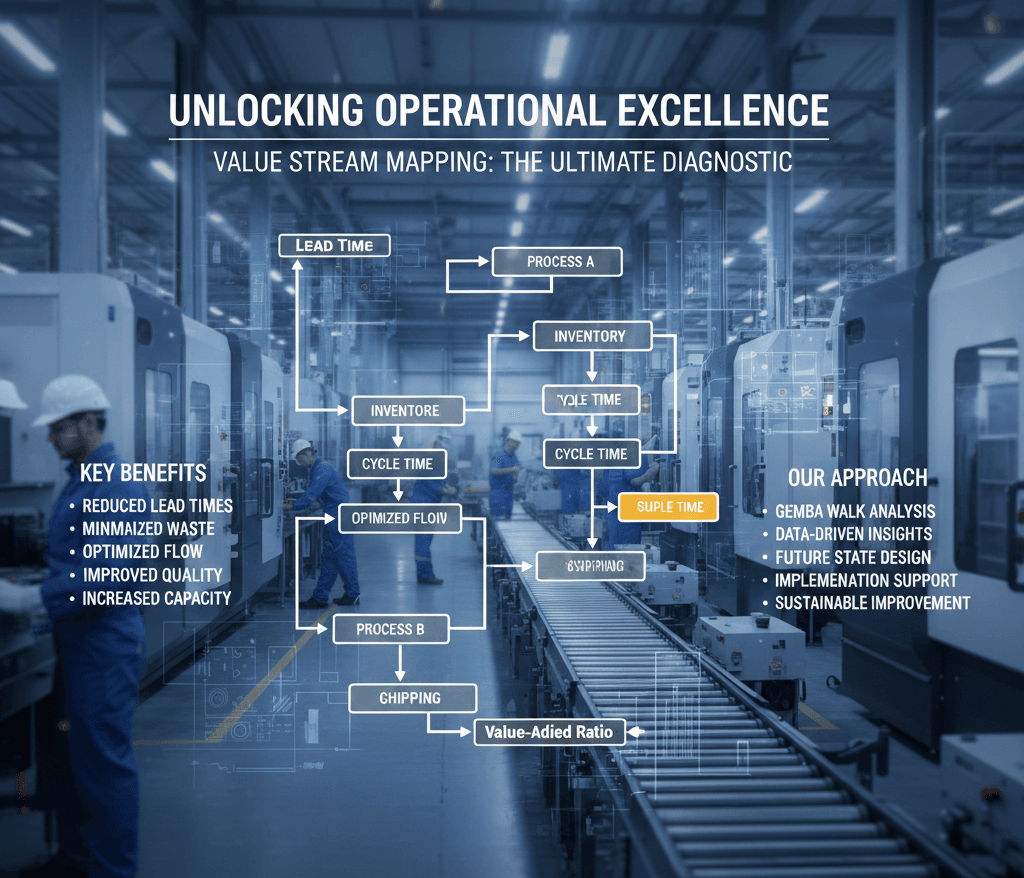
A common pitfall in process improvement is the tendency to fix individual tasks without looking at how they connect. This is where value stream mapping consultants provide essential guidance. Process mapping typically zooms in on a specific task, looking at the steps an operator takes to complete a single job. In contrast, VSM looks at the entire journey of a product, from the arrival of raw materials to the delivery at the customer’s dock.
Consultants argue that while a process map tells you how to do a task, a value stream map tells you why (or why not) that task should exist in the first place. Through rigorous value stream analysis, these experts help organizations see the “big picture.” Statistics from lean facility design research show that in unoptimized facilities, products often spend 90% of their time waiting in queues, yet most process improvement efforts focus on the 10% of the time the product is actually being worked on. By shifting the focus from individual machine speed to total system flow, consultants ensure that improvements actually reach the bottom line.
How Can Expert VSM Consultants Identify Wastes That Standard Process Maps Miss?
The primary advantage of engaging VSM consultants lies in their ability to map “Information Flow” alongside “Material Flow.” Standard process maps are excellent for documenting the physical steps of production, but they often ignore the triggers that tell those steps to happen. VSM captures the schedules, electronic signals, and paperwork that govern the floor.
In many facility redesign scenarios, the “information waste” is as damaging as the physical waste. For example, a consultant might discover that a high-speed machine is producing parts that won’t be needed for another week because of a disconnected scheduling system. This leads to excessive Work-in-Process (WIP) inventory. By utilizing lean methodology, consultants have helped firms reduce their WIP by as much as 40% to 50% simply by synchronizing the information flow with the actual production pace, or Takt time.
Without the high-level view provided by a lean value stream mapping consultant, a company might spend thousands of dollars speeding up a process that is already faster than the downstream bottleneck, effectively creating more waste, faster.
What are the Unique Advantages of Investing in Holistic VSM Consulting Services?
When an organization invests in VSM consulting services, they are buying a roadmap for productivity improvement that spans departments. Process maps are often siloed, they stay within the walls of a single department like “Machining” or “Assembly.” VSM crosses those walls.
The benefits of this holistic approach are quantifiable. In documented facility optimizations, a cross-departmental VSM revealed that material travel distance was inflated by nearly 200% because departments were organized by function rather than flow. By redesigning the facility into lean cells, consultants were able to reduce total travel distance from 2,500 feet to under 1,000 feet. This 60% reduction in movement is a direct result of the “macro” view that VSM provides.
Furthermore, these services often employ advanced VSM software tools to simulate how changes in one area will affect the entire stream. This predictive capability ensures that manufacturing optimization is balanced, preventing the creation of new bottlenecks while trying to solve old ones.
How Do Professional Value Stream Mapping Services Target Total Lead Time Reduction?
The ultimate goal of value stream mapping services is the compression of lead time. While process mapping might shave seconds off a cycle time, VSM aims to shave days off the total lead time.
Consider the impact of “wait time.” In an unoptimized facility, a product might have a total processing time (Value-Added time) of only 30 minutes, yet its lead time (the time it takes to get through the plant) is 15 days. A process map would focus on making that 30 minutes into 25 minutes. A VSM consultant, however, looks at the 14.5 days of waiting. By implementing “Pull” systems and continuous flow, consultants have demonstrated the ability to reduce lead times from weeks to just a few days. In one specific instance, a facility overhaul guided by VSM reduced the total throughput time from 12 days to 4.5 days, a 62.5% improvement that significantly boosted customer satisfaction and cash flow.
Why is Lean VSM Consulting Superior for Long-Term Organizational Transformation?
For a transformation to be sustainable, it must be part of the organizational DNA. Lean VSM consulting focuses on building this internal capability. Unlike a standard process mapping exercise, which can be done by a single engineer in an office, VSM is a team sport.
Consultants lead “Gemba walks” and mapping workshops that include operators, supervisors, and management. This collaborative environment ensures that everyone understands the “Current State” and agrees on the “Future State.” Statistics show that when the workforce is involved in the mapping process, the successful implementation rate of process improvement initiatives increases by over 30%.
By training internal “Lean Champions,” the consultant ensures that the organization continues to evolve. This cultural shift is the foundation of operational excellence. It moves the company away from “point improvements” and toward a permanent mindset of flow, where every employee is empowered to see and eliminate waste.
How Can a Lean Value Stream Mapping Consultant Prepare Your Facility for Industry 4.0?
As we move through 2026, the integration of digital technology is no longer optional. However, digitizing a mess only results in a “digital mess.” A lean value stream mapping consultant acts as a vital filter before technology is applied.
They use VSM to identify exactly where sensors, IoT devices, and real-time tracking will add the most value. By mapping the stream first, the organization can ensure that Industry 4.0 tools are used to monitor the “Future State,” the optimized version of the facility. This integration allows for:
- Live Bottleneck Detection: Seeing a backup on the floor as it happens.
- Real-time Takt Time Tracking: Automatically adjusting speeds to match demand.
- Synchronized Logistics: Notifying suppliers automatically as inventory is consumed in the cell.
This synergy between traditional lean methodology and modern digital tools ensures that manufacturing optimization is both agile and resilient, capable of handling the high-mix, low-volume demands of the modern market.
FAQs
What are the primary benefits of hiring value stream mapping consultants?
The benefits of hiring value stream mapping consultants include gaining an end-to-end view of your operations, identifying non-value-added time that process mapping misses, and achieving significant lead-time reductions. Consultants provide the objective data needed to make high-impact structural changes rather than just minor task adjustments.
Are there specialized VSM consulting services available for the manufacturing industry?
Yes, VSM consulting services for manufacturing industries are tailored to address shop-floor complexities like machine uptime, changeover efficiency, and complex material handling. These services are essential for any firm looking to achieve true operational excellence in a competitive market.
How do VSM consultants help reduce lead time and process waste?
When investigating how VSM consultants help reduce lead time and process waste, the focus is on flow. By reducing material travel, often by 60% or more, and eliminating excess inventory queues, consultants ensure products move through the facility with minimal interruption, slashing total lead times.
What are the essential VSM implementation steps for lean transformation?
The VSM implementation steps for lean transformation typically involve selecting a product family, creating a Current State Map through a Gemba walk, identifying wastes like overproduction and waiting, designing an optimized Future State Map, and executing a Kaizen implementation plan.
How does lean VSM consulting for continuous improvement culture-building work?
Lean VSM consulting for continuous improvement culture building works by engaging employees at all levels in the mapping process. This visibility creates a shared understanding of waste, empowering the workforce to take ownership of process improvement and sustaining gains long after the consultant has left.
How does VSM integration with Industry 4.0 provide real-time insights?
VSM integration with Industry 4.0 for real-time insights involves using digital tools to monitor the value stream. By creating a “Digital Twin” of the map, consultants help managers see live data on cycle times and flow, allowing for immediate corrective actions and a more responsive production system.