In the competitive landscape of 2026, the success of a business is determined not just by its technology but by the mindset of its people. Operational excellence is rarely achieved through a single executive decree; it is the result of a sustained, bottom-up commitment to excellence. For many organizations, the primary obstacle to growth is a culture of “siloed thinking,” where departments focus on their own metrics rather than the total flow of value. This is why the intervention of specialized experts is so transformative. By utilizing specific diagnostic tools, these professionals help bridge the gap between management goals and shop-floor reality.
Why Is the Expertise of Value Stream Mapping Consultants Vital for Cultural Change?
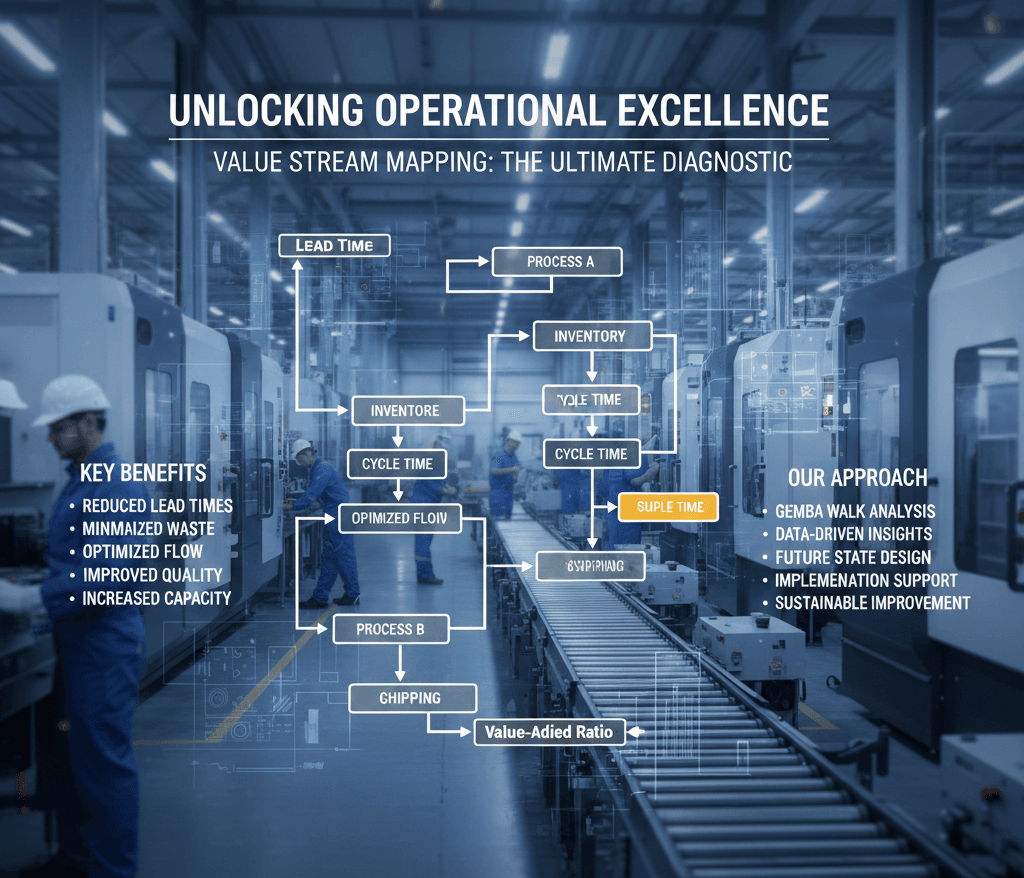
A culture of continuous improvement requires transparency, and transparency begins with a shared language. Value stream mapping consultants act as the facilitators of this new language. When a consultant enters a facility, their first task is to break down the barriers between departments. By conducting a comprehensive value stream analysis, they create a visual representation of the entire workflow that everyone, from the CEO to the machine operator, can understand.
In many facility design scenarios, the “current state” of a plant is often characterized by a lack of visibility. Research into facility optimization suggests that unoptimized environments often suffer from a 20% to 30% loss in productivity simply because employees do not understand how their specific task impacts the next person in line. A consultant uses the lean methodology to demonstrate these connections. By mapping out the “hidden factory,” the redundant emails, the excessive material handling, and the stagnant inventory, consultants provide the data-driven proof needed to convince a skeptical workforce that change is necessary and beneficial.
How Can VSM Consultants Empower Employees to Identify and Eliminate Waste?
One of the most powerful ways VSM consultants build culture is through the “Gemba” walk. Instead of sitting in a boardroom, the consultant takes the leadership team and the operators onto the production floor. This practice demystifies process improvement and places the power of observation in the hands of those doing the work.
The impact of this empowerment is measurable. In documented cases of facility redesign, involving the workforce in the mapping process led to a drastic reduction in material travel distance. For instance, when operators helped identify the most efficient paths for material flow, facilities were able to reduce travel from nearly 2,400 feet down to 800 feet. This 66% reduction was not just a logistical win; it was a cultural one. When an employee sees that their input leads to less physical strain and a more organized workspace, they shift from being a passive participant to an active problem-solver. This shift is the bedrock of manufacturing optimization.
What are the Long-Term Benefits of Utilizing Professional VSM Consulting Services?
Organizations that invest in VSM consulting services are not just buying a map; they are investing in a roadmap for long-term agility. These services provide the technical framework necessary to sustain improvements long after the initial engagement ends. By using VSM software tools, consultants help teams create “living” documents that evolve as the business grows.
The advantages of this approach include:
- Standardized Communication: Every department begins using the same KPIs, such as Takt time and Lead Time.
- Rapid Problem Solving: Because the value stream is visible, bottlenecks are identified in minutes rather than days.
- Space Efficiency: VSM-driven layouts often reclaim 20% to 25% of floor space, which boosts morale by creating a cleaner, more professional environment.
Furthermore, productivity improvement becomes a self-sustaining cycle. As lead times are compressed, sometimes from 14 days down to just 3, the increased cash flow allows the company to reinvest in further employee training and better tools, reinforcing the culture of excellence.
How Do Tailored Value Stream Mapping Services Align Management and Shop-Floor Goals?
Misalignment is the silent killer of operational excellence. Often, management is focused on “labor utilization,” while the shop floor is focused on “getting the job done.” Value stream mapping services align these two worlds by focusing both on “Flow.”
When consultants design a “Future State Map,” they focus on balancing the work to the rate of customer demand. This prevents the “Push” system, where machines run at 100% capacity just to stay busy, and introduces the “Pull” system. Statistics show that moving to a pull-based flow can reduce Work-in-Process (WIP) inventory by 40% to 60%. This reduction makes the workplace less cluttered and more manageable for the staff. By focusing on the flow of the product rather than the busyness of the person, consultants help management realize that “looking busy” is often a form of waste, while “moving product” is the true goal.
Why Is Lean VSM Consulting the Foundation for Sustainable Lean Transformation?
For a lean transformation to “stick,” it must move beyond the use of tools like 5S and enter the realm of systemic thinking. Lean VSM consulting provides this high-level perspective. A consultant ensures that the organization is not just performing “random acts of lean” but is instead moving toward a clearly defined goal.
The cultural impact of lean VSM consulting is often seen in the reduction of defects and rework. In facilities where the value stream is balanced and visual, the opportunity for error is minimized. Statistics from optimized facility layouts show that defect rates can drop by as much as 15% to 20% within the first year of a VSM-led redesign. This is because problems become visible immediately when the flow stops. This “stop-the-line” mentality encourages a culture of quality where every employee takes responsibility for the final product, rather than passing defects down the line.
How Can a Lean Value Stream Mapping Consultant Guide an Organization into the Digital Era?
As we look toward the future of 2026, the role of the lean value stream mapping consultant has evolved to include the integration of digital tools. However, the cultural principle remains the same: people first, then technology. A consultant ensures that a firm does not automate waste.
By mapping the stream first, the consultant identifies where Industry 4.0 technology, such as IoT sensors or real-time tracking, will actually empower the workforce. For example, a digital dashboard that shows the current state of the value stream against the Takt time provides the team with the information they need to self-manage. This reduces the need for constant supervision and increases employee autonomy. When technology is used to support the value stream, it reinforces the culture of continuous improvement by providing the team with the real-time data they need to win the day.
FAQs
What are the primary benefits of hiring value stream mapping consultants?
The benefits of hiring value stream mapping consultants include an objective, expert analysis of your facility, the identification of hidden wastes, and the creation of a unified vision for improvement. Consultants help reduce lead times and operational costs while training your internal team to maintain these gains through lean methodology.
Do you offer VSM consulting services for manufacturing industries with high complexity?
Yes, VSM consulting services for manufacturing industries are specifically designed to handle complex workflows. By categorizing products into families and simplifying material flow, consultants can help even the most fragmented facilities achieve manufacturing optimization.
How do VSM consultants help reduce lead time and process waste?
By using value stream analysis, how VSM consultants help reduce lead time and process waste becomes clear: they identify non-value-added activities. By reducing travel distances, often by 60% or more, and implementing pull systems, they ensure products move through the facility faster and more efficiently.
What are the typical VSM implementation steps for lean transformation?
The VSM implementation steps for lean transformation start with identifying the product family, followed by a Gemba walk to create the Current State Map. From there, waste is identified, a Future State Map is designed, and a Kaizen roadmap is established to implement the changes.
What is the role of lean VSM consulting for continuous improvement culture building?
Lean VSM consulting for continuous improvement culture building is about engagement. By involving employees in the mapping process, consultants foster a sense of ownership. When workers see how process improvement makes their jobs easier and more efficient, they become the driving force behind the transformation.
How does VSM integration with Industry 4.0 provide real-time insights for the team?
VSM integration with Industry 4.0 for real-time insights involves using digital tools to monitor the flow of value. By creating a digital twin of the value stream, consultants allow teams to see live data on cycle times and bottlenecks, enabling faster response times and more agile decision-making on the shop floor.