
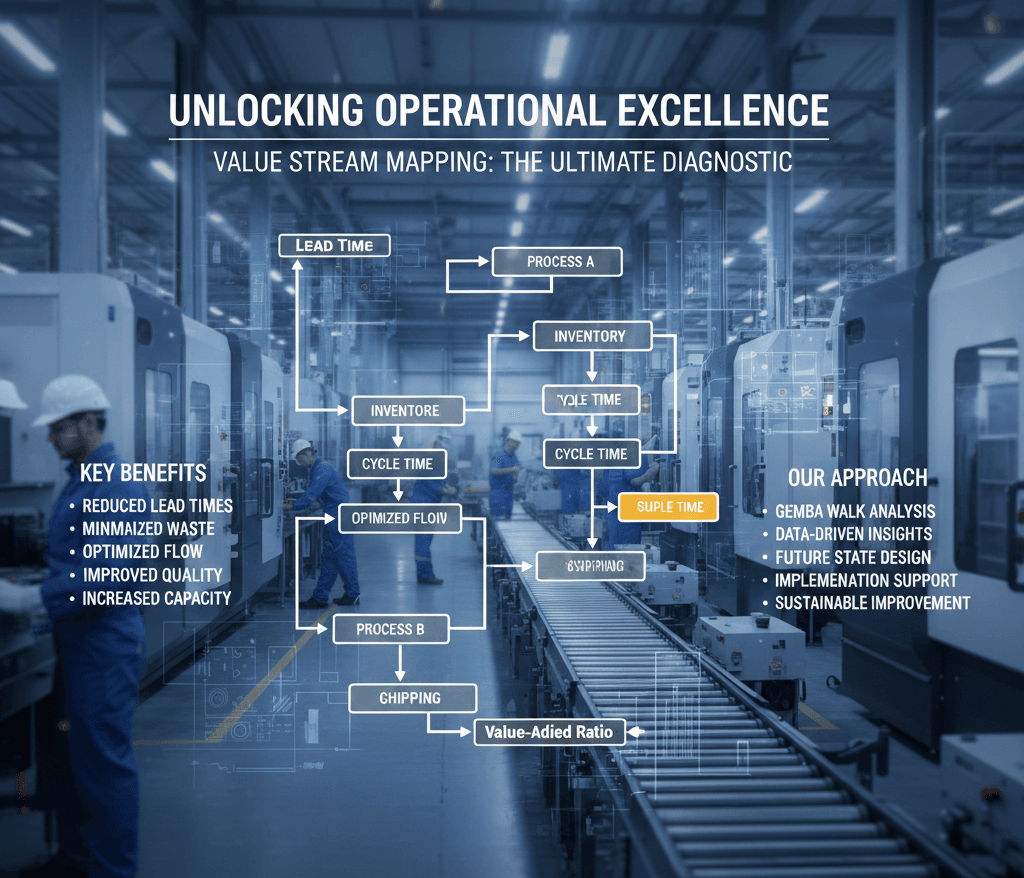
The manufacturing landscape in the East African region, particularly within the Kenyan borders, is undergoing a profound transformation. As the nation targets an economic rebound of 5.3% through 2026, the industrial sector is under immense pressure to evolve from traditional “take-make-waste” models toward lean manufacturing paradigms. For any production facility aiming to stay competitive, understanding the holistic flow of materials and information is no longer optional. This is where value stream mapping in Kenya emerges as a foundational strategy. It allows leaders to visualize the entire lifecycle of a product, from the arrival of raw materials to the moment the finished goods reach the consumer.
By creating a visual blueprint of operations, organizations can pinpoint exactly where operational efficiency is being compromised. It is not merely about identifying a single slow machine; it is about seeing the “door-to-door” flow. Statistics from recent industrial assessments indicate that implementing these visual methodologies can result in a 46% reduction in lead times and a 21% increase in overall productivity. In an environment where energy costs remain high and global supply chains are volatile, having a clear roadmap for continuous improvement ensures that a business can pivot quickly to meet changing customer demands without incurring unnecessary overhead.
How Can VSM Consultants Kenya Drive Sustainable Production Gains?
Navigating the complexities of a lean transition requires more than just internal will; it often requires the objective eye of VSM consultants in Kenya. These experts specialize in uncovering hidden inefficiencies that internal teams might overlook due to “operational blindness.” A consultant brings a structured approach to process mapping, ensuring that every step in the production line is scrutinized for its value-added contribution. By utilizing a “product family matrix,” consultants help firms prioritize which lines will benefit most from a redesign, often starting with high-volume or high-complexity units.
Working with VSM consultants in Kenya also facilitates the integration of smart manufacturing principles. As Kenya pushes toward Vision 2030 goals, the move toward Industry 4.0 becomes central. Consultants guide the transition from “push” systems, where products are made based on forecasts, to “pull” systems driven by actual customer demand. This shift is critical for inventory management, as it prevents the accumulation of excess stock that ties up capital. In many local contexts, moving to a pull-based system managed via visual signals has been shown to bring inventory back under control in as little as four to six weeks, significantly improving cash flow.
What Are the Core Benefits of Lean Consulting Kenya for Local Firms?
Engaging in lean consulting in Kenya provides a comprehensive framework for tackling the “seven wastes” of manufacturing: overproduction, waiting, transport, inappropriate processing, unnecessary inventory, unnecessary motion, and defects. For many Kenyan factories, the most significant gains are found in waste reduction. Currently, the industrial sector is responsible for a significant portion of local pollution, often stemming from inefficient material usage. Lean strategies help design out this waste by optimizing the factory layout and ensuring that resources are used at the precise rate of customer demand, known as “takt time.”
Furthermore, Lean Consulting in Kenya fosters a culture of empowered personnel. When a facility adopts lean methodologies, employees at all levels are trained to recognize waste and propose solutions. This “bottom-up” approach to continuous improvement ensures that gains are not just temporary fixes but are sustained over the long term. For instance, by implementing mistake-proofing mechanisms (Poka-Yoke) during the mapping phase, firms have seen a 32% improvement in defect reduction. This focus on quality at the source reduces the need for costly re-work and enhances the brand’s reputation in both local and export markets.
Why Choose Specialized VSM Consulting Services Kenya for Layout Design?
The physical arrangement of a factory is perhaps the most underrated factor in its success. VSM consulting services in Kenya bridge the gap between abstract process flow and the physical reality of the shop floor. A poorly planned factory layout can lead to excessive motion and transportation waste, which directly inflates production costs. By analyzing the current state through value stream maps, consultants can propose a future state that minimizes the distance materials travel. This often involves moving from a functional layout (where similar machines are grouped) to a cellular layout (where machines are arranged in the sequence of the process).
By utilizing VSM consulting services in Kenya, manufacturers can realize a substantial increase in operational efficiency. For example, redesigning the floor to support continuous flow can improve overall equipment efficiency (OEE) by up to 15%. These services ensure that the factory layout design is not just about fitting machines into a space, but about creating an environment where information and materials flow without interruption, directly impacting the bottom line.
How Does Lean Value Stream Mapping in Kenya Integrate Industry 4.0?
The intersection of traditional lean tools and modern technology is where the greatest competitive advantages are found today. Lean value stream mapping in Kenya is now incorporating smart manufacturing data to create “living” maps. Instead of a static drawing on a whiteboard, digital VSMs can pull real-time data from the shop floor, providing an instant view of bottlenecks and cycle times. This integration is vital for inventory management, as it allows for “paced withdrawal,” the practice of releasing only a small, consistent amount of work to the floor in direct response to finished goods being taken away.
Consultants focusing on lean value stream mapping in Kenya help businesses prepare for the future by ensuring their processes are robust enough to support automation. You cannot automate a mess; the process must be lean first. By identifying the “pacemaker process,” the single point in the value stream that sets the tempo for the entire line, firms can use Industry 4.0 tools to monitor performance precisely against takt time. This level of control allows for a 30% increase in on-time deliveries, a key metric for any firm looking to compete in the global supply chain.
Can Process Mapping Consultants Kenya Help in Reducing Production Costs?
In a market where input costs are rising, process mapping consultants in Kenya focus heavily on cost-out strategies. Through rigorous process mapping, every non-value-added activity is highlighted for elimination. This includes “over-processing,” such as adding features a customer doesn’t value or polishing parts that are never seen. By stripping away these costs, firms can achieve a significant reduction in production expenses, sometimes as high as 25%, without sacrificing quality.
The role of process mapping consultants in Kenya also extends to optimizing the supply chain. By mapping the “dock-to-dock” flow, they help identify delays in the arrival of raw materials or the dispatch of finished goods. This holistic view is essential for waste reduction, as it addresses the “waiting” waste that often occurs at the handoffs between different departments. When everyone in the organization speaks the “common language” of the value stream map, decision-making becomes faster and more transparent, leading to a leaner, more agile enterprise.
FAQs
How does factory layout improve productivity in Kenyan factories?
A well-designed factory layout reduces the physical distance that materials and workers must travel. By arranging equipment in a sequence that mirrors the value stream, factories can eliminate “motion waste” and “transportation waste.” This leads to faster cycle times and allows the same workforce to produce more output with less fatigue, directly boosting operational efficiency.
Are there Industry 4.0 factory planning consultants in Kenya?
Yes, there is a growing niche of Industry 4.0 factory planning consultants in Kenya who specialize in merging lean manufacturing with digital technologies. These experts help firms implement sensors and data analytics to monitor their value streams in real-time, facilitating smart manufacturing transitions that align with the nation’s industrialization goals.
How can one reduce production costs through factory layout design in Kenya?
Reducing costs starts with identifying and removing the hidden expenses of a cluttered or illogical floor plan. Factory layout design focused on lean principles minimizes work-in-progress (WIP) inventory and reduces the need for expensive material handling equipment, such as forklifts. By streamlining the flow, you reduce energy consumption and labor hours per unit, which are two of the highest costs for local manufacturers.
What are the lean manufacturing layout best practices for Kenyan factories?
Best practices include establishing a “U-shaped” cell for better communication, ensuring the “pacemaker process” is clearly identified, and using “supermarkets” for inventory management to prevent overproduction. Additionally, maintaining clear sightlines across the floor allows for “visual management,” where any deviation from the standard process is immediately apparent to supervisors.