
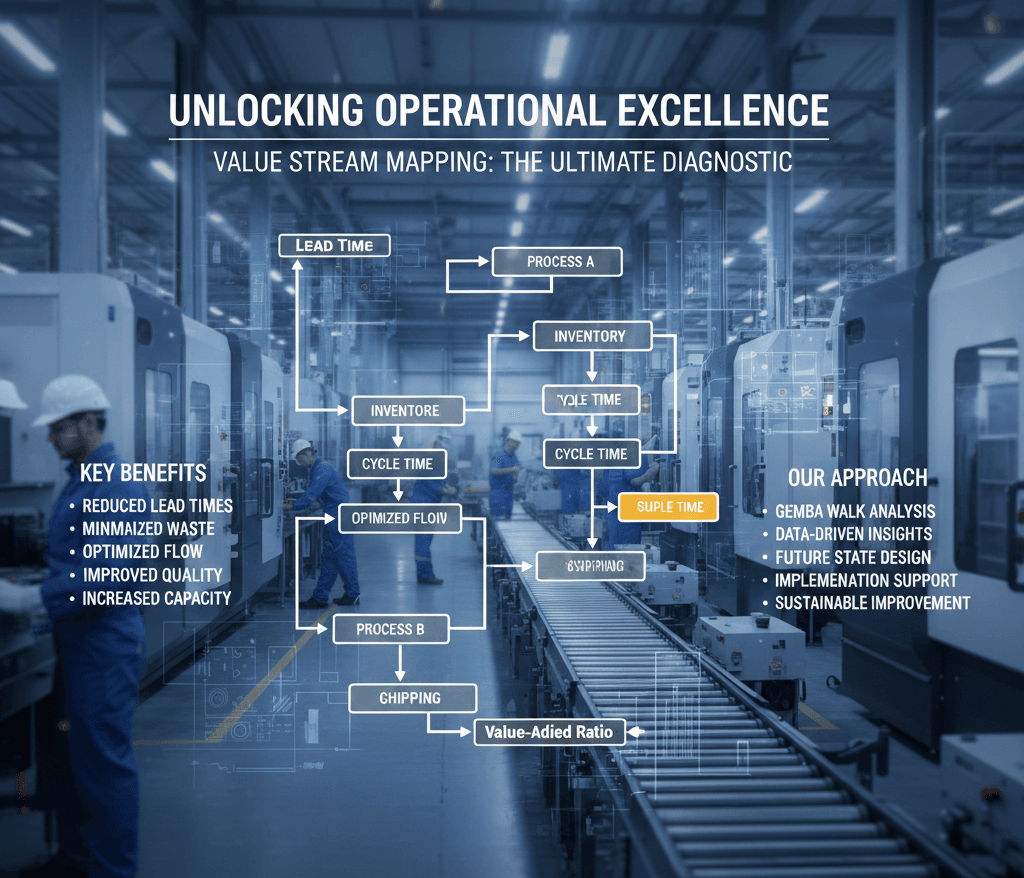
The industrial landscape in Kenya is a diverse ecosystem, ranging from agile SMEs to massive multinational manufacturing hubs. Regardless of the size of the operation, the fundamental objective remains the same: maximizing value while minimizing expenditure. In this context, value stream mapping in Kenya serves as the primary diagnostic tool for organizational health. It allows stakeholders to look beyond individual departments and view the entire flow of a product, from the moment raw materials enter the warehouse to the final delivery to the end-user. For many local enterprises, the “current state” of their operations often reveals that only a fraction of the time spent in the factory actually adds value to the product.
By implementing value stream mapping in Kenya, businesses can transition from a reactive “firefighting” culture to a proactive, data-driven management style. It provides a common language for teams to identify bottlenecks and systemic inefficiencies. Recent data from facility overhauls suggests that organizations focusing on this holistic view can reclaim approximately 13.2% of their existing floor space. This reclaimed area is often the result of removing obsolete inventory and poorly placed machinery that disrupts the natural flow of work. For an SME, this can mean avoiding the high cost of moving to a larger facility, while for a large enterprise, it represents a significant opportunity to introduce new product lines without expanding the building’s footprint.
How Can VSM Consultants Kenya Help bridge the Gap Between Current and Future State?
Transitioning from an inefficient current state to an optimized future state is a complex journey that often requires the specialized knowledge of VSM consultants in Kenya. These experts bring an objective perspective to the production floor, identifying “invisible” wastes that internal teams may have grown accustomed to over years of operation. One of the most critical contributions of a consultant is the reduction of material travel distance. By restructuring the sequence of operations based on a rigorous value stream analysis, consultants have successfully demonstrated that material travel can be reduced by as much as 65.8%.
Furthermore, VSM consultants in Kenya play a vital role in synchronizing the information flow with the material flow. In many Kenyan factories, the physical product moves, but the paperwork or digital instructions are delayed, leading to idle machines and frustrated workers. Consultants utilize process mapping to ensure that information reaches each workstation exactly when needed. This synchronization is a hallmark of lean manufacturing, ensuring that the “pacemaker process” dictates the tempo of the entire line. By stabilizing these flows, firms can achieve a 17% enhancement in production capacity, effectively doing more with the same resources.
What Impact Does Lean Consulting Kenya Have on Total Lead Time and Customer Satisfaction?
In a competitive market, speed is just as important as quality. This is where Lean Consulting in Kenya becomes a strategic game-changer. By focusing on the “total lead time,” the time elapsed from customer order to delivery, lean experts help firms identify and remove non-value-added activities. In many high-complexity manufacturing environments, the time spent actually working on the product is a small fraction of the total time it spends in the facility. By applying lean principles, organizations have seen their production cycles drop significantly, such as moving from a 9-month cycle to a 5-month cycle.
This 40% reduction in lead time, often facilitated by lean consulting in Kenya, directly correlates to higher customer satisfaction and improved cash flow. When products move faster through the system, the amount of money tied up in work-in-progress (WIP) inventory drops. In fact, data from optimized layouts shows that a 50% reduction in tied-up working capital is entirely achievable. This liquidity is crucial for Kenyan SMEs looking to scale or for larger firms needing to hedge against fluctuating raw material prices. By shortening the distance between investment and return, lean strategies ensure that the business remains financially resilient.
Why Are VSM Consulting Services Kenya Necessary for Modernizing Factory Layouts?
The physical layout of a factory is the “skeleton” upon which all processes hang. If the skeleton is misaligned, the entire body suffers. VSM consulting services in Kenya specialize in creating “flow-based” layouts rather than “department-based” ones. In a traditional setup, products often zigzag across the floor to reach different departments, creating chaos and increasing the risk of damage. Consulting services utilize the data gathered from value stream maps to design a factory layout that supports “one-piece flow” or “small-batch” processing, which drastically improves operational efficiency.
By utilizing VSM consulting services in Kenya, manufacturers can transform their floor into a high-performance environment. The financial impact of these changes is often profound; for instance, redesigning a facility to eliminate bottlenecks and reduce travel can lead to a 62% increase in revenue per square meter. This is a vital metric in urban industrial areas where land and warehouse costs are high. These services ensure that every square inch of the factory is contributing to the bottom line, turning a static cost center into a dynamic engine of growth through continuous improvement.
How Does Lean Value Stream Mapping in Kenya Support Smart Manufacturing Goals?
The future of the Kenyan industry lies in the integration of technology and lean thinking. Lean value stream mapping in Kenya acts as the prerequisite for any successful digital transformation. Before a company can invest in smart manufacturing or Industry 4.0 tools, it must first ensure its underlying processes are lean. Digitizing an inefficient process only results in a “digital mess.” Mapping identifies exactly where sensors, data analytics, and automation will provide the most significant return on investment.
When lean value stream mapping in Kenya is used as a foundation, the results of automation are far more predictable. For example, by identifying the “pacemaker” of the value stream, a firm can use real-time monitoring to ensure that a specific station never runs out of work. This level of precision helps in waste reduction, particularly in the form of overproduction. By only producing what is needed when it is needed, firms can maintain high quality and low costs. This systematic approach has been shown to reduce defect rates by 50% to 90%, as issues are caught and corrected almost instantly within a lean, transparent flow.
Can Process Mapping Consultants Kenya Enhance Inventory Management Strategies?
One of the biggest “money pits” in manufacturing is excess inventory. Process mapping consultants in Kenya address this by analyzing the handoffs between different stages of production. Often, inventory accumulates because one stage of the process is faster than the next, leading to a build-up of unfinished goods. Through detailed process mapping, consultants help firms implement “pull” systems, where each stage of production only produces what the next stage has requested.
The intervention of process mapping consultants Kenya leads to a more disciplined approach to inventory management. Instead of relying on guesswork or complex forecasts that are often wrong, the factory floor uses visual signals to manage flow. This not only reduces the physical space needed for storage but also minimizes the risk of product obsolescence. In many cases, these improvements lead to a 25% reduction in the warehouse footprint, allowing that space to be repurposed for value-adding production activities. By ensuring that the right parts arrive at the right place at the right time, consultants help Kenyan manufacturers achieve a level of agility that is essential in today’s volatile global market.
FAQs
How does factory layout improve productivity in Kenyan factories?
A strategic factory layout eliminates the “hidden” work of moving parts and searching for tools. By arranging equipment in a logical sequence that matches the product’s flow, factories can reduce material travel by over 60%. This streamlines the work of the operators, reduces physical fatigue, and ensures that the “takt time” is consistently met, leading to a direct and measurable increase in daily output.
Who are the Industry 4.0 factory planning consultants in Kenya?
These are specialists who help local firms prepare for the next industrial revolution by combining lean manufacturing with digital connectivity. They focus on creating “intelligent” value streams where machines communicate with each other and with the management team. These Industry 4.0 factory planning consultants in Kenya ensure that technology is used to enhance flow and quality, rather than just adding complexity.
What is the benefit of reducing production costs through factory layout design in Kenya?
The primary benefit is a significant improvement in the company’s financial health. By reclaiming floor space (often up to 13%) and reducing the capital tied up in work-in-progress inventory (by as much as 50%), companies can lower their break-even point. This makes the business more competitive, allowing it to offer better pricing to customers or achieve higher profit margins for reinvestment.
What are the lean manufacturing layout best practices for Kenyan factories?
Best practices include moving from functional departments to manufacturing cells, using visual management tools to monitor flow, and implementing “supermarkets” to manage inventory at the point of use. Additionally, factories should focus on reducing “transportation waste” by placing consecutive process steps as close together as possible, which is a core tenet of lean manufacturing layout best practices for Kenyan factories.