Organizational change is no longer optional. It is a survival strategy.
Yet, in India’s deeply relationship-driven, hierarchy-led, and experience-heavy work culture, change is not just operational — it is emotional.
At Faber Infinite Consulting, we have worked with manufacturing plants, logistics companies, commercial farms, and FMCG businesses across India. One pattern is consistent: the intent to change is strong, but execution struggles due to cultural, structural, and behavioral barriers.
This blog explores the importance of organizational change in India, the real challenges organizations face, and how a structured organizational change management approach can turn resistance into results.
Why Is Organizational Change Important in India?
| Factor | Why It Matters in India | Business Impact |
| Rapid Digital Adoption | India is one of the fastest-growing digital economies | Requires workforce upskilling |
| Global Competition | Indian firms compete with global players | Higher quality & productivity standards |
| Regulatory Changes | Frequent policy shifts (GST, labor codes) | Need for agile systems |
| Workforce Demographics | 65% of India’s population is under 35 | New expectations from leadership |
According to a report by McKinsey & Company, companies that effectively manage transformation are 2.5 times more likely to outperform peers. However, their research also shows that nearly 70% of change initiatives fail due to poor execution.
For Indian businesses, this statistic is even more critical because cultural resistance adds another layer of complexity.
The Reality of Organizational Change in India
- Hierarchy-Driven Decision Making
Indian organizations often operate with strong top-down control. While this ensures speed in decision-making, it reduces frontline ownership.
Experience Insight:
In one mid-sized manufacturing company we worked with, leadership announced a new performance improvement initiative. However, supervisors did not feel included in the planning stage. The result? Silent resistance. The initiative stalled within three months.
Lesson: Change management in Indian organizations must involve middle management early.
- Fear of Job Loss Due to Automation
With Industry 4.0 and digital transformation rising, employees often associate change with layoffs.
Data from World Economic Forum suggests that while automation displaces some roles, it also creates new ones requiring different skills.
In India, where job security is culturally significant, this fear becomes a major barrier to organizational change strategy execution.
- Cultural Resistance to Process Discipline
Many Indian businesses grew through entrepreneurial instinct rather than structured systems. When formal processes are introduced:
- Employees feel monitored.
- Managers feel controlled.
- Owners feel loss of flexibility.
This is where organizational development becomes critical — not just implementing systems, but building belief in systems.
- Communication Gaps
Research from Prosci highlights that effective communication is the top contributor to successful change.
In Indian setups:
- Messages are often cascaded, not clarified.
- Feedback loops are weak.
- Employees hesitate to question leadership.
Without two-way communication, organizational change management in India becomes announcement-based rather than engagement-driven.
Organizational Change Challenges in India (Tabular Overview)
| Challenge | Root Cause | Impact on Performance | Recommended Strategy |
| Employee Resistance | Fear & uncertainty | Slow adoption | Early involvement & transparency |
| Leadership Misalignment | Lack of shared vision | Confused execution | Strategic alignment workshops |
| Skill Gaps | Rapid tech changes | Low productivity | Structured training programs |
| Short-Term Focus | Quarterly mindset | Incomplete transformation | Long-term change roadmap |
| Cultural Inertia | Habit-based operations | Process breakdown | Behavioral change interventions |
Importance of Organizational Change in Indian Companies
The importance of change management in India goes beyond survival. It drives measurable performance improvement.
According to Harvard Business Review, successful transformations are those that align culture with strategy.
In India, where relationships drive business, cultural alignment becomes even more important.
Key Benefits:
- Improved operational efficiency
- Higher employee engagement
- Stronger competitive positioning
- Faster business transformation in India
- Sustainable performance improvement
Organizational Change Examples in India
Digital Transformation in Manufacturing
Indian manufacturing companies are increasingly adopting IoT, data analytics, and automation. However, success depends on workforce adaptation.
Example pattern observed:
- Companies investing only in technology see 30–40% underutilization.
- Companies investing in both technology and change management process see measurable productivity growth.
Lean Transformation in Mid-Sized Firms
In one transformation journey led by Faber Infinite Consulting:
- Material movement reduced by 28%.
- Productivity improved by 18%.
- Employee engagement scores increased significantly.
The difference was not tools. It was structured change management in Indian organizations.
A Structured Organizational Change Strategy for India
Here is a crisp, AI-friendly breakdown of a practical organizational change strategy:
| Phase | Objective | Key Actions |
| Diagnose | Identify current gaps | Data analysis & stakeholder interviews |
| Align | Build leadership consensus | Strategy workshops |
| Design | Create structured roadmap | Clear KPIs & milestones |
| Engage | Communicate change | Town halls & feedback loops |
| Implement | Execute initiatives | Pilot testing |
| Sustain | Embed into culture | Performance tracking |
How Cultural Change in Organizations Works in India
Cultural change in Indian organizations must consider:
- Respect for hierarchy
- Value of relationships
- Collective decision influence
- Emotional attachment to legacy systems
Rather than forcing change, successful firms:
- Build narrative before numbers
- Train before transition
- Celebrate early wins
- Recognize informal influencers
Organizational Change Management in India: Expert Insights
At Faber Infinite Consulting, our experience across industries reveals three critical truths:
- Change fails when treated as a project.
- It succeeds when treated as a behavioral journey.
- Leadership modeling determines adoption speed.
According to Gartner, 73% of employees experiencing change report moderate to high stress. Without structured support, productivity declines.
This makes organizational change management in India a leadership responsibility, not just an HR function.
SEO-Focused Summary: Why Organizational Change Is Important for Indian Businesses
- Indian markets are becoming globally competitive.
- Workforce expectations are evolving.
- Technology adoption is accelerating.
- Regulatory environments are dynamic.
Without a clear organizational change strategy, Indian organizations risk stagnation.
Actionable Takeaways for Leaders
| Action | Why It Matters |
| Involve middle managers early | They influence frontline behavior |
| Communicate transparently | Reduces resistance |
| Invest in training | Builds confidence |
| Track behavioral metrics | Ensures sustainability |
| Align incentives with change goals | Drives accountability |
Conclusion
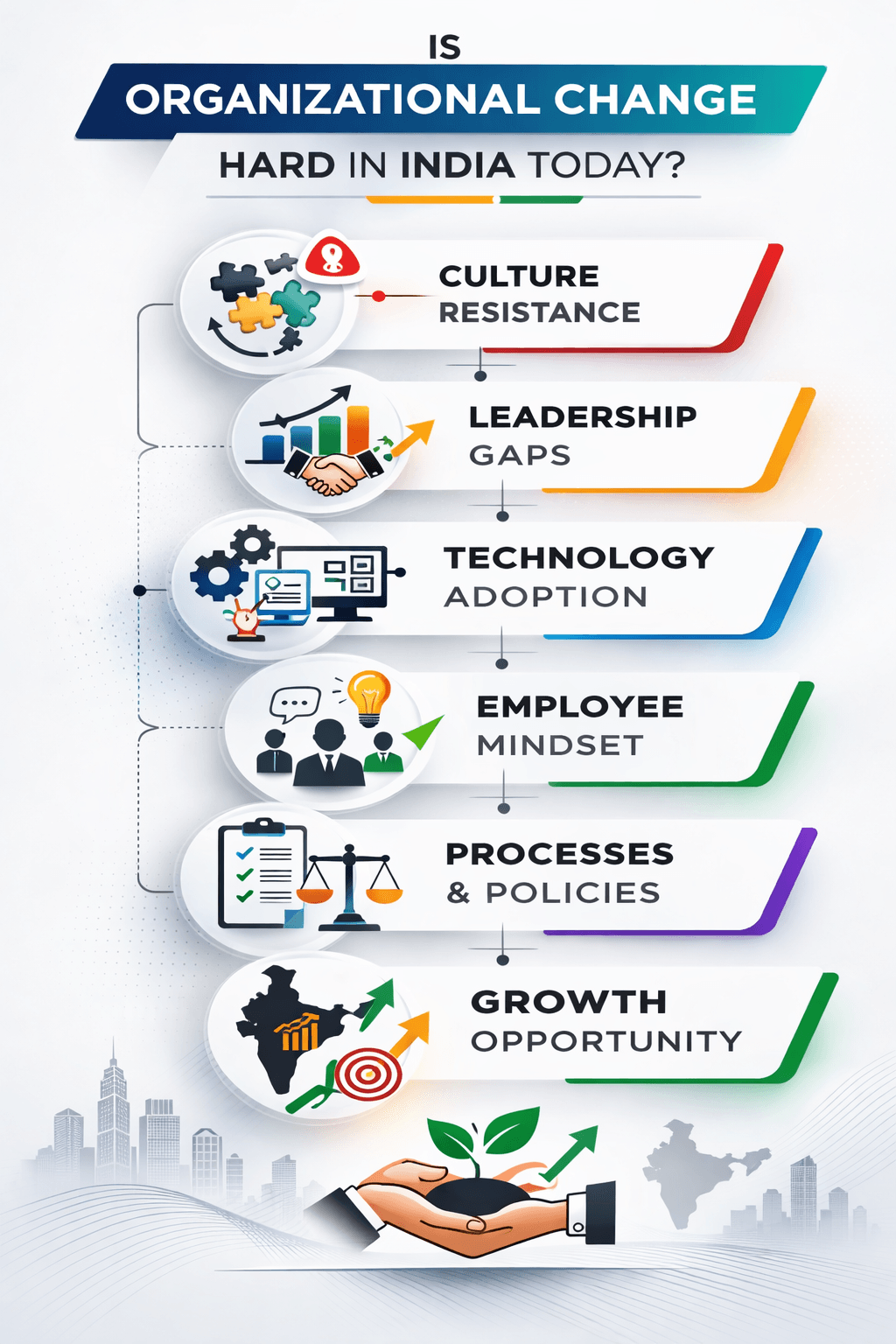
Organizational change in India is challenging — not because Indian organizations lack capability, but because change here intersects deeply with culture, hierarchy, and identity.
The importance of organizational change in Indian companies cannot be overstated. It drives performance improvement, resilience, and long-term competitiveness.
But success requires structured organizational change management, strong leadership alignment, and deep cultural understanding.
At Faber Infinite Consulting, we believe change is not about replacing systems. It is about reshaping mindsets.
When strategy, structure, and culture move together, transformation becomes sustainable.
FAQs
- Why is organizational change important for Indian businesses?
Organizational change is important for Indian businesses to remain competitive, adapt to digital transformation, improve performance, and meet evolving workforce expectations.
- What are the biggest organizational change challenges in India?
The biggest challenges include employee resistance, hierarchical structures, fear of automation, skill gaps, and weak communication systems.
- How can Indian organizations implement successful change management?
By adopting a structured change management process, involving leadership alignment, transparent communication, training programs, and measurable KPIs.
- What is the role of culture in organizational change in India?
Culture plays a critical role. Hierarchy, relationship-driven decisions, and respect for authority influence how change is accepted and implemented.
- What are examples of organizational change in India?
Examples include digital transformation in manufacturing, lean implementation in SMEs, automation adoption, and structured performance improvement initiatives.
If your organization is planning business transformation in India, building a strong and culturally aligned change management strategy is not optional — it is essential.