
Indian manufacturers today face a tough equation: rising input costs, global competition, tighter margins, and increasing compliance requirements. The question is no longer whether to improve efficiency—but how fast you can do it.
At Faber Infinite Consulting, we have worked with manufacturers across automotive, FMCG, engineering, packaging, and process industries. One clear pattern emerges: cost reduction in the manufacturing industry does not come from cutting budgets—it comes from redesigning processes. Lean manufacturing provides that structured path.
Let’s explore how Lean manufacturing India is transforming cost structures and improving profitability across plants.
Understanding Cost Reduction in Manufacturing Industry
Cost reduction in manufacturing industry is not about layoffs or supplier squeezing. It is about eliminating waste, improving flow, and optimizing resource utilization.
According to the McKinsey & Company, lean transformations can improve productivity by 15–30% and reduce operating costs by up to 25% in manufacturing environments.
Similarly, the World Economic Forum reports that smart factories applying lean principles alongside Industry 4.0 technologies achieve up to 20% improvement in cost competitiveness.
These numbers are achievable in India—if implementation is structured.
What Makes Lean Manufacturing India Relevant Today?
India’s manufacturing ecosystem is unique:
- High labor intensity
- Space constraints in legacy plants
- Variable supplier quality
- Energy cost pressures
- Rapid scale-up demands
Lean manufacturing India focuses on manufacturing process optimization, waste reduction techniques, and production cost control suited to Indian realities.
Where Do Costs Hide in Indian Plants?
In our on-ground assessments, cost leakage typically occurs in:
| Hidden Cost Area | Impact on Business |
| Excess material movement | Increased labor & fuel cost |
| High WIP inventory | Blocked working capital |
| Rework & rejection | Quality cost reduction challenge |
| Machine downtime | Lost production capacity |
| Poor layout design | Productivity loss |
| Overstaffed processes | Reduced manpower productivity |
Cost reduction strategies in manufacturing must target these structural inefficiencies.
Core Lean Manufacturing Cost Reduction Strategies
-
Waste Reduction Techniques (Muda Elimination)
Lean identifies 7 classical wastes: overproduction, waiting, transport, overprocessing, inventory, motion, defects.
Impact:
- 10–20% reduction in material handling cost
- 15–30% improvement in throughput
Practical example: In one Indian engineering plant, reducing material travel distance by 38% improved output per operator by 22%.
-
Manufacturing Process Optimization
Mapping value streams helps identify bottlenecks and non-value-added steps.
Tools used:
- Value Stream Mapping (VSM)
- Line balancing
- Flow redesign
- Layout re-engineering
Result:
Manufacturing cost optimization without capital expenditure.
-
TPM in Manufacturing (Total Productive Maintenance)
Unplanned downtime directly increases production cost.
According to the Japan Institute of Plant Maintenance, effective TPM programs can improve Overall Equipment Effectiveness (OEE) by 15–25%.
TPM improves:
- Machine reliability
- Preventive maintenance culture
- Breakdown cost reduction
- Spare inventory optimization
-
Quality Cost Reduction
Poor quality increases:
- Rework cost
- Scrap
- Warranty claims
- Customer dissatisfaction
The American Society for Quality estimates that Cost of Poor Quality (COPQ) can range from 10–30% of revenue in manufacturing firms.
Lean Six Sigma initiatives help:
- Reduce defects
- Improve process capability
- Lower inspection costs
-
Productivity Improvement Through Workforce Optimization
Labor cost is a major factor in Indian plants.
Time and Motion Studies often reveal:
- 15–25% idle time
- Role overlaps
- Poor task sequencing
Structured manpower productivity improvement can reduce headcount dependence without layoffs—by redeployment and skill alignment.
Real Experience: Cost Reduction Case Study in Indian Manufacturing Industry
In a mid-sized automotive component plant in western India:
Initial Situation:
- 52% OEE
- 18% rejection rate
- High overtime cost
- Excess WIP
Lean Intervention Steps:
- Value stream redesign
- Layout optimization
- TPM implementation
- Skill matrix restructuring
- Standard work documentation
Results in 8 months:
- OEE improved to 71%
- Rejection reduced to 7%
- 19% reduction in manufacturing cost
- 23% improvement in productivity
This was achieved without major capex—only process restructuring.
Cost Reduction Through Lean Manufacturing in India: Step-by-Step Framework
| Phase | Focus Area | Outcome |
| Diagnose | Cost mapping & waste analysis | Visibility |
| Design | Flow & layout optimization | Efficiency |
| Deploy | TPM & standard work | Stability |
| Develop | Skill & productivity improvement | Sustainability |
| Drive | Performance metrics & review | Continuous improvement |
This structured approach ensures manufacturing cost reduction techniques for Indian plants deliver measurable ROI.
Why Lean Is a Strategic Cost Saving Tool
Lean manufacturing supports:
- Operational efficiency improvement
- Manufacturing cost optimization
- Production cost control
- Sustainable cost saving in manufacturing industry
- Scalable growth
Unlike short-term cost cutting, lean embeds long-term capability.
Actionable Takeaways for Indian Manufacturers
If you are asking, “How to reduce manufacturing costs in India?” start here:
- Measure OEE and real capacity utilization.
- Map total material movement distance.
- Calculate Cost of Poor Quality.
- Audit manpower utilization scientifically.
- Redesign layout for flow, not convenience.
- Implement TPM in manufacturing for stability.
Cost reduction strategies for manufacturing companies in India work only when driven by data—not assumptions.
Internal & External Resources
- Explore operational transformation frameworks by Faber Infinite Consulting (Internal link suggestion: /operational-excellence-consulting)
- Learn about lean principles from Lean Enterprise Institute
- Industry productivity insights from Confederation of Indian Industry
Conclusion: Lean Is the Engine of Sustainable Cost Reduction
Cost reduction in manufacturing industry in India is no longer optional—it is a survival strategy.
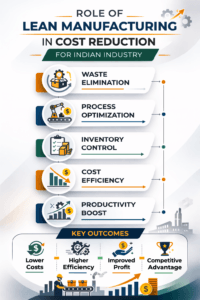
Lean manufacturing India offers a structured, measurable, and sustainable path toward manufacturing cost reduction. It addresses root causes, not symptoms. The real competitive advantage lies in process discipline, productivity improvement, and waste elimination.
Indian manufacturers who embed lean thinking today will lead tomorrow’s cost curve.
FAQs
-
What is the best way to achieve cost reduction in manufacturing industry in India?
The most effective approach combines lean manufacturing, TPM in manufacturing, process optimization, and manpower productivity improvement.
-
How much cost reduction is realistically achievable?
Typically, structured lean programs deliver 15–25% manufacturing cost reduction within 6–12 months.
-
Does lean manufacturing require heavy investment?
No. Most manufacturing cost reduction strategies focus on process redesign and waste elimination rather than capital expenditure.
-
How does TPM help in production cost control?
TPM reduces machine breakdowns, improves OEE, and lowers maintenance costs—directly impacting cost saving in manufacturing industry.
-
Is lean suitable for small and mid-sized Indian manufacturers?
Yes. Lean manufacturing cost optimization strategies in India are scalable and adaptable to plant size and industry type.
If your plant is ready to move from reactive cost cutting to structured manufacturing cost optimization, lean manufacturing is the right starting point.