In today’s competitive manufacturing environment, operational efficiency is not optional—it is a survival strategy. Rising input costs, supply chain disruptions, and customer expectations for faster delivery have made business operations efficiency a boardroom priority.
According to McKinsey & Company, manufacturing productivity improvements can reduce operating costs by up to 30% when lean principles are systematically applied. Yet, many plants still operate below 60% of their optimal capacity.
At Faber Infinite Consulting, we have worked across diverse industries to improve operational efficiency through structured lean interventions, process redesign, and data-driven decision-making. This article combines hands-on experience, global best practices, and credible research to provide a comprehensive guide to operational optimization in manufacturing.
What Is Operational Efficiency in Manufacturing?
| Aspect | Explanation |
| Definition | The ability to deliver maximum output with minimum waste |
| Objective | Reduce cost while increasing throughput and quality |
| Focus Areas | Time, labor, inventory, energy, and capital utilization |
| Outcome | Higher margins, faster delivery, improved competitiveness |
Operational excellence is achieved when efficiency becomes embedded in culture, systems, and leadership decisions.
Why Lean Management Is the Foundation of Efficiency
Lean management originated from the Toyota Motor Corporation Production System and focuses on eliminating waste (Muda), unevenness (Mura), and overburden (Muri).
The 8 Common Wastes in Manufacturing
| Waste Type | Impact on Efficiency in Operations |
| Overproduction | Excess inventory and working capital blockage |
| Waiting | Idle manpower and machine downtime |
| Transportation | Increased handling cost |
| Overprocessing | Higher cycle time |
| Inventory | Storage and obsolescence cost |
| Motion | Operator fatigue and inefficiency |
| Defects | Rework and scrap |
| Underutilized Talent | Lost productivity |
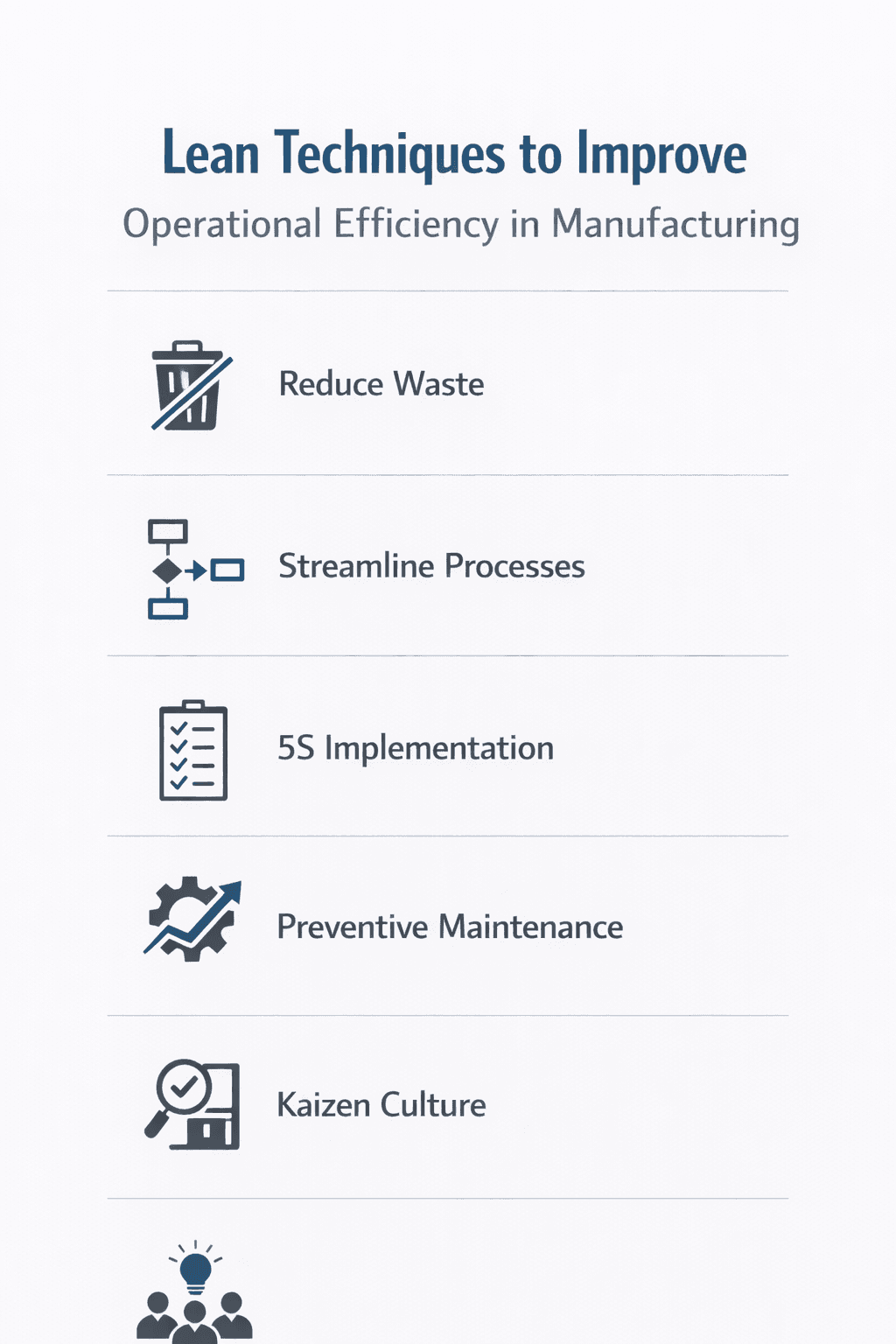
Proven Lean Techniques to Improve Operational Efficiency
- Value Stream Mapping (VSM)
Purpose: Identify bottlenecks and non-value-added activities.
| Benefit | Impact |
| Visual process clarity | Faster decision-making |
| Waste identification | Direct cost efficiency gains |
| Lead time reduction | Improved supply chain efficiency |
Real Experience Insight:
In one FMCG plant engagement, mapping a high-volume product line revealed 38% of process time was non-value-adding. By redesigning material flow, we improved process efficiency by 22% within 90 days.
- 5S Workplace Organization
| Step | Meaning | Operational Impact |
| Sort | Remove unnecessary items | Reduced clutter |
| Set in Order | Arrange tools logically | Faster retrieval |
| Shine | Clean workspace | Fewer breakdowns |
| Standardize | Maintain procedures | Consistency |
| Sustain | Discipline | Long-term efficiency |
Research from Lean Enterprise Institute shows 5S implementation improves workplace productivity by 15–20% in structured environments.
- Kaizen Methodology (Continuous Improvement)
The Kaizen Institute promotes small, incremental improvements driven by employees.
| Key Feature | Result |
| Daily problem-solving | Continuous process improvement |
| Employee engagement | Higher organizational efficiency |
| Standardized work | Reduced variation |
Case Insight:
At a packaging facility, daily Kaizen huddles reduced minor stoppages by 27% over six months, directly impacting productivity improvement.
- Just-in-Time (JIT) Production
| Principle | Operational Benefit |
| Produce only what is needed | Lower inventory cost |
| Synchronize demand and supply | Improved supply chain efficiency |
| Shorter lead time | Better customer responsiveness |
According to Boston Consulting Group, companies that optimize inventory levels through lean systems reduce working capital requirements by up to 25%.
- Total Productive Maintenance (TPM)
| Focus Area | Impact on Operational Optimization |
| Preventive maintenance | Reduced breakdowns |
| Operator ownership | Faster issue detection |
| OEE tracking | Measurable performance gains |
TPM improves Overall Equipment Effectiveness (OEE), a key metric for business process optimization.
Impact of Automation on Operational Performance
Automation enhances lean systems rather than replacing them.
| Automation Type | Efficiency Outcome |
| IoT monitoring | Real-time decision-making |
| Robotics | Reduced labor dependency |
| ERP integration | End-to-end visibility |
| AI-based forecasting | Better production planning |
According to World Economic Forum, smart manufacturing technologies can increase productivity by 20–30% when aligned with lean frameworks.
Operational Efficiency Strategies for Manufacturing Companies
| Strategy | Description | Expected Outcome |
| Layout Optimization | Reduce material travel distance | 10–25% productivity gain |
| Time & Motion Study | Identify labor inefficiencies | Cost reduction |
| Standard Operating Procedures | Reduce variation | Consistent quality |
| KPI Alignment | Focus on OEE, cycle time, takt time | Clear accountability |
| Data-Driven Decisions | Real-time dashboards | Faster corrective action |
At Faber Infinite Consulting, we integrate lean management with strategic alignment to ensure efficiency in operations translates into sustained profitability.
How to Improve Operational Efficiency in a Business: Step-by-Step
| Step | Action |
| 1 | Conduct operational diagnostic audit |
| 2 | Map current processes |
| 3 | Identify high-impact waste areas |
| 4 | Implement lean techniques |
| 5 | Train teams for cultural shift |
| 6 | Track measurable KPIs |
| 7 | Sustain through continuous improvement |
Cost Reduction Through Operational Efficiency Strategies
Operational efficiency directly impacts financial performance:
| Area | Financial Impact |
| Reduced waste | Lower production cost |
| Improved throughput | Higher revenue |
| Better asset utilization | Higher ROI |
| Reduced downtime | Lower maintenance cost |
Studies from Deloitte show that structured operational excellence programs improve EBITDA margins by 3–8% in manufacturing firms.
Conclusion: From Lean Tools to Operational Excellence
Lean techniques are not isolated tools; they are a system of thinking. True operational excellence requires leadership commitment, cultural adoption, and continuous monitoring.
Actionable Takeaways
- Start with a diagnostic audit.
- Focus on one high-volume product line.
- Measure before and after implementation.
- Align leadership KPIs with operational efficiency.
- Embed Kaizen culture at every level.
If you are seeking measurable productivity improvement and sustainable operational optimization, Faber Infinite Consulting provides structured frameworks tailored to manufacturing environments.
FAQs
- What are the best lean techniques to increase operational efficiency?
Value Stream Mapping, 5S, Kaizen methodology, TPM, and Just-in-Time are proven methods to improve operational efficiency in manufacturing.
- How does automation impact operational performance?
Automation enhances visibility, reduces manual errors, and supports lean systems, improving productivity by 20–30% when properly integrated.
- How long does it take to see results from lean implementation?
Initial improvements can be visible within 60–90 days, but cultural transformation may take 6–12 months.
- Can small manufacturing companies implement lean?
Yes. Lean techniques are scalable and particularly effective for SMEs seeking cost efficiency and business operations efficiency.
- What is the difference between operational efficiency and operational excellence?
Operational efficiency focuses on doing things right; operational excellence ensures the organization consistently sustains and improves those efficiencies.