In manufacturing and operations, profitability rarely depends only on sales. It depends on how efficiently time, labor, and processes are utilized on the shop floor.
A well-executed time and motion study helps organizations eliminate waste, improve labor productivity, and increase capacity utilization—without additional capital investment.
At Faber Infinite Consulting, we have implemented time study in manufacturing across FMCG, packaging, textile, engineering, and logistics sectors. In many projects, structured work measurement study initiatives have improved manpower productivity by 15–30% within 90 days.
This blog explains how to conduct a time and motion study step by step, supported by industry standards, practical experience, and proven frameworks.
What is a Time and Motion Study?
A time and motion study combines:
| Component | Definition | Objective |
| Time Study | Measurement of time taken to complete a task | Establish standard time |
| Motion Study | Analysis of physical movements involved in a task | Eliminate unnecessary motion |
| Work Measurement Study | Systematic evaluation of task duration and effort | Improve labor productivity |
| Method Study | Examination of how a task is performed | Optimize workflow |
The concept originated from industrial pioneers like Frederick Winslow Taylor and Frank Gilbreth and later evolved through lean manufacturing principles promoted by organizations such as Toyota Motor Corporation.
Why Conduct a Time and Motion Study?
Benefits in Manufacturing & Operations
| Benefit | Impact on Business |
| Productivity Improvement | 10–30% increase in output |
| Labor Productivity | Reduced idle time |
| Capacity Utilization | Better machine & manpower usage |
| Cost Reduction | Lower unit manufacturing cost |
| Lean Implementation | Eliminates waste (Muda) |
| Standardization | Creates measurable benchmarks |
According to global lean manufacturing practices adopted by Toyota Production System, eliminating non-value-added motion significantly improves operational efficiency.
Step-by-Step Process to Conduct a Time and Motion Study
Below is a structured, practical framework used by Faber Infinite Consulting in industrial time study assignments.
Step 1: Define Objective Clearly
Key Questions:
- What problem are we solving?
- Is it manpower productivity, bottleneck removal, or capacity optimization?
- What KPI will improve?
| Action | Output |
| Define scope | Selected department/process |
| Set measurable goals | Target % improvement |
| Identify stakeholders | Production, HR, Maintenance |
Practical Insight:
In one FMCG packaging unit, unclear objectives led to incorrect data collection. Once we defined “reduce line changeover time by 20%,” the study became focused and measurable.
Step 2: Select the Process or Task
Choose repetitive, measurable tasks such as:
- Machine loading/unloading
- Assembly operations
- Packaging processes
- Material handling
Selection Criteria
| Criteria | Reason |
| High labor involvement | Maximum impact |
| Repetitive operations | Reliable data |
| Bottleneck process | Immediate ROI |
Step 3: Break Down the Task into Elements
This is critical in industrial time study.
Divide work into measurable elements:
| Example: Carton Packing Process | Element |
| Pick carton | Element 1 |
| Open carton | Element 2 |
| Insert product | Element 3 |
| Seal carton | Element 4 |
| Place on conveyor | Element 5 |
Each element must be:
- Clearly observable
- Measurable
- Repeatable
This forms the foundation of motion efficiency study.
Step 4: Conduct Time Observation
Tools Used:
- Stopwatch
- Time study sheet
- Video recording (if permitted)
- Digital time study apps
Types of Time Study Techniques
| Technique | Application |
| Continuous timing | Entire cycle measured |
| Snapback timing | Each element measured separately |
| Predetermined motion time systems (PMTS) | Advanced industrial studies |
In most shop floors, snapback timing provides better clarity for time study techniques for improving production efficiency.
Step 5: Apply Performance Rating
Not all operators work at the same speed. Therefore:
Standard Time = Observed Time × Performance Rating
Performance Rating Factors:
- Skill
- Effort
- Conditions
- Consistency
| Rating | Interpretation |
| 100% | Normal performance |
| 110% | Above average |
| 90% | Below average |
Accurate operator performance rating and work measurement methods ensure fairness and transparency.
Step 6: Add Allowances
Allowances account for:
- Fatigue
- Personal needs
- Machine delays
- Contingencies
Typical allowance range: 10–20%
| Type | % Range |
| Personal | 5% |
| Fatigue | 4–7% |
| Delay | 3–8% |
Standard Time = Normal Time + Allowances
This becomes the benchmark for productivity planning and incentive systems.
Step 7: Conduct Motion Study (Motion Economy Principles)
Now analyze movement efficiency.
Observe:
- Excess walking
- Bending
- Reaching
- Searching for tools
- Double handling
Based on motion economy principles, improvements may include:
| Problem | Improvement |
| Excess walking | Re-layout workstation |
| Tool searching | Fixed tool location |
| Bending repeatedly | Height-adjustable table |
| Double handling | Flow redesign |
At Faber Infinite Consulting, layout corrections alone have reduced operator fatigue by 18% in one textile unit.
Step 8: Analyze and Identify Waste
Classify activities:
| Activity Type | Value |
| Value-added | Necessary |
| Non-value-added | Waste |
| Necessary non-value-added | Required but non-productive |
Lean manufacturing applications of time and motion study help eliminate:
- Waiting
- Over-processing
- Unnecessary motion
- Transportation waste
Step 9: Develop Improved Method
Redesign process based on findings.
Example improvements:
- Combine two elements into one
- Reduce material travel distance
- Introduce jigs or fixtures
- Standardize work sequence
Document new method with:
- SOPs
- Visual aids
- Standard work charts
Step 10: Implement and Monitor
Implementation is where many studies fail.
Key Actions:
| Action | Purpose |
| Train operators | Acceptance |
| Pilot run | Validate new standard |
| Monitor KPIs | Measure impact |
| Continuous review | Sustain gains |
In one packaging industry project, after implementing revised standard time, manpower allocation was optimized—saving 12 operators per shift without layoffs.
Difference Between Time Study and Motion Study Explained
| Parameter | Time Study | Motion Study |
| Focus | Duration | Movement |
| Objective | Set standard time | Eliminate waste |
| Tool | Stopwatch | Observation & layout |
| Outcome | Work measurement | Efficiency redesign |
Both together form a powerful work-study technique.
Real-World Case Example (Faber Infinite Consulting)
Industry: FMCG
Challenge: Low labor productivity & poor capacity utilization
Approach:
- Conducted industrial time study
- Applied motion efficiency study
- Redesigned layout
- Implemented standard work
Results:
- 22% productivity improvement
- 18% reduction in idle time
- 15% increase in output
- Improved morale due to clear targets
Common Mistakes to Avoid
- Not defining objective
- Observing only one cycle
- Ignoring operator performance rating
- Skipping allowances
- Failing to implement findings
Conclusion: Actionable Takeaways
A structured time and motion analysis is one of the most powerful productivity improvement tools in manufacturing.
Key Takeaways:
✔ Start with a clear objective
✔ Break work into measurable elements
✔ Use correct performance rating
✔ Apply allowances transparently
✔ Improve layout using motion economy principles
✔ Monitor continuously
If implemented correctly, a time and motion study can unlock 15–30% productivity gains without heavy capital investment.
At Faber Infinite Consulting, we help organizations implement scientific work measurement systems that drive measurable, sustainable results.
FAQs
- How to conduct a time and motion study step by step?
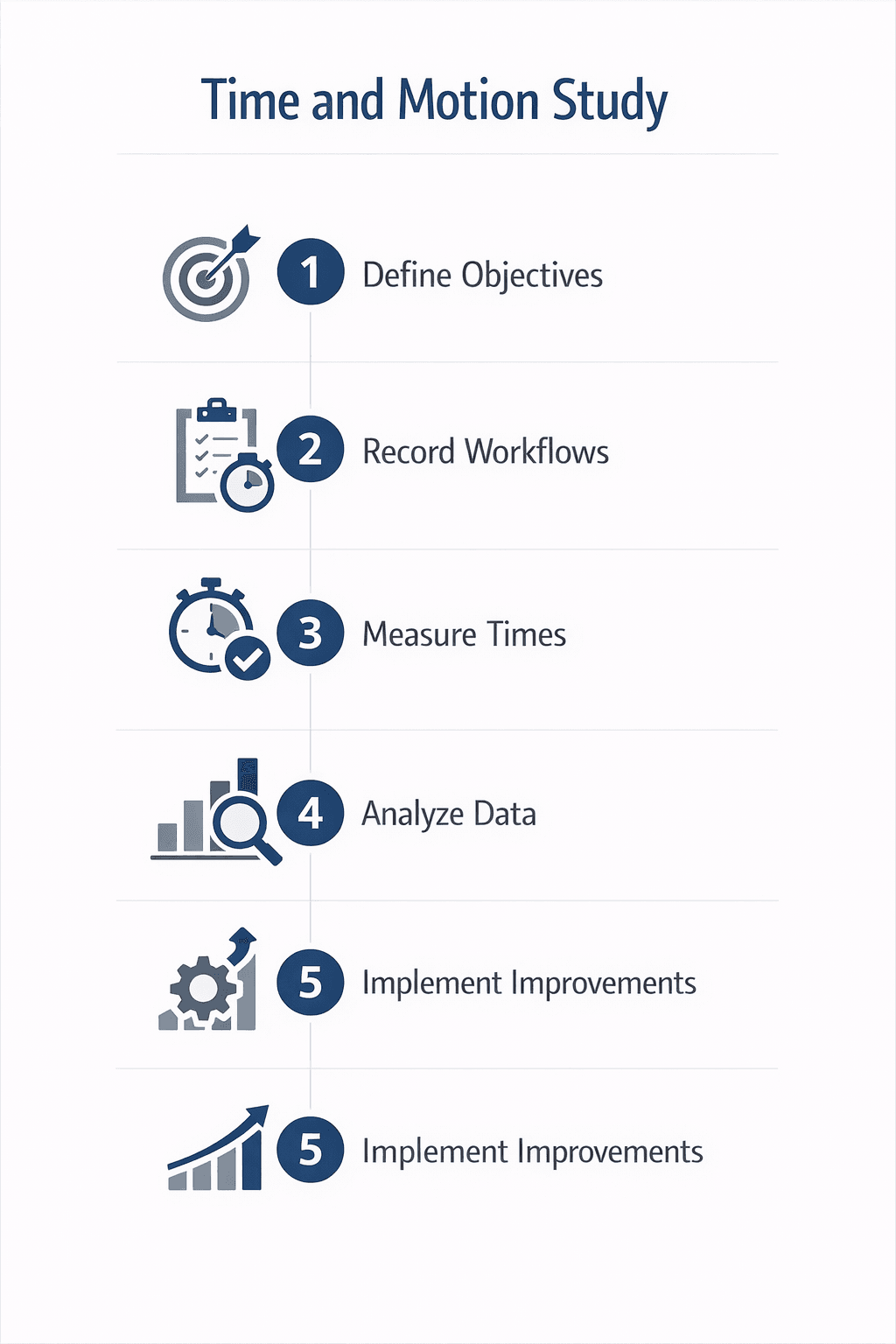
Define objective, select task, break into elements, measure time, apply performance rating, add allowances, analyze motion, redesign method, and monitor results.
- What is the difference between time study and motion study?
Time study measures task duration, while motion study analyzes physical movement to eliminate inefficiencies.
- What are the benefits of time and motion study in manufacturing industry?
It improves productivity, reduces costs, enhances capacity utilization, and supports lean manufacturing initiatives.
- How accurate is a work measurement study?
Accuracy depends on proper sampling, performance rating, and adequate observation cycles.
- What industries benefit most from industrial time study?
Manufacturing, logistics, FMCG, textile, packaging, engineering, and warehousing sectors benefit significantly.