In manufacturing, profits are rarely lost in strategy meetings—they are lost on the shop floor. Seconds of delay, excess motion, idle manpower, and unbalanced lines silently reduce margins every day.
This is where a time and motion study becomes powerful.
At Faber Infinite Consulting, we have observed that organizations often invest in automation before optimizing their basic processes. However, when a structured industrial time study and motion efficiency study are implemented first, companies typically achieve 10–30% productivity improvement without additional capital expenditure.
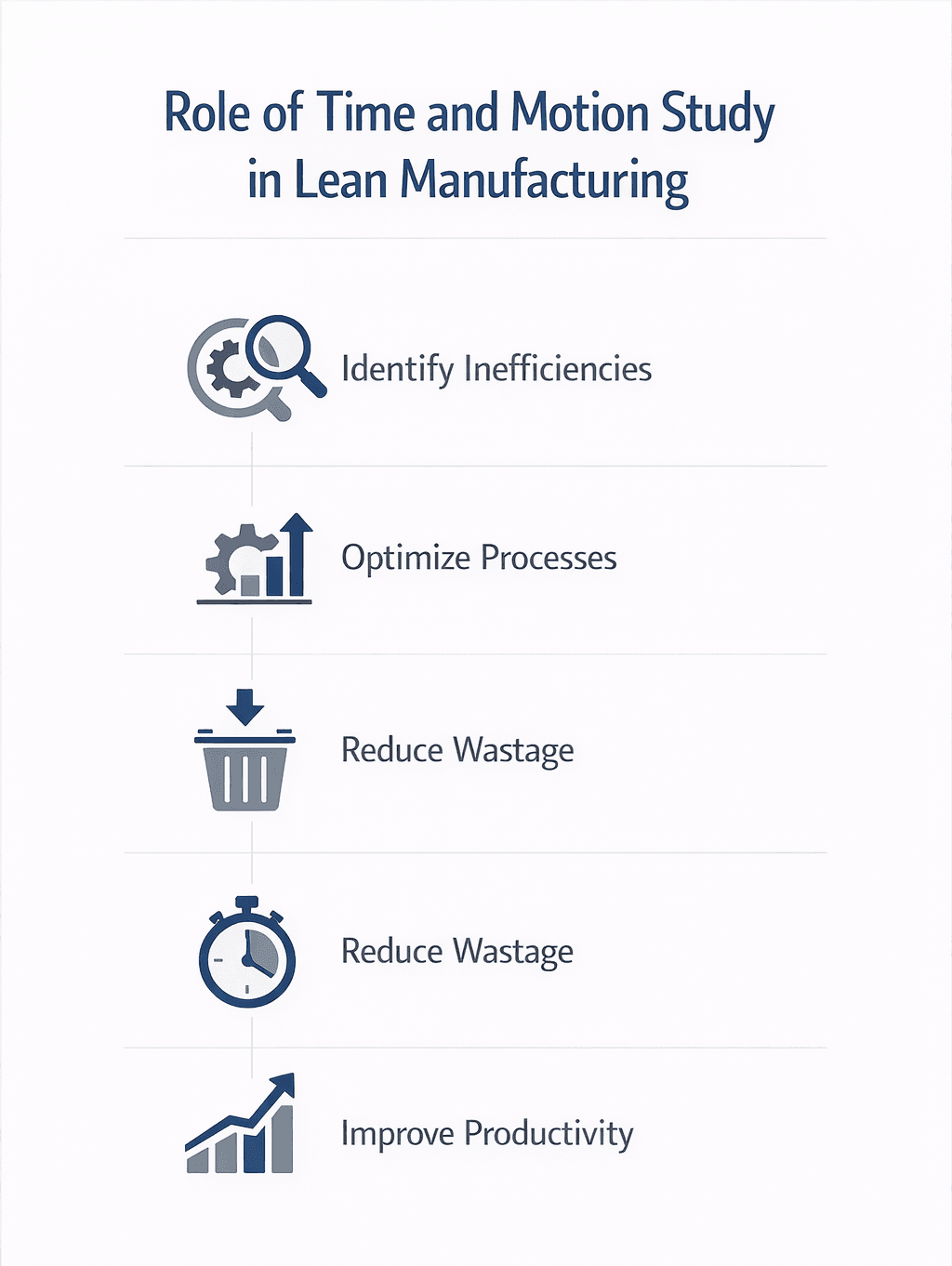
Time and motion study is not about speeding up workers. It is about eliminating waste, balancing work, and designing smarter systems aligned with Lean Manufacturing principles.
What is a Time and Motion Study?
| Component | Definition | Objective |
| Time Study in Manufacturing | Measuring the time taken to perform a task under defined conditions | Establish standard time |
| Motion Study | Analyzing body movements to eliminate unnecessary motions | Improve motion economy |
| Work Measurement Study | Structured method to calculate standard labor time | Improve productivity planning |
| Time and Motion Analysis | Combined approach of time + movement optimization | Reduce waste & increase efficiency |
The concept originated in the early 20th century with Frederick Winslow Taylor and Frank Bunker Gilbreth. Later, it became foundational to the Toyota Motor Corporation Production System, which shaped modern Lean Manufacturing.
Why Time and Motion Study Matters in Lean Manufacturing
Lean manufacturing focuses on eliminating waste (Muda). According to the Lean Enterprise Institute, the seven wastes include overproduction, waiting, transport, excess motion, inventory, over-processing, and defects.
A time and motion study directly addresses:
- Excess motion
- Waiting time
- Line imbalance
- Underutilized manpower
- Low capacity utilization
Key Benefits
| Benefit | Impact on Manufacturing |
| Improved labor productivity | Higher output per operator |
| Reduced cycle time | Faster production |
| Better capacity utilization | Higher throughput |
| Standardized work methods | Consistent quality |
| Accurate manpower planning | Reduced labor cost |
Real Experience: Case Insight from Faber Infinite Consulting
In one mid-sized FMCG plant in India, line productivity was stagnant despite new machinery installation.
Challenges Identified:
- Operators walking 8–10 meters repeatedly per cycle
- Inconsistent work methods
- No defined standard time
- Hidden waiting losses
Our Approach:
- Conducted industrial time study
- Applied motion economy principles
- Rebalanced workstation layout
- Introduced standard work sheets
Results:
- 22% labor productivity improvement
- 18% reduction in cycle time
- 12% improvement in capacity utilization
- Zero additional capital investment
This reinforces that time study techniques for improving production efficiency often unlock hidden performance.
Difference Between Time Study and Motion Study Explained
| Parameter | Time Study | Motion Study |
| Focus | Time measurement | Movement optimization |
| Tool Used | Stopwatch, time recording sheets | Video analysis, process mapping |
| Output | Standard time | Improved method |
| Goal | Work measurement | Motion economy |
In Lean manufacturing applications of time and motion study, both are integrated for maximum impact.
How to Conduct a Time and Motion Study Step by Step
Step 1: Select the Process
Choose repetitive, high-volume operations.
Step 2: Break into Elements
Divide task into measurable work elements.
Step 3: Conduct Time Study
Use stopwatch or digital tools to record multiple cycles.
Step 4: Apply Operator Performance Rating
Adjust observed time based on skill and effort level.
Step 5: Add Allowances
Include fatigue, delays, and personal allowances.
Step 6: Calculate Standard Time
Standard Time = (Observed Time × Rating) + Allowances
Step 7: Conduct Motion Study
- Record video
- Identify unnecessary movements
- Apply motion economy principles
- Redesign layout if required
Step 8: Implement Standard Work
Document and train operators.
Core Time Study Techniques for Improving Production Efficiency
| Technique | Application |
| Stopwatch Time Study | Repetitive manual operations |
| Work Sampling | Indirect labor analysis |
| Predetermined Motion Time Systems (PMTS) | High precision tasks |
| Method Study | Process redesign |
| Line Balancing | Assembly lines |
These work-study techniques ensure measurable and sustainable productivity improvement.
Role of Operator Performance Rating in Work Measurement
A major misconception is assuming all operators work at identical speed.
Performance rating adjusts for:
- Skill level
- Effort
- Working conditions
- Consistency
Accurate rating improves reliability of work measurement methods and prevents unrealistic targets.
Time and Motion Study & Industry Standards
Modern Lean systems use time and motion analysis aligned with:
- ISO productivity standards
- Industrial engineering guidelines
- Best practices from the Toyota Production System
According to industry research, structured work measurement can improve labor productivity by 15–30% when properly implemented.
Motion Economy Principles in Lean Manufacturing
Motion study applies three core principles:
- Eliminate unnecessary movements
- Simplify necessary movements
- Combine motions where possible
Example:
- Replace manual bending with height-adjusted tables
- Arrange tools within ergonomic reach zone
- Convert two-hand operations into synchronized motions
These improvements directly increase motion efficiency.
Common Mistakes in Time and Motion Study
| Mistake | Risk |
| Observing too few cycles | Inaccurate data |
| Ignoring allowances | Unrealistic targets |
| Not involving operators | Resistance |
| Focusing only on speed | Quality drop |
| No follow-up review | Sustainability loss |
At Faber Infinite Consulting, we emphasize collaborative implementation to build trust and ownership.
Time and Motion Study vs Automation
Before investing in automation, companies should:
- Optimize manual process
- Eliminate waste
- Standardize work
Automation without motion optimization can lock inefficiencies permanently.
Strategic Impact on Business Performance
When applied correctly, time and motion study contributes to:
- Better cost competitiveness
- Improved delivery timelines
- Increased throughput
- Sustainable lean transformation
For manufacturers operating in competitive markets like India, this becomes a strategic advantage.
Actionable Takeaways
✔ Conduct time and motion analysis before capital investment
✔ Use structured work measurement study for manpower planning
✔ Integrate motion economy principles into layout design
✔ Train supervisors in work-study techniques
✔ Review and update standard times periodically
Time and motion study is not a one-time project—it is a continuous improvement tool.
FAQs
- What is the main objective of a time and motion study?
The objective is to improve productivity by measuring task time and eliminating unnecessary motions.
- How long does a time study in manufacturing take?
Depending on process complexity, it may take a few days to several weeks including data validation.
- What is the difference between time study and work measurement?
Time study is one technique under the broader category of work measurement methods.
- Can time and motion study reduce labor costs?
Yes. By improving labor productivity and optimizing manpower deployment.
- Is time and motion study suitable for small manufacturers?
Absolutely. In fact, SMEs often gain faster ROI due to simpler process structures.
Conclusion
Time and motion study remains one of the most powerful yet underutilized tools in Lean Manufacturing. When executed scientifically and ethically, it transforms productivity without increasing workload.
At Faber Infinite Consulting, we believe sustainable growth begins with structured work measurement, data-driven decisions, and practical shop-floor improvements.
Before adding new machines, optimize the movements around existing ones.
Because efficiency is not about working harder—it is about working smarter.
Contact us