Kenya’s manufacturing sector plays a vital role in economic growth, job creation, and industrial development. As the country pursues its long-term industrialization goals, manufacturers are facing increasing pressure to improve productivity, reduce costs, enhance quality, and remain competitive in regional and global markets.
At the same time, customer expectations are changing. Buyers expect faster delivery, greater product consistency, improved traceability, and higher quality standards. Global supply chains are becoming increasingly digital, and manufacturers that fail to modernize, risk falling behind competitors that can operate more efficiently and respond more quickly to market demands.
This is where Industry 4.0 manufacturing is becoming increasingly important.
By integrating technologies such as Artificial Intelligence (AI), industrial automation, advanced analytics, and connected production systems, manufacturers can improve operational performance and build more resilient, data-driven operations.
However, while the benefits of Industry 4.0 are well documented, many manufacturers underestimate what it takes to successfully implement these technologies. Digital transformation is not simply a technology project, it is a business transformation initiative that requires planning, readiness, and a clear roadmap.
For manufacturers pursuing Industry 4.0 manufacturing in Kenya, understanding where to start may be just as important as understanding which technologies to adopt.
What Is Industry 4.0 Manufacturing?
Industry 4.0 manufacturing is the integration of connected digital technologies into manufacturing operations to enable real-time data, automation, and intelligent decision-making.
It transforms traditional factories into data-driven, connected production systems.
Rather than operating through disconnected systems and manual processes, Industry 4.0 environments use real-time data to improve operational performance and support continuous improvement.
Common Industry 4.0 manufacturing technologies include:
- Artificial Intelligence (AI)
- Industrial automation
- Advanced analytics
- Predictive maintenance
- Smart factory solutions
Together, these technologies form the foundation of modern digital manufacturing in Kenya.
Why Industry 4.0 Manufacturing Is Critical for Kenya’s Industrial Future
Kenya’s manufacturing sector is operating in an increasingly competitive environment.
Manufacturers must contend with:
- Rising production costs
- Supply chain volatility
- Equipment downtime
- Increasing quality expectations
- Regional and international competition
- Pressure to improve operational efficiency
Traditional manufacturing approaches often struggle to address these challenges because they rely heavily on manual processes, delayed reporting, and limited operational visibility.
Industry 4.0 provides a different approach.
By connecting machines, people, processes, and data, manufacturers gain access to real-time insights that support faster decision-making and continuous operational improvement.
As Kenya seeks to strengthen its industrial base and expand manufacturing output, Industry 4.0 technologies can help organizations build the operational agility needed to compete in a rapidly evolving market.
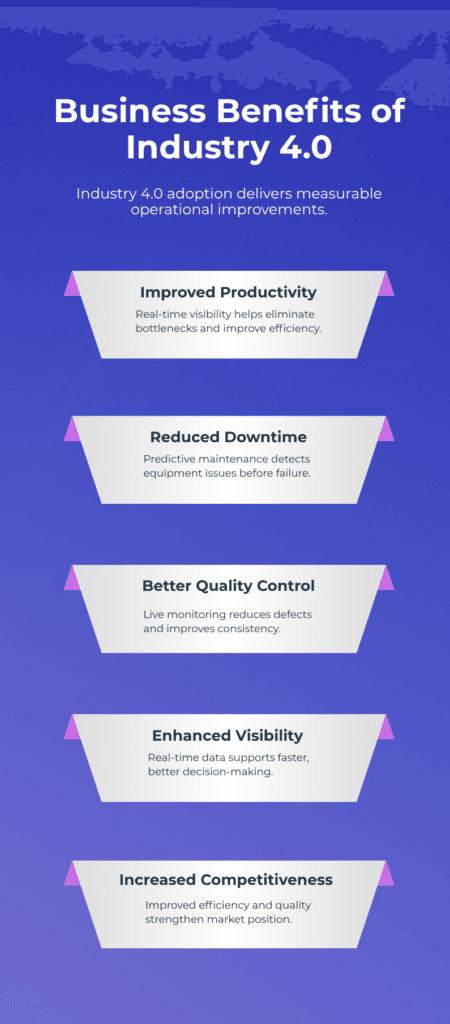
The Business Benefits of Industry 4.0 Manufacturing
The growing interest in smart manufacturing in Kenya is driven by the tangible business outcomes Industry 4.0 can deliver. These include:
Improved Productivity
Connected systems provide greater visibility into production performance, allowing manufacturers to identify inefficiencies and eliminate bottlenecks more quickly.
Reduced Downtime
Predictive analytics and condition monitoring help organizations identify potential equipment failures before they occur, supporting more effective predictive maintenance programs in Kenya.
Better Quality Control
Real-time production monitoring allows manufacturers to detect quality issues earlier, reducing defects and improving consistency.
Enhanced Operational Visibility
Industry 4.0 technologies provide access to live production data, enabling management teams to make informed decisions based on current operational conditions.
Increased Competitiveness
Manufacturers that improve efficiency, quality, and responsiveness are often better positioned to compete in both domestic and export markets.
These benefits explain why many organizations are exploring Industry 4.0 solutions in Kenya as part of their long-term growth strategy.
The Challenge: Technology Alone Does Not Guarantee Success
Despite the opportunities Industry 4.0 presents, many digital transformation initiatives fail to deliver expected results.
The reason is often surprisingly simple.
Organizations focus on technology before understanding their readiness for transformation.
Many manufacturers invest in automation systems, data platforms, sensors, or analytics tools without first answering key strategic questions:
- Which operational challenges should be addressed first?
- What level of digital maturity exists today?
- Is the necessary infrastructure in place?
- How prepared is the workforce for change?
- Which technologies will deliver the greatest business value?
Without clear answers, even the most advanced technologies may struggle to generate meaningful results.
This is one reason why Industry 4.0 consulting services are becoming increasingly important in Kenya.
Successful digital transformation requires more than technology implementation. It requires a clear understanding of business objectives, operational priorities, and organizational readiness.
Why Industry 4.0 Consulting Comes Before Implementation
One of the biggest misconceptions about Industry 4.0 is that transformation begins when technology is installed.
In reality, successful transformation begins much earlier.
Before implementing new technologies, manufacturers need a clear understanding of their current capabilities, challenges, and opportunities.
This is where Industry 4.0 consulting plays a critical role.
A structured assessment helps organizations evaluate:
Operational Maturity
Understanding current processes helps identify inefficiencies, bottlenecks, and opportunities for improvement.
Technology Readiness
Organizations need to determine whether existing systems and infrastructure can support future digital initiatives.
Data Availability
Industry 4.0 relies heavily on accurate and accessible data. Assessing current data capabilities is necessary for identifying gaps that may affect future projects.
Workforce Readiness
Digital transformation often requires new skills, training, and organizational change management.
Strategic Alignment
Technology investments should support business goals rather than exist as standalone projects.
By evaluating these areas before implementation, manufacturers can reduce risk and create a more effective transformation strategy.
How Faber Infinite Supports Industry 4.0 Transformation
At Faber Infinite, we believe that successful Industry 4.0 adoption begins with understanding the business before selecting the technology.
Rather than starting with software, sensors, or automation platforms, we help manufacturers evaluate their current state and identify the initiatives most likely to create measurable business value.
Our Industry 4.0 consulting approach focuses on:
- Assessing operational readiness
- Evaluating digital maturity
- Identifying improvement opportunities
- Prioritizing high-impact initiatives
- Developing practical transformation roadmaps
- Aligning technology investments with business goals
This helps manufacturers move forward with greater confidence and clarity.
By creating a structured roadmap before implementation begins, organizations can make better decisions about where to invest and how to scale future Industry 4.0 initiatives.
The Technologies Shaping the Future of Manufacturing
Once a clear roadmap has been established, manufacturers can begin evaluating technologies that support their transformation goals.
Artificial Intelligence (AI)
Artificial Intelligence helps manufacturers identify patterns, optimize production processes, improve forecasting, and support data-driven decision-making.
Industrial Automation
Automation improves consistency, reduces manual intervention, and increases operational efficiency across production processes.
Smart Factory Solutions
Smart factories combine connected systems, automation, analytics, and real-time monitoring to create highly responsive manufacturing environments.
These technologies are powerful enablers of transformation; but they deliver the greatest value when implemented as part of a well-defined strategy.
The Future of Industry 4.0 Manufacturing in Kenya
The future of manufacturing will be increasingly connected, intelligent, and data-driven.
Across sectors such as food processing, consumer goods, packaging, pharmaceuticals, engineering, and industrial products, manufacturers are exploring new ways to improve efficiency and strengthen competitiveness.
As Industry 4.0 technologies become more accessible, adoption is expected to accelerate across Kenya’s manufacturing sector.
However, the manufacturers that achieve the greatest success will not necessarily be those that invest in the most technology. They will be the organizations that take the time to assess their readiness, prioritize the right initiatives, and build a roadmap that aligns technology with business objectives.
Conclusion
Industry 4.0 manufacturing is becoming increasingly critical to Kenya’s industrial future.
The ability to improve productivity, reduce downtime, enhance quality, and make data-driven decisions will play an important role in helping manufacturers compete in an increasingly digital economy.
Yet successful transformation requires more than adopting new technologies.
It requires a clear understanding of where the organization stands today, what challenges need to be addressed, and how digital technologies can support long-term business goals.
By combining strategic planning, readiness assessment, and practical implementation roadmaps, manufacturers can create a stronger foundation for sustainable Industry 4.0 success.
FAQs
What is Industry 4.0 manufacturing?
Industry 4.0 manufacturing refers to the use of connected technologies such as AI, automation, analytics, and real-time monitoring to improve manufacturing efficiency, productivity, and decision-making.
How can Kenyan manufacturers implement Industry 4.0?
Manufacturers should begin by assessing their current operational maturity, identifying improvement opportunities, developing a transformation roadmap, and prioritizing initiatives before implementing new technologies.
Is Industry 4.0 suitable for all manufacturers In Kenya?
Yes. All Kenyan manufacturers can adopt Industry 4.0 incrementally by focusing on high-impact initiatives such as production monitoring, predictive maintenance, and process automation.
What are the costs of Industry 4.0 solutions in Kenya?
Costs vary depending on the technologies selected, implementation scope, infrastructure requirements, and business objectives. Many organizations begin with focused projects and expand as capabilities mature.
Contact us