Industry 4.0 manufacturing is reshaping how Kenyan plants meet rising performance demands. Manufacturers across Kenya are under increasing pressure to improve productivity, enhance quality, reduce costs, and respond faster to changing market demands. As manufacturing becomes more connected, data-driven, and automated, many organizations are exploring Smart Manufacturing as part of their digital transformation efforts.
However, successful adoption requires more than implementing new technologies. Manufacturers must align solutions with business goals, assess operational readiness, and develop a clear roadmap. A strategic approach to Smart Manufacturing in Kenya is essential for achieving long-term efficiency, competitiveness, and business value.
What Is Smart Manufacturing?
Smart Manufacturing is the use of connected digital technologies, data, and automation to improve the efficiency, visibility, flexibility, and performance of manufacturing operations. By integrating machines, systems, and processes, manufacturers can make faster, data-driven decisions and respond more effectively to changing business conditions.
Smart Manufacturing combines technologies such as Artificial Intelligence (AI), automation, data analytics, and cloud-connected systems to create more efficient, intelligent, and responsive manufacturing environments.
Unlike traditional manufacturing, which often relies on manual processes and disconnected systems, Smart Manufacturing enables real-time monitoring, predictive insights, and continuous optimization. This helps manufacturers reduce downtime, improve product quality, increase productivity, and lower operational costs.
As Smart Manufacturing in Kenya continues to gain momentum, many organizations are investing in digital manufacturing initiatives that connect people, processes, machines, and data within a unified ecosystem. This Industry 4.0 manufacturing approach supports continuous improvement, greater operational visibility, and long-term business growth.
Why Smart Manufacturing Is Gaining Momentum in Kenya
Manufacturing organizations throughout Kenya are increasingly recognizing the need to modernize operations.
Several factors are driving this shift:
- Rising production costs
- Growing customer expectations
- Increased regional competition
- Supply chain uncertainty
- Demand for greater operational visibility
- The need for higher productivity and efficiency
To remain competitive, manufacturers must find ways to do more with existing resources while maintaining product quality and controlling operational costs.
This is where Smart Manufacturing technologies can deliver significant value.
By improving access to real-time operational data, organizations can identify inefficiencies, reduce downtime, optimize production, and make more informed decisions.
As a result, industrial automation initiatives are becoming a strategic priority for many organizations across the industrial sector in Kenya.
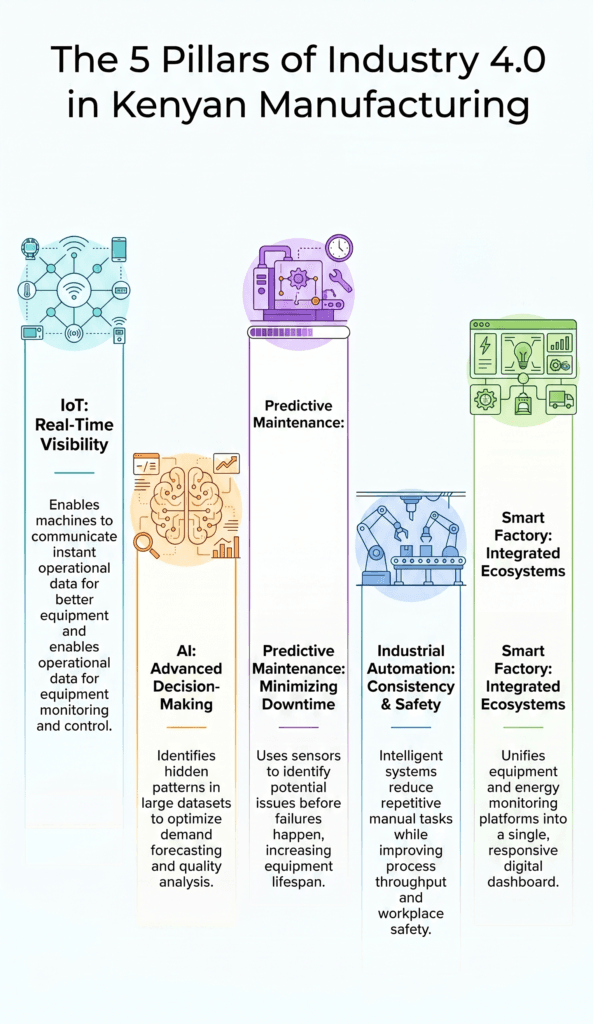
The Technologies Driving Industry 4.0
Industry 4.0 manufacturing is powered by a combination of technologies that work together to create connected, intelligent manufacturing environments.
While every manufacturer’s journey is different, several technologies are consistently driving transformation across the sector.
AI
Artificial Intelligence is becoming an increasingly important tool for manufacturers seeking to improve decision-making and operational efficiency.
AI systems can analyze large volumes of manufacturing data and identify patterns that may not be immediately visible to human operators.
Common applications of AI in Kenyan manufacturing include:
- Demand forecasting
- Production optimization
- Quality analysis
- Process improvement
- Intelligent decision support
As manufacturing environments generate more operational data, AI can help organizations convert that information into actionable insights.
Industrial Automation
Industrial automation has long been a driver of manufacturing efficiency, but modern automation systems are becoming more intelligent and connected than ever before.
Automation technologies help manufacturers in Kenya:
- Improve process consistency
- Reduce repetitive manual tasks
- Increase throughput
- Enhance workplace safety
- Improve quality control
Many industrial automation projects in Kenya are now integrated with analytics and monitoring systems, creating more responsive and efficient production environments.
Predictive Maintenance
Equipment downtime remains one of the most significant challenges facing manufacturers.
Traditional maintenance approaches are often reactive, meaning equipment is repaired only after a failure occurs.
Predictive maintenance takes a different approach.
Using sensor data, machine monitoring, and analytics, manufacturers can identify potential equipment issues before failures happen.
Benefits of predictive maintenance initiatives in Kenya include:
- Reduced downtime
- Improved asset reliability
- Lower maintenance costs
- Better production planning
- Increased equipment lifespan
For many manufacturers, predictive maintenance delivers some of the fastest and most measurable returns from Industry 4.0 manufacturing investments.
Smart Factory Solutions
A smart factory uses connected technologies to monitor, analyze, and optimize manufacturing operations continuously.
Rather than operating through isolated systems, smart factories integrate equipment, software, analytics, and business processes into a connected ecosystem.
Common smart factory applications in Kenya include:
- Real-time production monitoring
- Connected manufacturing equipment
- Digital performance dashboards
- Automated reporting systems
- Energy monitoring platforms
- Integrated analytics solutions
These capabilities help manufacturers improve visibility and respond more quickly to operational challenges.
The Rise of Data-Driven Industry 4.0 Manufacturing
One of the most significant shifts occurring within manufacturing is the move toward data-driven decision-making.
Previously, many operational decisions relied on historical reports, manual observations, or assumptions.
Today, connected technologies enable manufacturers to access real-time operational information.
A modern data-driven manufacturing strategy for Kenya allows organizations to:
- Monitor production performance continuously
- Track key performance indicators
- Identify bottlenecks quickly
- Improve forecasting accuracy
- Optimize inventory management
- Support continuous improvement initiatives
Organizations that effectively leverage operational data are often better positioned to respond to market changes and improve overall performance.
Why Technology Alone Is Not Enough
While Industry 4.0 manufacturing technologies offer significant potential, technology implementation alone does not guarantee success.
Many digital transformation initiatives struggle because organizations focus on solutions before understanding their operational priorities and readiness for change.
Common challenges include:
- Unclear business objectives
- Limited digital maturity
- Poor data quality
- Workforce skill gaps
- Disconnected systems
- Lack of implementation planning
Without a clear strategy, even the most advanced technologies can fail to deliver meaningful business outcomes.
Successful transformation requires manufacturers to evaluate their current capabilities, identify improvement opportunities, and prioritize initiatives that align with business goals.
The Importance of Smart Manufacturing Readiness
Before investing in new technologies, manufacturers should understand their readiness for transformation.
This typically involves evaluating:
Operational Processes
Successful Smart Manufacturing initiatives require standardized and well-documented processes that support consistency, efficiency, and continuous improvement.
Technology Infrastructure
Existing systems and infrastructure should be capable of supporting current operations while providing a foundation for future digital initiatives.
Data Availability
Reliable, accurate, and accessible operational data is essential for effective decision-making, performance monitoring, and automation.
Workforce Readiness
Organizations need employees with the necessary digital skills, along with strong change management capabilities, to support transformation efforts.
Leadership Alignment
Digital transformation initiatives are most successful when they are aligned with broader business objectives and supported by leadership across the organization.
Assessing these factors helps manufacturers fmake more informed decisions about future technology investments.
Faber Infinite Insight
Many manufacturers begin their Industry 4.0 manufacturing journey by exploring technologies such as AI, automation, and predictive maintenance. While these technologies can create substantial value, successful transformation often depends on understanding operational priorities before selecting solutions.
Organizations that evaluate readiness, identify high-impact opportunities, and develop a structured roadmap are typically better positioned to achieve measurable outcomes from their Smart Manufacturing investments.
Building an Industry 4.0 Manufacturing Digital Transformation Roadmap
Industry 4.0 manufacturing adoption does not need to happen all at once.
Many successful organizations follow a phased approach:
Assess Current Capabilities
Understand existing processes, systems, and operational challenges.
Identify Priority Opportunities
Focus on areas where technology can deliver measurable business value.
Develop a Roadmap
Create a structured implementation plan aligned with business objectives.
Pilot and Validate
Test initiatives on a smaller scale before broader deployment.
Scale Successful Solutions
Expand proven technologies across operations while continuously measuring results.
This approach helps reduce risk and supports more sustainable transformation outcomes.
The Future of Smart Manufacturing in Kenya
Smart Manufacturing is expected to play an increasingly important role in Kenya’s industrial development.
As technologies become more accessible, manufacturers will continue exploring opportunities to improve efficiency, visibility, quality, and competitiveness through Industry 4.0 manufacturing initiatives.
Technologies such as AI, industrial automation, predictive maintenance, and smart factory solutions will continue to shape the future of manufacturing operations.
However, organizations that combine these technologies with clear strategy, readiness assessments, and practical implementation roadmaps will be best positioned to realize long-term value.
As Kenya’s manufacturing sector continues to evolve, Smart Manufacturing will remain a key driver of industrial competitiveness and long-term growth.
FAQs
What is Smart Manufacturing?
Smart Manufacturing uses connected technologies such as AI, automation, and analytics to improve manufacturing efficiency, visibility, and decision-making.
How is AI used in manufacturing?
AI is used for applications such as demand forecasting, quality analysis, predictive maintenance, production optimization, and operational decision support.
What are smart factory solutions?
Smart factory solutions integrate connected technologies, analytics, automation, and monitoring systems to improve manufacturing performance and operational visibility.
How can manufacturers prepare for Industry 4.0 manufacturing?
Manufacturers can prepare by assessing operational readiness, evaluating digital maturity, identifying priority opportunities, and developing a structured transformation roadmap before implementing new technologies.
Contact us