
Every organization has process gaps. Some are easy to spot, such as missed deadlines, recurring customer complaints, or rising operating costs. Others are less visible, quietly reducing productivity, creating quality issues, and slowing business growth.
Across Kenya’s manufacturing, healthcare, logistics, financial services, telecommunications, and public sectors, process inefficiencies often emerge as organizations grow, adopt new technologies, or expand into new markets. While growth creates new opportunities, it can also introduce operational complexity, duplicated work, communication breakdowns, and inconsistent processes.
This is where a Lean Six Sigma consultant can make a significant difference.
By applying structured problem-solving techniques, process analysis, and data-driven decision-making, Lean Six Sigma consultants help organizations identify process gaps, eliminate inefficiencies, and build systems that support long-term Operational Excellence.
As a result, many businesses partner with Lean Six Sigma consultants in Kenya to improve efficiency, strengthen quality management, and create sustainable performance improvements.
What Are Process Gaps?
A process gap is the difference between a process’s current performance and the performance required to achieve business objectives.
These gaps often appear in the form of:
- Missed deadlines
- Customer complaints
- High operating costs
- Excessive manual work
- Recurring quality issues
- Slow approvals
- Poor communication between departments
- Frequent rework and corrections
While these symptoms are usually easy to recognize, the underlying causes are often hidden within day-to-day operations.
For example, delayed customer service responses may be caused by fragmented workflows rather than staffing shortages. Similarly, rising operational costs may stem from inefficient processes that have gradually developed over time.
Identifying the root cause, and not just the symptom, is what drives meaningful improvement.
Why Process Gaps Persist in Growing Organizations in Kenya
Many process challenges do not appear overnight. They develop gradually as organizations evolve.
A workflow that worked effectively for a team of 20 employees may become inefficient when the organization expands to several hundred employees across multiple departments or locations.
Common causes of process gaps include:
- Legacy workflows that were never updated
- Siloed departments with limited collaboration
- Inconsistent procedures across teams
- Manual reporting and tracking systems
- Poor visibility into performance metrics
- Lack of process ownership
- Limited accountability structures
These challenges are particularly common among organizations undergoing expansion, digital transformation, or operational restructuring.
Without a structured approach to process improvement, inefficiencies often become embedded in daily operations and continue generating hidden costs.
How a Lean Six Sigma Consultant Identifies Process Gaps
One of the biggest misconceptions about process improvement is that solutions should come first.
Experienced consultants begin with diagnosis.
Before recommending changes, a Lean Six Sigma consultant works to understand how processes actually operate in practice rather than how they appear in policies or procedure manuals.
Process Discovery and Assessment
The first step is gaining a clear understanding of current operations.
This often involves:
- Stakeholder interviews
- Process mapping workshops
- Workflow observations
- Performance reviews
- Data collection and analysis
By documenting how work flows through the organization, consultants can identify bottlenecks, delays, duplication, and other sources of inefficiency.
This assessment provides the foundation for effective process improvement.
Root Cause Analysis
Many organizations attempt to solve symptoms rather than the underlying problem.
For example:
- Customer complaints may be caused by process variation
- Project delays may result from approval bottlenecks
- Quality issues may stem from unclear procedures
- Low productivity may be linked to inefficient workflows
Using tools such as Root Cause Analysis, the Five Whys, and Fishbone Diagrams, consultants identify the factors that drive poor performance.
This approach helps organizations avoid short-term fixes that fail to deliver lasting results.
Data-Driven Validation
Assumptions can lead organizations in the wrong direction.
A common finding during improvement projects is that the perceived problem is not always the actual problem.
Through data-driven process improvement consulting, consultants validate findings using measurable performance indicators rather than opinions or assumptions. This ensures resources are focused on initiatives that generate the greatest business impact.
The Role of a Lean Six Sigma Consultant in Kenyan Industries
The role of a Lean Six Sigma consultant in Kenyan industries extends beyond identifying process problems.
Consultants help organizations improve performance by combining analytical expertise with practical implementation support.
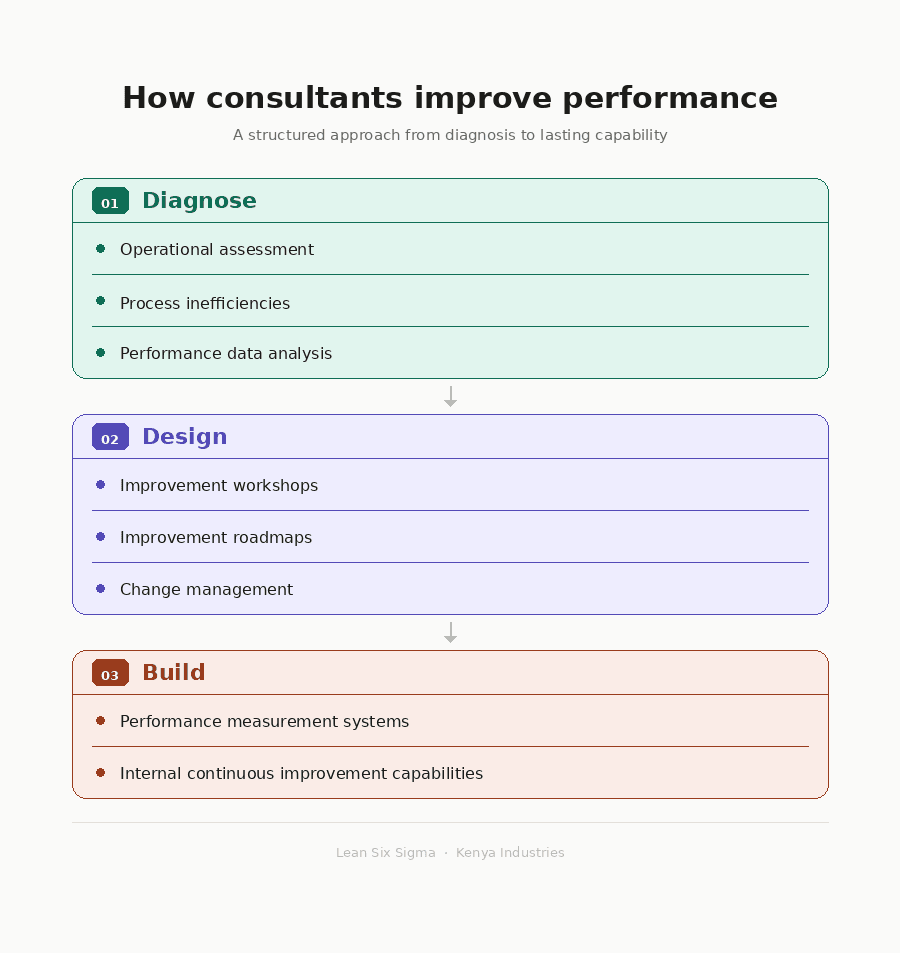
Typical responsibilities of consultants include:
- Conducting operational assessments
- Identifying process inefficiencies
- Analyzing performance data
- Facilitating improvement workshops
- Designing improvement roadmaps
- Supporting change management initiatives
- Establishing performance measurement systems
- Building internal continuous improvement capabilities
Many organizations work with Kenya Lean Six Sigma process experts because they provide an objective perspective and proven methodologies that reduce implementation risks.
Common Process Gaps Lean Six Sigma Helps Solve
While every organization is different, several operational challenges appear consistently across industries.
Inefficient Workflows
Many business processes contain unnecessary approvals, duplicated activities, and administrative delays.
Through Lean Six Sigma process optimization in Kenya, organizations can streamline workflows, eliminate non-value-added activities, and improve process efficiency.
Tools such as Value Stream Mapping (VSM) help visualize how work flows through a process and reveal opportunities for improvement.
Quality and Consistency Issues
Quality problems can increase costs, damage customer relationships, and reduce operational performance.
Organizations implementing Lean Six Sigma quality management for Kenya focus on reducing process variation and strengthening quality controls. This leads to more consistent outcomes, fewer defects, and improved customer satisfaction.
Excessive Waste
Waste exists in almost every business process. Common examples include:
- Waiting time
- Excess inventory
- Overprocessing
- Unnecessary movement
- Rework
- Inefficient handoffs
- Underutilized employee skills
Through waste reduction consulting using Six Sigma, organizations can systematically identify and eliminate activities that consume resources without creating value.
Lack of Standardization
When teams perform the same tasks differently, performance becomes difficult to measure and improve.
Standardized processes help create consistency, improve accountability, and support business scalability. This is particularly important for organizations experiencing rapid growth or expansion across multiple locations.
How Lean Six Sigma Consulting Services Improve Operations in Kenya
Organizations often ask how Lean Six Sigma consulting services improve operations in Kenya.
The answer lies in the methodology’s ability to address process issues at their source rather than treating symptoms.
Improvement initiatives typically focus on:
- Reducing process variation
- Eliminating waste
- Improving productivity
- Strengthening quality controls
- Enhancing resource utilization
- Accelerating cycle times
- Improving customer experiences
Rather than delivering isolated improvements, Lean Six Sigma creates systems that support ongoing Operational Excellence.
This is why many businesses invest in Lean Six Sigma consulting services in Kenya as part of broader transformation and performance improvement programs.
When Should a Business Engage a Lean Six Sigma Consultant?
Many organizations wait until operational issues become severe before seeking support. However, improvement initiatives are often most effective when challenges are addressed early.
Common warning signs include:
- Rising operating costs
- Recurring customer complaints
- Missed performance targets
- Declining productivity
- Excessive manual work
- Employee frustration
- Delayed projects
- Inconsistent quality performance
When multiple issues occur simultaneously, they often indicate deeper process challenges that require structured analysis.
Experienced providers of Lean Six Sigma consultant services in Kenya help organizations prioritize opportunities and focus resources on improvements that deliver measurable results.
Building a Culture of Continuous Improvement
Identifying and solving process gaps is only part of the journey.
Sustaining improvements is equally important.
Without the right systems and accountability structures, organizations can gradually return to old habits and performance levels.
A strong continuous improvement framework that Kenyan firms can implement typically includes:
- Process ownership
- Performance dashboards
- Standard operating procedures (SOPs)
- Employee involvement
- Ongoing problem-solving practices
- Leadership accountability
When continuous improvement becomes part of organizational culture, businesses are better positioned to adapt, innovate, and remain competitive.
Lean Six Sigma and Long-Term Business Growth
As organizations expand, operational complexity naturally increases.
New products, services, technologies, and locations create additional opportunities for inefficiency if processes are not designed to scale effectively. This is one reason many businesses, especially Kenyan enterprises pursuing sustainable growth, invest in Lean Six Sigma consulting services.
By improving efficiency, strengthening quality management systems, and developing internal improvement capabilities, organizations can create scalable operations that support future expansion.
Many companies in Kenya also leverage Lean Six Sigma improvement consulting to align operational improvements with strategic business objectives.
Ultimately, Lean Six Sigma consulting for long term growth in Kenya is about more than solving today’s challenges. It helps organizations build the agility, resilience, and operational discipline needed to succeed in increasingly competitive markets.
Conclusion
Process gaps are often among the largest hidden barriers to business performance. Left unresolved, they can increase costs, reduce productivity, create quality issues, and limit growth opportunities.
Lean Six Sigma provides a structured framework for identifying these gaps, understanding their root causes, and implementing sustainable solutions.
By combining process analysis, data-driven decision-making, and continuous improvement principles, organizations can transform inefficient workflows into reliable, high-performing systems.
Whether the objective is cost reduction, operational efficiency, quality improvement, or business transformation, partnering with experienced Lean Six Sigma consultants in Kenya can help organizations achieve measurable and lasting results.
Frequently Asked Questions
What is the role of a Lean Six Sigma consultant in Kenya’s industries?
A Lean Six Sigma consultant helps organizations identify process inefficiencies, analyze root causes, implement improvement initiatives, and establish systems that support long-term Operational Excellence.
How do Lean Six Sigma consulting services improve operations in Kenya?
Lean Six Sigma consulting services improve operations by reducing waste, streamlining workflows, improving quality, and supporting data-driven decision-making that leads to measurable business results.
Are Lean Six Sigma consulting services suitable for growing organizations?
Yes. Lean Six Sigma helps growing organizations create scalable processes, improve productivity, maintain quality standards, and reduce operational costs during expansion.
How effective is Lean Six Sigma for reducing defects?
Lean Six Sigma is highly effective because it focuses on identifying and eliminating the root causes of defects rather than simply addressing symptoms.
Why is Lean Six Sigma important for long-term growth?
Lean Six Sigma helps organizations build efficient, scalable processes while fostering a culture of continuous improvement that supports sustainable growth and competitive advantage.
Contact us