
In today’s competitive business environment, quality is no longer just a competitive advantage; it is an expectation.
Customers expect consistent service, reliable products, and fast response times. Organizations are required to continuously improve quality while managing costs and maintaining operational efficiency.
As businesses grow, maintaining quality often becomes more challenging. Increased demand, complex workflows, inconsistent processes, and limited visibility into performance can create defects, delays, and customer dissatisfaction.
This is where Lean Six Sigma provides significant value.
By combining waste reduction with data-driven process improvement, Lean Six Sigma helps organizations identify the root causes of quality issues, reduce process variation, and create more reliable operations.
As a result, many organizations engage Lean Six Sigma consultants in Kenya to strengthen quality management systems, improve operational performance, and support long-term business growth.
Why Quality Challenges Persist in Organizations
Quality problems rarely originate from a single issue. In most cases, they are the result of multiple process weaknesses that develop gradually over time. Common quality challenges include:
- Product or service defects
- Inconsistent customer experiences
- High levels of rework
- Delayed service delivery
- Poor process standardization
- Communication breakdowns between teams
- Limited performance visibility
- Inconsistent operating procedures
Organizations are often aware of these symptoms but struggle to identify the underlying causes.
For example, recurring manufacturing defects may be caused by inconsistent process execution rather than equipment failures. Customer complaints may stem from unclear workflows or poor handoffs between departments rather than employee performance.
Without a structured approach to process analysis, these issues often continue to affect quality, productivity, and profitability.
How Lean Six Sigma Improves Quality
Lean Six Sigma is designed to improve process performance by reducing variation, eliminating waste, and creating greater consistency.
The methodology combines two complementary approaches:
Lean focuses on improving workflow efficiency and eliminating activities that do not create value.
Six Sigma focuses on reducing variation and defects through measurement, analysis, and structured problem-solving.
Together, these methodologies help organizations move from reactive quality management to proactive process improvement.
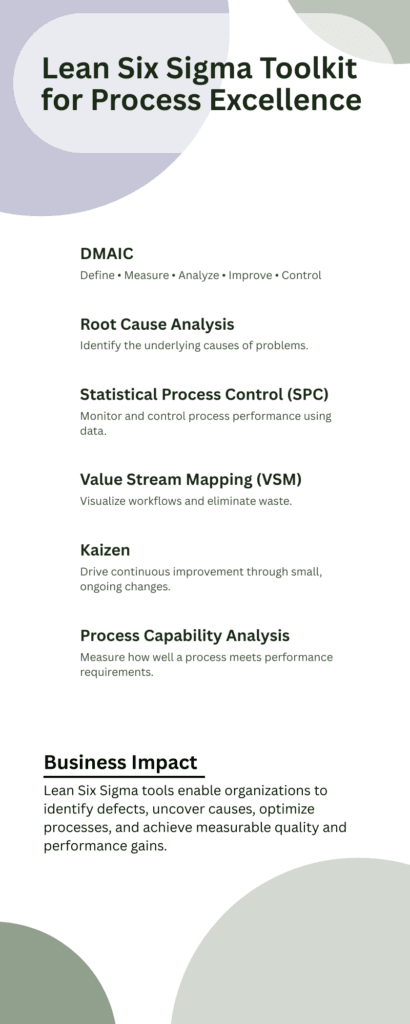
Common Lean Six Sigma tools include:
- DMAIC (Define, Measure, Analyze, Improve, Control)
- Root Cause Analysis
- Statistical Process Control (SPC)
- Value Stream Mapping
- Kaizen continuous improvement practices
- Process Capability Analysis
These tools help organizations identify quality issues, understand why they occur, and implement solutions that deliver measurable improvements.
The Link Between Process Quality and Business Performance
Quality affects far more than customer satisfaction.
When quality problems occur, organizations often experience:
- Increased operating costs
- Higher rework rates
- Lost productivity
- Customer complaints
- Delayed delivery times
- Compliance risks
- Reduced profitability
Improving quality therefore has a direct impact on operational performance. Organizations that successfully improve process quality often benefit from:
- Lower defect rates
- More consistent service delivery
- Improved customer loyalty
- Reduced operational costs
- Better resource utilization
- Stronger business performance
This is why Lean Six Sigma quality management continues to gain attention across both private and public sector organizations in Kenya.
How Lean Six Sigma Consultants Improve Quality Performance
In Kenya’s industrial sector, the role of a Lean Six Sigma consultant is to help organizations identify, analyze, and eliminate the factors that negatively affect quality.
Rather than focusing on isolated problems, consultants examine entire processes to uncover opportunities for improvement.
Process Assessment and Diagnosis
Improvement begins with understanding how processes currently operate.
Consultants typically conduct:
- Process mapping workshops
- Workflow assessments
- Quality audits
- Stakeholder interviews
- Operational observations
- Performance reviews
This helps identify bottlenecks, inconsistencies, and sources of variation that may be affecting quality outcomes.
Data-Driven Analysis
One of the strengths of Lean Six Sigma is its reliance on measurable evidence.
Through data driven process improvement consulting, organizations gain a clearer understanding of process performance and quality trends. This allows improvement efforts to focus on verified issues rather than assumptions.
Root Cause Identification
Many organizations spend considerable time addressing symptoms without solving the underlying problem.
Lean Six Sigma uses tools such as:
- Five Whys Analysis
- Fishbone (Ishikawa) Diagrams
- Pareto Analysis
- Cause-and-Effect Analysis
These techniques help identify the root causes of recurring quality issues so that corrective actions can produce lasting results.
Solution Design and Implementation
Once root causes are identified, consultants help implement practical improvements that strengthen process performance and reduce variation.
Many organizations in Kenya engage Lean Six Sigma process experts to accelerate implementation and ensure best-practice methodologies are applied effectively.
The Relationship Between Waste Reduction and Quality
Quality issues and operational waste are often closely connected. Every defect, delay, or inconsistency typically creates additional work, costs, and complexity.
Common forms of waste include:
- Rework caused by defects
- Waiting time between process steps
- Excess approvals
- Overprocessing
- Duplicate activities
- Inventory inefficiencies
- Unnecessary movement
Through waste reduction consulting using Six Sigma, organizations can eliminate activities that negatively affect both quality and operational performance.
Reducing waste not only lowers costs but also improves process reliability and customer satisfaction.
How Lean Six Sigma Consulting Services Improve Operations in Kenya
Organizations frequently ask how Lean Six Sigma consulting services improve operations in Kenya. The answer lies in the methodology’s ability to improve both efficiency and quality simultaneously.
Through Lean Six Sigma consulting services, organizations in Kenya can:
- Reduce process variation
- Improve consistency
- Lower defect rates
- Strengthen quality controls
- Accelerate cycle times
- Improve customer experiences
- Increase operational visibility
These improvements help organizations achieve measurable performance gains while building stronger operational foundations.
Building a Culture of Continuous Quality Improvement
Quality improvement should not be treated as a one-time initiative.
The most successful organizations create systems that continuously identify opportunities for improvement and address emerging challenges.
A strong continuous improvement framework that Kenyan firms can implement often includes:
- Performance dashboards
- Clearly defined KPIs
- Standard operating procedures (SOPs)
- Structured problem-solving methods
- Employee engagement programs
- Leadership accountability
When continuous improvement becomes part of organizational culture, quality improvements are more likely to be sustained over the long term.
Lean Six Sigma and Long-Term Quality Excellence
Organizations that consistently deliver high-quality products and services rarely rely on inspections alone. Instead, they build systems that prevent problems before they occur.
This is where Lean Six Sigma improvement consulting creates long-term value for Kenya’s industrial sector.
By strengthening processes, improving visibility, and developing internal improvement capabilities, organizations become better equipped to maintain quality as they grow.
Many Kenyan enterprises also invest in Lean Six Sigma consulting services to ensure that quality management supports broader operational and strategic objectives.
Ultimately, Lean Six Sigma consulting for long term growth helps organizations create scalable, reliable, and customer-focused operations that can adapt to changing market demands of Kenya’s industrial sector.
Conclusion
Quality is one of the most important drivers of business performance, customer satisfaction, and long-term competitiveness.
Lean Six Sigma provides a proven framework for improving quality by reducing variation, eliminating waste, and strengthening process performance.
By combining data-driven analysis with structured problem-solving methodologies, organizations can reduce defects, improve consistency, and create more reliable operations.
Whether the goal is improving customer experience, reducing operational costs, enhancing compliance, or supporting business growth, Lean Six Sigma helps organizations build the systems and capabilities needed for sustainable quality excellence.
For businesses seeking measurable and lasting improvements, partnering with experienced Lean Six Sigma consultants in Kenya can provide the expertise and structure required to achieve meaningful results.
Frequently Asked Questions
How do Lean Six Sigma consulting services improve operations in Kenya?
Lean Six Sigma consulting services improve operations by reducing process variation, eliminating waste, improving quality controls, and supporting data-driven decision-making that enhances overall business performance.
What is the role of a Lean Six Sigma consultant in Kenya’s industrial sector?
A Lean Six Sigma consultant helps organizations identify quality issues, analyze root causes, implement improvement initiatives, and establish sustainable Operational Excellence practices.
Are Lean Six Sigma consulting services suitable for quality improvement?
Yes. Lean Six Sigma is widely used to improve quality because it focuses on reducing defects, increasing consistency, and creating processes that deliver reliable outcomes.
How effective is Lean Six Sigma for reducing defects?
Lean Six Sigma is highly effective because it uses structured methodologies such as DMAIC, Root Cause Analysis, and Statistical Process Control to identify and eliminate the causes of defects.
Why is Lean Six Sigma important for long-term growth?
Lean Six Sigma helps organizations build efficient, scalable, and high-quality processes that support sustainable growth, operational resilience, and continuous improvement.
Contact us