
Daily Work Management consultants help manufacturers design, implement, and sustain structured daily management systems that improve operational visibility, accountability, and performance.
Implementing Daily Work Management requires more than introducing new routines or performance metrics. It often involves changes to leadership practices, operational processes, and organizational culture.
For many manufacturers, external consulting support helps accelerate implementation by providing structured methodologies, objective assessments, and practical guidance tailored to operational needs.
This guide explains the role of Daily Work Management consultants in Egypt, when manufacturers typically engage them, and what to consider when selecting a consulting partner.
Key Takeaways
- DWM consultants help manufacturers implement structured daily management systems.
- Consulting support can reduce implementation risks and improve adoption.
- Effective engagements focus on leadership, processes, and operational routines.
- Experience in manufacturing transformation is an important evaluation criterion.
- The right consulting approach should be tailored to each organization’s needs.
When Do Manufacturers Typically Engage a Daily Work Management Consultant?
Organizations usually seek consulting support when they want to improve operational performance but require additional expertise to design or implement a structured Daily Work Management system.
Common situations include:
- Launching Operational Excellence initiatives
- Preparing for Lean Manufacturing implementation
- Addressing recurring productivity or quality issues
- Standardizing management practices across multiple production areas
- Supporting broader manufacturing transformation programs
Consultants can also help organizations establish a roadmap that aligns daily management practices with strategic business objectives.
What Does a Daily Work Management Consultant Do?
A Daily Work Management consultant works with leadership and operational teams to design, implement, and sustain structured daily management practices.
While the scope varies by organization, consulting engagements often include:
- Assessing current management practices
- Identifying operational improvement opportunities
- Designing Daily Work Management frameworks
- Supporting leadership capability development
- Facilitating implementation workshops
- Establishing performance review routines
- Monitoring implementation progress
The objective is not simply to introduce new processes, but to help organizations build management systems that can be sustained over time.
How Consultants Support Manufacturing Transformation
Daily Work Management is often implemented as part of broader manufacturing improvement initiatives rather than as a standalone project.
Consultants help connect daily management practices with wider operational goals such as:
- Productivity improvement
- Operational Excellence
- Lean Manufacturing
- Performance management
- Continuous improvement
By aligning these initiatives, organizations can create a more integrated approach to operational transformation.
Why Local Manufacturing Context Matters
Every manufacturing environment has unique operational characteristics. Production processes, workforce structures, product complexity, and management practices can vary significantly between organizations.
For manufacturers operating in Egypt’s industrial zones, these differences highlight the importance of adapting Daily Work Management practices to the realities of each operation rather than applying a standardized model.
An effective consulting engagement begins with understanding the organization’s current state before recommending changes or introducing new management routines.
How to Evaluate a Daily Work Management Consultant
Not every manufacturing consulting engagement delivers the same results. Before selecting a consulting partner, manufacturers should evaluate both industry expertise and the consultant’s approach to implementation.
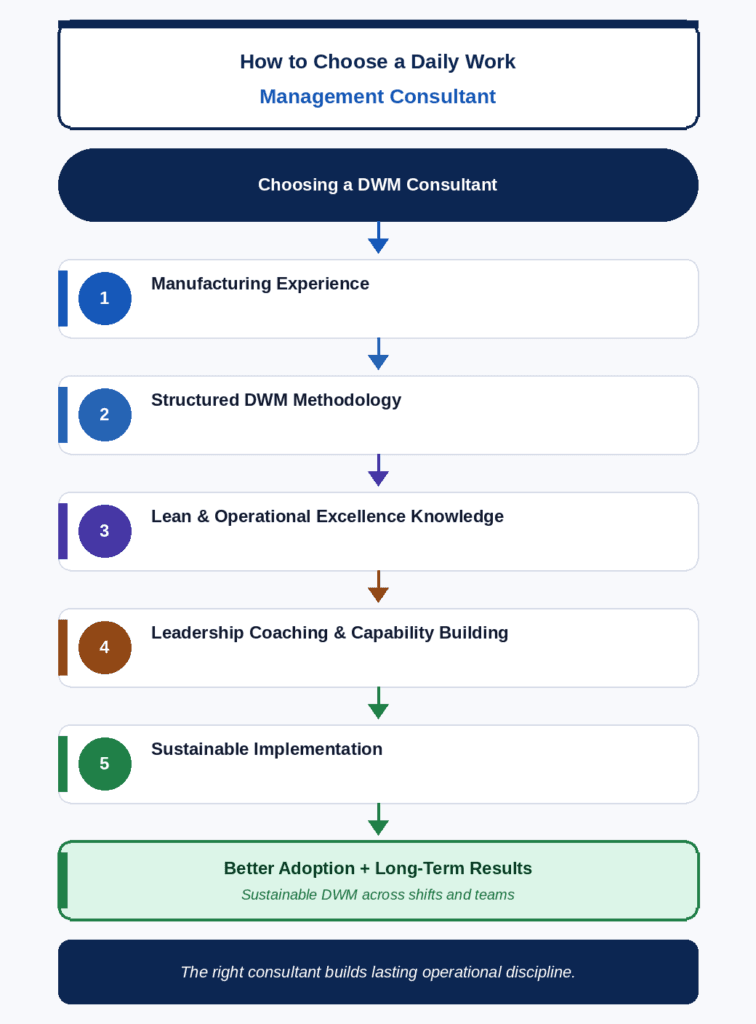
Look for a consulting partner that can demonstrate these 5 capabilities:
1. Manufacturing Experience
Understands production environments, shop floor challenges, and operational realities.
2. Proven DWM Methodology
Uses a structured approach instead of introducing isolated tools.
3. Lean Manufacturing Knowledge
Can connect daily management with continuous improvement.
4. Leadership Capability Building
Develops internal ownership instead of creating dependency.
5. Practical Implementation Approach
Adapts methods to your organization’s maturity and needs.
Rather than focusing only on technical expertise, consider whether the consultant can help your teams adopt new management routines that are sustainable over the long term.
Questions to Ask Before Engaging a Consultant
A consulting engagement should begin with a clear understanding of business objectives, operational challenges, and expected outcomes.
Consider asking questions such as:
| Question | Why It Matters |
| How do you assess our current daily management practices? | Understands the consultant’s diagnostic approach. |
| How will the implementation be adapted to our operations? | Ensures the solution fits your manufacturing environment. |
| What role will our leadership team play? | Leadership involvement is essential for long-term adoption. |
| How do you support knowledge transfer? | Helps internal teams sustain improvements after the engagement. |
| How will implementation progress be reviewed? | Establishes accountability and continuous improvement. |
These discussions help set realistic expectations and ensure both parties are aligned before implementation begins.
Common Challenges Consultants Help Address
Daily Work Management initiatives often encounter obstacles during implementation. An experienced consultant can help organizations anticipate these challenges and establish practical ways to address them.
Some of the most common challenges include:
- Inconsistent leadership participation
- Resistance to new daily management routines
- Too many operational Key Performance Indicators (KPIs) with limited focus
- Poor follow-up on corrective actions
- Difficulty sustaining improvements after initial implementation
Addressing these challenges early helps improve adoption and increases the likelihood that new management practices become part of everyday operations.
Daily Work Management Across Egypt’s Industrial Zones
Manufacturers across Egypt’s industrial zones operate in a wide range of industries, each with its own operational priorities and production requirements. While implementation details may differ, the underlying principles of Daily Work Management remain consistent.
A structured daily management system can support organizations by:
- Improving operational visibility
- Standardizing management routines
- Strengthening cross-functional communication
- Supporting continuous improvement initiatives
- Reinforcing accountability across production teams
The exact approach should always reflect the organization’s size, operational maturity, and business objectives rather than following a one-size-fits-all model.
Choosing the Right Long-Term Consulting Partner
Implementing Daily Work Management is not only about introducing new processes, it is also about developing management capabilities that can be sustained over time.
When evaluating consulting support, manufacturers should look beyond short-term implementation activities and consider whether the engagement will help strengthen internal capabilities.
An effective consulting partner should focus on enabling organizations to manage and continuously improve their own operations, rather than creating long-term dependence on external support.
Conclusion
Daily Work Management can help manufacturers strengthen operational consistency, improve communication, and support continuous improvement. However, successful implementation requires more than introducing new routines; it requires leadership alignment, structured execution, and sustained follow-through.
For organizations in Egypt exploring Daily Work Management, consulting support can provide an objective assessment, implementation guidance, and practical expertise tailored to manufacturing environments. The most effective engagements focus on building internal capabilities so that improvements continue long after the initial implementation phase.
Frequently Asked Questions
What does a Daily Work Management consultant do?
A Daily Work Management consultant helps manufacturers design, implement, and sustain structured daily management practices that improve operational visibility, accountability, and performance.
When should a manufacturer consider hiring a Daily Work Management consultant?
Organizations often seek consulting support when introducing Daily Work Management, improving operational performance, standardizing management practices, or supporting broader Lean and Operational Excellence initiatives.
How long does a Daily Work Management implementation take?
Implementation timelines vary depending on factors such as organizational size, operational maturity, and the scope of the initiative. Many organizations begin with a pilot area before expanding to other functions or production lines.
How do I choose the right Daily Work Management consultant?
Look for a consultant with manufacturing experience, a structured implementation methodology, expertise in Operational Excellence, and an approach that emphasizes leadership involvement and long-term capability building.
Contact us