Manufacturing excellence depends on more than efficient production processes. It requires reliable equipment, standardized maintenance practices, and a culture of continuous improvement. Total Productive Maintenance (TPM) Consultants help manufacturers in Egypt establish structured frameworks that strengthen equipment performance, improve operational consistency, and align maintenance activities with broader business objectives. By providing strategic guidance and implementation support, consultants enable organizations to build sustainable maintenance practices that contribute to long term manufacturing excellence.
Key Takeaways
- TPM consultants help manufacturers establish structured maintenance systems that support Operational Excellence.
- Successful TPM implementation combines process improvement, workforce engagement, and leadership commitment.
- Planned maintenance strategies contribute to improved equipment reliability and operational consistency.
- Overall Equipment Effectiveness (OEE) improves when maintenance activities align with business objectives.
- Manufacturing excellence is achieved through continuous improvement rather than isolated maintenance initiatives.
What Is the Role of TPM Consultants?
Total Productive Maintenance is a structured methodology that aims to maximize equipment effectiveness by integrating maintenance activities into everyday manufacturing operations. While the principles of TPM are well established, implementing them successfully requires careful planning, organizational alignment, and consistent execution.
This is where TPM consultants provide value. Rather than focusing solely on maintenance activities, consultants help manufacturers evaluate their existing maintenance practices, identify operational improvement opportunities, and develop practical implementation roadmaps.
For organizations beginning their TPM journey, consultants help translate established TPM principles into structured improvement initiatives that support sustainable operational performance.
Why Manufacturers Engage TPM Consultants
Manufacturers often recognize the need to improve equipment reliability or maintenance performance but may face challenges in determining where to begin.
TPM consultants help Egyptian manufacturing organizations develop a structured approach by assessing current maintenance maturity, identifying operational priorities, and aligning TPM initiatives with broader business goals.
Rather than introducing isolated process changes, consultants focus on building systems that support continuous improvement across manufacturing operations.
Key reasons manufacturers engage TPM consultants include:
- Establishing structured maintenance frameworks
- Improving collaboration between production and maintenance teams
- Developing planned maintenance strategies
- Strengthening equipment reliability
- Supporting continuous improvement initiatives
- Standardizing maintenance processes
How TPM Consultants Support Manufacturing Excellence
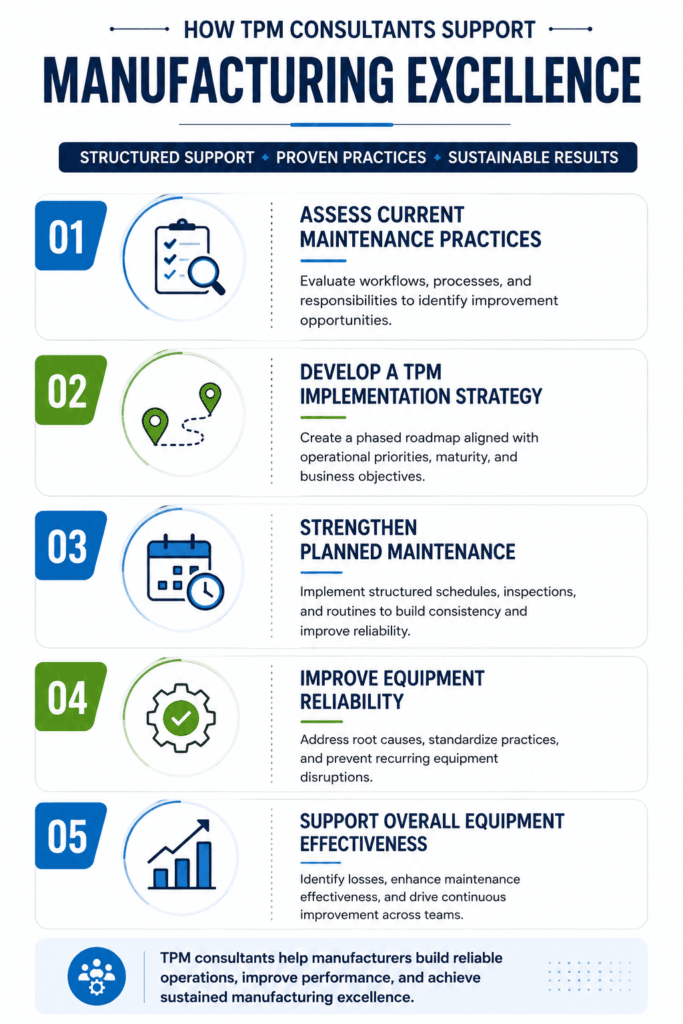
Assessing Current Maintenance Practices
Every successful TPM initiative begins with understanding the current operating environment.
Consultants review maintenance workflows, equipment management practices, operational procedures, maintenance planning, and organizational responsibilities to identify opportunities for improvement.
This assessment helps establish a realistic implementation roadmap based on existing operational capabilities rather than assumptions.
Developing a TPM Implementation Strategy
No two manufacturing organizations operate in exactly the same way.
TPM implementation consultants in Egypt develop phased implementation strategies that reflect each organization’s operational priorities, maintenance maturity, and business objectives.
A structured roadmap helps manufacturers introduce TPM practices progressively while minimizing disruption to ongoing operations.
Strengthening Planned Maintenance
One of the primary responsibilities of TPM consultants is supporting planned maintenance strategy implementation.
Rather than relying on reactive maintenance activities, organizations establish structured maintenance schedules, standardized inspections, routine equipment care, and clearly defined maintenance responsibilities.
This proactive approach improves maintenance consistency and supports long-term operational stability.
Improving Equipment Reliability
Reliable equipment forms the foundation of manufacturing excellence.
Through equipment reliability improvement consulting, TPM consultants evaluate recurring maintenance challenges, identify process improvements, and recommend structured maintenance practices that contribute to more dependable equipment performance.
The objective is not simply to resolve maintenance issues but to reduce the likelihood of recurring operational disruptions.
Supporting Overall Equipment Effectiveness
Overall Equipment Effectiveness improvement is one of the core objectives of TPM implementation.
Consultants help manufacturers identify operational losses, evaluate maintenance effectiveness, and establish continuous improvement initiatives that support better equipment utilization while maintaining production consistency.
Rather than treating equipment performance as a maintenance issue alone, TPM encourages shared responsibility across manufacturing functions.
Beyond Maintenance: Building a Culture of Continuous Improvement
A successful TPM program extends beyond maintenance schedules and equipment inspections.
Manufacturing excellence depends on creating an environment where continuous improvement becomes part of everyday operations.
TPM consultants help organizations establish governance structures, clarify roles and responsibilities, and encourage collaboration between production, maintenance, engineering, quality, and leadership teams.
This cross functional approach strengthens communication and supports consistent decision making throughout the organization.
By embedding TPM principles into daily activities, manufacturers create sustainable operational improvements rather than temporary maintenance initiatives.
Common Challenges During TPM Implementation
Although TPM offers significant operational benefits, implementation often requires organizational change.
Reactive Maintenance Practices
Many organizations begin with maintenance processes that focus primarily on responding to equipment issues after they occur.
Transitioning to planned maintenance requires changes in maintenance planning, scheduling, and operational discipline.
Inconsistent Maintenance Standards
Without standardized procedures, maintenance practices may vary between teams or production areas.
TPM consultants help establish consistent maintenance processes that improve reliability and operational consistency.
Limited Cross Functional Collaboration
Maintenance performance depends on cooperation between multiple departments.
Encouraging shared ownership of equipment performance helps improve communication and supports more effective decision making.
Organizational Change
TPM implementation requires leadership commitment, employee engagement, and continuous communication.
Consultants help organizations manage this transition by supporting change management initiatives that encourage long-term adoption.
Best Practices for Successful TPM Implementation in Egypt
Manufacturers seeking long-term success with TPM should focus on building a structured improvement framework rather than implementing isolated maintenance activities.
Best practices include:
Assess Maintenance Maturity
Understand current maintenance capabilities before defining improvement priorities.
Align TPM With Business Objectives
Ensure maintenance initiatives support broader operational and organizational goals.
Standardize Maintenance Processes
Develop consistent maintenance procedures, documentation, inspections, and review practices.
Encourage Cross Functional Participation
Involve production, maintenance, engineering, quality, and leadership teams throughout the implementation process.
Focus on Continuous Improvement
Regularly evaluate maintenance performance, gather operational feedback, and refine TPM practices to support ongoing improvement.
Why Strategic TPM Consulting Matters
Implementing TPM is not simply about introducing maintenance procedures. It requires organizations to establish structured frameworks that connect maintenance practices with broader operational goals.
Many manufacturers engage manufacturing TPM consulting specialists in Egypt to assess current maintenance maturity, develop implementation roadmaps, and guide organizational change throughout the TPM journey.
By combining structured planning, workforce engagement, and continuous improvement, TPM consultants help manufacturers create maintenance systems that support sustainable manufacturing excellence.
Conclusion
TPM consultants play an important role in helping manufacturers transform maintenance from a reactive function into a strategic contributor to Operational Excellence. Through structured assessments, planned maintenance strategies, equipment reliability improvement, and continuous improvement initiatives, consultants help organizations establish maintenance systems that support long-term business performance.
For manufacturers across Egypt, successful TPM implementation depends not only on adopting maintenance best practices but also on creating a culture where equipment reliability, collaboration, and continuous improvement become shared organizational priorities. By taking a structured and strategic approach, manufacturers can strengthen operational consistency and build a solid foundation for sustainable manufacturing excellence.
Frequently Asked Questions
What is Total Productive Maintenance consulting in Egypt?
Total Productive Maintenance consulting helps manufacturers assess maintenance practices, develop structured TPM implementation roadmaps, and improve equipment performance through planned maintenance and continuous improvement.
How do TPM consultants improve factory performance in Egypt?
TPM consultants evaluate maintenance processes, identify improvement opportunities, establish planned maintenance strategies, strengthen equipment reliability, and support organizational change that contributes to manufacturing excellence.
What do TPM implementation consultants do?
TPM implementation consultants help manufacturers assess maintenance maturity, develop implementation roadmaps, standardize maintenance practices, and guide organizations through the adoption of Total Productive Maintenance principles.
How does TPM consulting reduce operational losses?
TPM consulting reduces operational losses by improving maintenance planning, strengthening equipment reliability, standardizing maintenance processes, and supporting continuous improvement across manufacturing operations.
Why is continuous improvement important in TPM?
Continuous improvement helps manufacturers regularly evaluate maintenance performance, identify opportunities for optimization, and ensure TPM practices continue to support changing operational and business requirements.
Contact us