
Manufacturing and industrial organizations rely on consistent execution to achieve Operational Excellence. However, even well designed processes can lose effectiveness when daily activities lack structure, accountability, or clear communication. Daily Work Management (DWM) provides a practical framework for aligning teams, monitoring performance, and resolving issues before they become larger operational challenges. When supported by Lean principles, it helps organizations establish disciplined routines that improve collaboration, strengthen decision making, and create a culture of continuous improvement across daily operations.
Key Takeaways
- Daily Work Management creates structure and consistency in day-to-day operations.
- Lean principles help organizations identify and eliminate common management inefficiencies.
- Standardized daily routines improve communication, accountability, and operational performance.
- Visual management and regular performance reviews enable faster problem identification and resolution.
- Sustainable Operational Excellence depends on continuous improvement rather than isolated initiatives.
Why Daily Work Management Matters
Operational Excellence is built through the quality of daily execution rather than occasional improvement initiatives. Organizations that consistently monitor performance, review priorities, and address issues in real time are better positioned to improve efficiency and maintain operational stability.
Daily Work Management provides the structure needed to support this consistency. It establishes regular management routines that help teams monitor key activities, identify deviations, and respond to operational challenges before they affect broader business performance.
For organizations pursuing Operational Excellence in KSA, Daily Work Management strategies serve as a practical foundation for improving coordination, strengthening accountability, and embedding continuous improvement into everyday operations.
Common Mistakes in Daily Work Management
Lack of Standardized Daily Processes
One of the most common challenges is the absence of consistent daily management routines.
When different teams follow different approaches to planning, communication, and performance reviews, it becomes difficult to maintain operational consistency across the organization.
Implementing standardized Saudi DWM operations helps establish common expectations, improve coordination, and ensure that daily activities follow structured processes.
Focusing Only on Problems Instead of Prevention
Many organizations spend significant time responding to operational issues after they occur.
Without proactive daily reviews, recurring problems may continue without addressing their underlying causes.
Lean Daily Management encourages teams to identify trends, monitor performance, and resolve issues before they develop into larger operational challenges.
Ineffective Daily Meetings
Daily meetings should create alignment, not consume valuable time.
Meetings without clear objectives, relevant performance information, or defined follow up actions often fail to support effective decision making.
Well structured Daily Work Management meetings focus on reviewing priorities, discussing performance, identifying barriers, and assigning ownership for improvement actions.
Limited Performance Visibility
When operational performance is not reviewed consistently, teams may struggle to identify opportunities for improvement.
Daily performance boards, visual management tools, and standardized reporting help create transparency while supporting faster and more informed decisions.
These practices demonstrate many of the daily management system benefits associated with structured operational management.
Weak Accountability
Improvement initiatives often lose momentum when responsibilities are unclear.
Daily Work Management establishes clear ownership for operational activities, improvement actions, and performance reviews, creating greater accountability across teams.
Treating Continuous Improvement as a Separate Initiative
Continuous improvement should be integrated into daily operations rather than managed as an occasional project.
Organizations that embed improvement discussions into daily routines are better positioned to sustain Operational Excellence over time.
How Lean Principles Address These Challenges
Lean provides practical methods for improving how work is planned, monitored, and executed.
Standardization
Standardized work creates consistency by ensuring that routine management activities follow agreed procedures across the organization.
Visual Management
Visual performance boards enable teams to quickly review priorities, monitor progress, and identify operational issues requiring attention.
Structured Problem Solving
Rather than addressing symptoms, Lean encourages teams to investigate root causes and implement sustainable corrective actions.
Continuous Improvement
Regular review of daily performance creates opportunities to refine processes and strengthen operational discipline over time.
Employee Engagement
Lean Daily Work encourages participation from employees across all levels of the organization, strengthening ownership and supporting collaborative problem solving.
Best Practices for Effective Daily Work Management
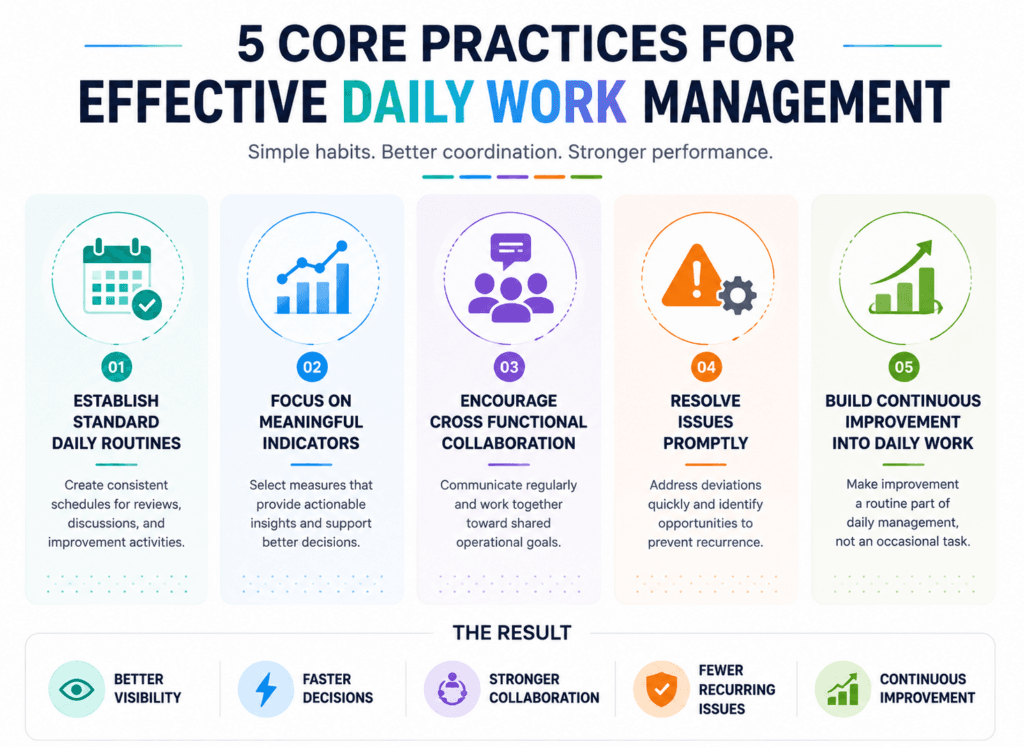
Establish Standard Daily Routines
Create consistent schedules for performance reviews, operational discussions, and improvement activities.
Focus on Meaningful Performance Indicators
Select measures that provide actionable insights and support informed decision making.
Encourage Cross Functional Collaboration
Daily management is most effective when departments communicate regularly and work toward shared operational objectives.
Resolve Issues Promptly
Address operational deviations quickly while identifying opportunities to prevent recurrence.
Build Continuous Improvement into Daily Activities
Improvement should become part of routine management rather than an occasional initiative.
This approach supports KSA’s continuous improvement context by creating sustainable operational habits that strengthen long-term performance.
Common Challenges During Implementation
Organizations introducing Daily Work Management may experience challenges such as:
Resistance to New Routines
Teams may require time to adapt to structured daily management practices.
Inconsistent Leadership Participation
Daily management depends on active leadership involvement and visible commitment.
Too Many Performance Measures
Tracking excessive indicators can reduce focus and make daily reviews less effective.
Limited Follow Through
Improvement actions should be monitored regularly to ensure agreed activities are completed and sustained.
Conclusion
Daily Work Management is more than a collection of meetings or performance reviews. It is a structured management approach that helps organizations strengthen operational discipline, improve communication, and support continuous improvement through consistent daily execution.
For organizations across Saudi Arabia, combining Daily Work Management with Lean principles creates a practical framework for improving operational performance, increasing accountability, and reducing inefficiencies. By establishing standardized routines, encouraging collaboration, and embedding continuous improvement into everyday work, organizations can build a stronger foundation for sustainable Operational Excellence.
Frequently Asked Questions
What is Daily Work Management?
Daily Work Management is a structured approach that uses standardized routines, performance reviews, visual management, and problem solving to improve operational performance and support continuous improvement.
How does Lean improve Daily Work Management?
Lean strengthens Daily Work Management by promoting standardization, visual management, structured problem solving, employee engagement, and continuous improvement across daily operations.
What are the benefits of Daily Work Management?
Daily Work Management improves communication, accountability, operational visibility, decision making, and collaboration while supporting consistent execution and continuous improvement.
How can organizations implement Daily Work Management successfully?
Successful implementation begins with standardized daily routines, meaningful performance indicators, leadership involvement, visual management, and regular follow up on improvement actions.
Why is Daily Work Management important for Operational Excellence in Saudi Arabia?
Daily Work Management helps organizations improve operational consistency, strengthen performance management, and embed continuous improvement into everyday operations, supporting broader Operational Excellence objectives across Saudi Arabia.
Contact us