Manufacturing productivity depends on how effectively an organization converts people, equipment, materials, information, and time into valuable output. To increase productivity in manufacturing, organizations need to look beyond production volume and examine the processes that determine how work is performed. For manufacturers in Saudi Arabia, productivity improvement can involve better process flow, workforce productivity, equipment reliability, quality improvement, waste reduction, and appropriate technology adoption. The strongest approach is usually systematic rather than dependent on a single initiative. By understanding current performance, identifying sources of loss, and building continuous improvement into daily operations, manufacturers can create more consistent and sustainable productivity gains.
Key Takeaways
- Manufacturing productivity improves when organizations address processes, people, equipment, quality, and resources together.
- Productivity improvement should begin with understanding the current production process and identifying sources of loss.
- Lean manufacturing, TPM, quality improvement, and workforce development can work together to strengthen manufacturing performance.
- Industry 4.0 technologies can support productivity when they are aligned with clearly defined operational needs.
- Sustainable productivity improvement requires measurement, standardization, employee involvement, and continuous improvement.
What Is Manufacturing Productivity?
Manufacturing productivity refers to how effectively a manufacturing organization uses its available resources to produce its intended output.
These resources can include:
- Workforce
- Equipment
- Materials
- Energy
- Time
- Production capacity
- Information
- Technology
Productivity is therefore not simply about producing more.
An organization may increase production volume while still experiencing poor productivity if it requires excessive overtime, generates high levels of rework, experiences frequent equipment interruptions, or consumes unnecessary resources.
A more useful question is:
How effectively is the manufacturing system converting available resources into the required output?
This perspective provides a stronger foundation for manufacturing productivity improvement.
Why Manufacturing Productivity Matters in Saudi Arabia
Manufacturing organizations operate within increasingly competitive and changing business environments.
Saudi Arabia’s broader economic transformation agenda places emphasis on economic diversification, industrial development, productivity, and the development of competitive capabilities.
At the organizational level, manufacturing productivity contributes to the ability to:
- Use production resources effectively
- Improve operational efficiency
- Maintain consistent quality
- Respond to demand
- Reduce avoidable losses
- Improve workforce utilization
- Strengthen cost competitiveness
- Support continuous improvement
For this reason, manufacturing productivity in Saudi Arabia should be viewed as a system-level performance objective rather than a single production metric.
How to Increase Productivity in Manufacturing
1. Understand the Current Production Process
The first step in productivity improvement is understanding how production actually works.
Organizations should examine the complete process from inputs through to finished output. This can reveal:
- Waiting
- Bottlenecks
- Unnecessary movement
- Rework
- Quality problems
- Equipment interruptions
- Excessive changeover activity
- Material flow problems
- Information delays
Process observation is particularly important because documented procedures do not always reflect actual operating conditions.
Understanding the current state creates a factual basis for improvement.
2. Identify Sources of Productivity Loss
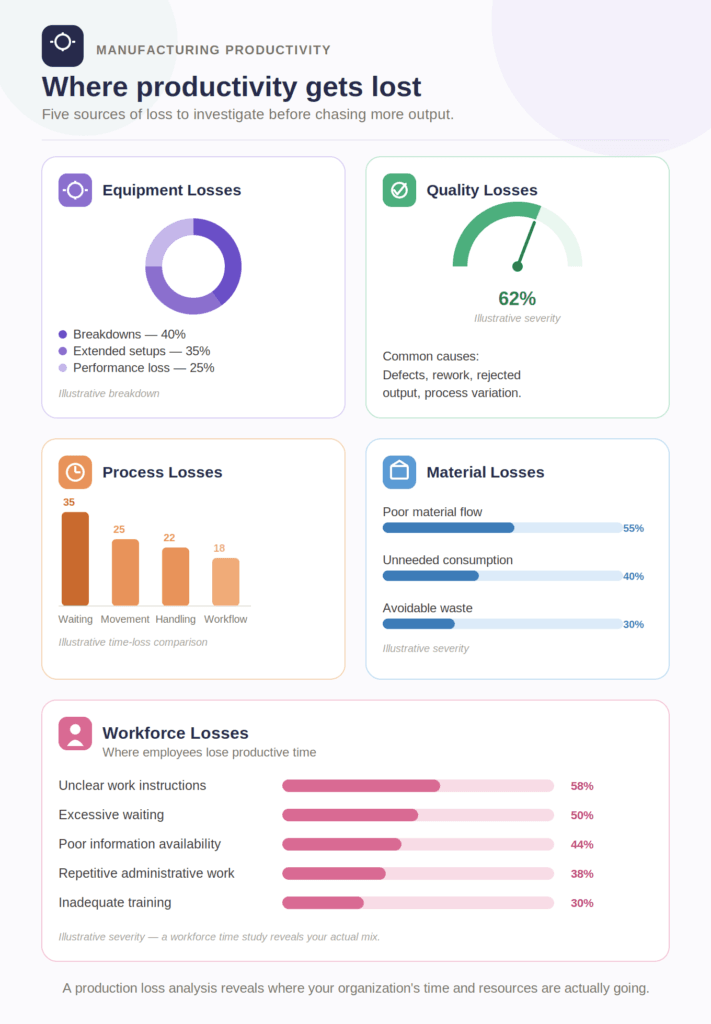
Manufacturing productivity can be affected by many different forms of loss. These may include:
Equipment Losses
Equipment interruptions, unreliable machinery, extended setup activities, and performance variation can reduce available production capacity.
Quality Losses
Defects, rework, rejected output, and process variation consume resources without creating additional value.
Process Losses
Unnecessary movement, waiting, excessive handling, and inefficient workflows can reduce productivity.
Material Losses
Poor material flow, unnecessary consumption, and avoidable waste can affect both productivity and cost.
Workforce Losses
Employees may lose productive time because of unclear processes, waiting, poor information flow, repetitive administrative tasks, or inadequate workplace organization.
The objective is to understand the causes rather than simply record the symptoms.
3. Improve Flow and Eliminate Waste
Production flow has a direct influence on productivity.
A process that appears efficient at individual workstations may still perform poorly overall if work accumulates between stages. This is why productivity improvement should consider the complete production flow rather than optimizing isolated activities.
Lean manufacturing provides a structured approach to identifying and reducing waste and improving flow. Useful Lean methods include:
Value Stream Mapping (VSM)
Value Stream Mapping provides a visual representation of how materials and information move through a process. It can help identify bottlenecks, delays, unnecessary activities, and opportunities for improving flow.
5S
5S supports workplace organization, visibility, discipline, and standardization.
Kaizen
Kaizen encourages employees to identify and implement incremental improvements.
Standardized Work
Standardized work creates a consistent baseline for important production activities.
5. Improve Equipment Reliability and OEE
Equipment performance can have a significant influence on manufacturing productivity. Whereas, Overall Equipment Effectiveness (OEE) provides a framework for evaluating equipment effectiveness through availability, performance, and quality.
When equipment is unavailable or operating below its expected performance level, production flow can be disrupted.
Organizations can strengthen equipment reliability through structured maintenance practices and appropriate performance monitoring. This involves understanding:
- Equipment failure patterns
- Maintenance requirements
- Recurring breakdown causes
- Preventive maintenance activities
- Maintenance response
- Equipment operating conditions
OEE can help organizations understand different categories of equipment-related loss.
6. Improve Workforce Productivity
Technology and equipment are important, but people remain central to manufacturing performance.
Workforce productivity depends partly on how effectively employees can perform their responsibilities. Organizations should examine whether employees experience:
- Unclear work instructions
- Excessive waiting
- Unnecessary movement
- Repetitive administrative work
- Poor information availability
- Unclear responsibilities
- Inadequate training
- Frequent process disruptions
Improving these conditions can help employees spend more time performing productive work.
7. Use Industry 4.0 to Support Productivity Improvement
Industry 4.0 initiatives can create opportunities to strengthen manufacturing productivity in Saudi Arabia through connected systems, automation, data analysis, and improved operational visibility.
Potential applications include:
- Automated data collection
- Production monitoring
- Equipment condition monitoring
- Process analytics
- Workflow automation
- Quality monitoring
- Performance dashboards
- Decision support
The objective should not be to introduce technology simply because it is available. Organizations should first identify a productivity problem and then determine whether Industry 4.0 technology can provide an effective solution.
A practical sequence is:
Identify the problem → Understand the process → Improve the process → Evaluate technology → Implement → Measure → Improve
This helps connect Industrial 4.0 technology adoption in KSA with genuine operational requirements.
The Role of Total Productive Maintenance
Total Productive Maintenance (TPM) provides a structured approach to improving equipment effectiveness through the involvement of people across the organization.
TPM focuses on developing a proactive approach to equipment care rather than relying entirely on reactive maintenance.
Relevant practices can include:
- Autonomous maintenance
- Planned maintenance
- Problem prevention
- Equipment condition awareness
- Operator involvement
- Maintenance performance monitoring
Organizations seeking to increase productivity in Saudi manufacturing through TPM can use these principles as part of a broader productivity improvement program.
Build a Manufacturing Productivity Improvement Strategy
A structured productivity strategy can bring multiple improvement areas together.
Step 1: Establish the Objective
Define what the organization wants to improve.
Possible objectives include:
- Production flow
- Productivity
- Quality
- Equipment reliability
- Resource utilization
- Manufacturing cost
- Responsiveness
Step 2: Assess the Current State
Observe production processes and collect relevant operational information.
Step 3: Identify Major Losses
Determine where productivity is being affected by waste, equipment issues, quality problems, process variation, or workforce constraints.
Step 4: Prioritize Opportunities
Not every problem should be addressed simultaneously.
Prioritize opportunities according to their business impact, feasibility, and relevance to strategic objectives.
Step 5: Select Improvement Methods
Depending on the problem, organizations may apply:
- Lean manufacturing
- TPM
- Standardized work
- Root cause problem solving
- Quality improvement
- Workforce development
- Industry 4.0 technologies
Step 6: Implement and Measure
Implement improvements and monitor appropriate performance indicators.
Step 7: Standardize Successful Improvements
Document successful practices and integrate them into normal operations.
Step 8: Continue Improving
Use performance results to identify the next improvement opportunity.
Manufacturing Productivity Improvement Strategies in Saudi Arabia
Manufacturers looking for manufacturing productivity improvement strategies in Saudi Arabia can consider a combination of the following:
Process Improvement
Identify and remove unnecessary steps, delays, and bottlenecks.
Lean Manufacturing
Reduce waste and improve process flow.
TPM
Strengthen equipment reliability and effectiveness.
Quality Improvement
Prevent defects and reduce rework.
Workforce Productivity
Improve skills, work methods, information flow, and employee involvement.
Standardization
Create consistent methods for important production activities.
Industry 4.0
Use appropriate technology to improve visibility, automation, analysis, and decision support.
The appropriate combination will depend on the organization’s current condition and improvement priorities.
Conclusion
To increase productivity in manufacturing in Saudi Arabia, organizations need to look at the complete manufacturing system rather than relying on a single productivity initiative.
Process flow, Lean manufacturing, equipment reliability, TPM, quality improvement, workforce productivity, standardization, and Industry 4.0 can all contribute to manufacturing performance when applied to clearly defined needs.
The strongest productivity programs begin by understanding the current state, identifying major sources of loss, prioritizing improvement opportunities, and involving the people who perform the work.
Technology can strengthen these efforts, but it should complement sound manufacturing processes rather than replace them.
Ultimately, sustainable manufacturing productivity improvement comes from creating better ways of working and establishing a management system that continuously identifies and addresses opportunities for improvement.
Frequently Asked Questions
How can manufacturers increase productivity in Saudi Arabia?
Manufacturers can increase productivity by improving process flow, reducing waste, strengthening equipment reliability, improving quality, developing workforce capability, standardizing work, and applying appropriate technologies.
What are the main manufacturing productivity improvement strategies?
Key strategies include Lean manufacturing, TPM, process improvement, standardized work, quality improvement, workforce productivity improvement, root cause problem solving, and appropriate Industry 4.0 technology adoption.
How can manufacturers increase productivity while reducing costs in KSA?
Manufacturers can improve productivity and reduce costs by addressing process waste, equipment losses, rework, inefficient resource utilization, and unnecessary activities rather than relying only on across-the-board cost reductions.
How can TPM increase productivity in Saudi manufacturing?
TPM can support productivity by improving equipment reliability, encouraging proactive maintenance, involving operators in equipment care, and reducing losses associated with equipment performance.
Can Industry 4.0 improve manufacturing productivity?
Yes. Industry 4.0 technologies can support productivity through automation, operational data collection, connected manufacturing systems, process monitoring, analytics, and decision support. The technology should be selected according to a clearly defined operational need.
Contact us