Industry 4.0 can help manufacturers improve productivity by connecting production processes with automation, operational data, analytics, and intelligent decision support. However, technology alone does not guarantee better performance. Organizations need to first understand where productivity losses occur and then determine which technologies can address those problems effectively. For manufacturers in Saudi Arabia, Industry 4.0 can support improvements in process visibility, equipment performance, quality, workforce productivity, and resource utilization. A practical approach combines process improvement with appropriate technology adoption, ensuring that digital initiatives solve real operational problems and contribute to measurable manufacturing performance.
Key Takeaways
- Industry 4.0 can improve manufacturing productivity through automation, data visibility, analytics, and better decision making.
- Technology should be selected according to specific operational problems rather than implemented simply because it is available.
- Industry 4.0 can complement Lean manufacturing, TPM, quality improvement, and workforce productivity initiatives.
- Connected manufacturing systems can provide better visibility into processes, equipment, quality, and resource utilization.
- Successful technology adoption requires process readiness, workforce capability, appropriate implementation, and continuous improvement.
What Is Industry 4.0 in Manufacturing?
Industry 4.0 refers to the development of more connected, automated, data-driven, and intelligent manufacturing environments.
It brings together technologies and systems that can improve how manufacturing operations are monitored, controlled, analyzed, and improved.
Depending on the organization’s requirements, Industry 4.0 can involve:
- Industrial automation
- Connected manufacturing systems
- Manufacturing data collection
- Advanced analytics
- Artificial intelligence
- Machine learning
- Industrial communication systems
- Cloud and edge computing
- Automated workflows
- Digital production monitoring
The specific technology combination depends on the manufacturing process and the problem being addressed.
The objective is not to adopt every available technology. The objective is to use technology to create better manufacturing performance.
Why Industry 4.0 Matters for Manufacturing Productivity
Manufacturing productivity depends on the effective use of people, equipment, materials, information, and time.
Traditional production environments can sometimes have limited visibility into what is happening across the manufacturing process. Information may be collected manually. Performance data may be available only after a delay. Equipment problems may be identified after production has already been affected. Quality information may not be connected effectively with production information.
Industry 4.0 can help address these challenges by improving the availability and use of operational information.
Better information can support faster identification of problems and more informed decisions.
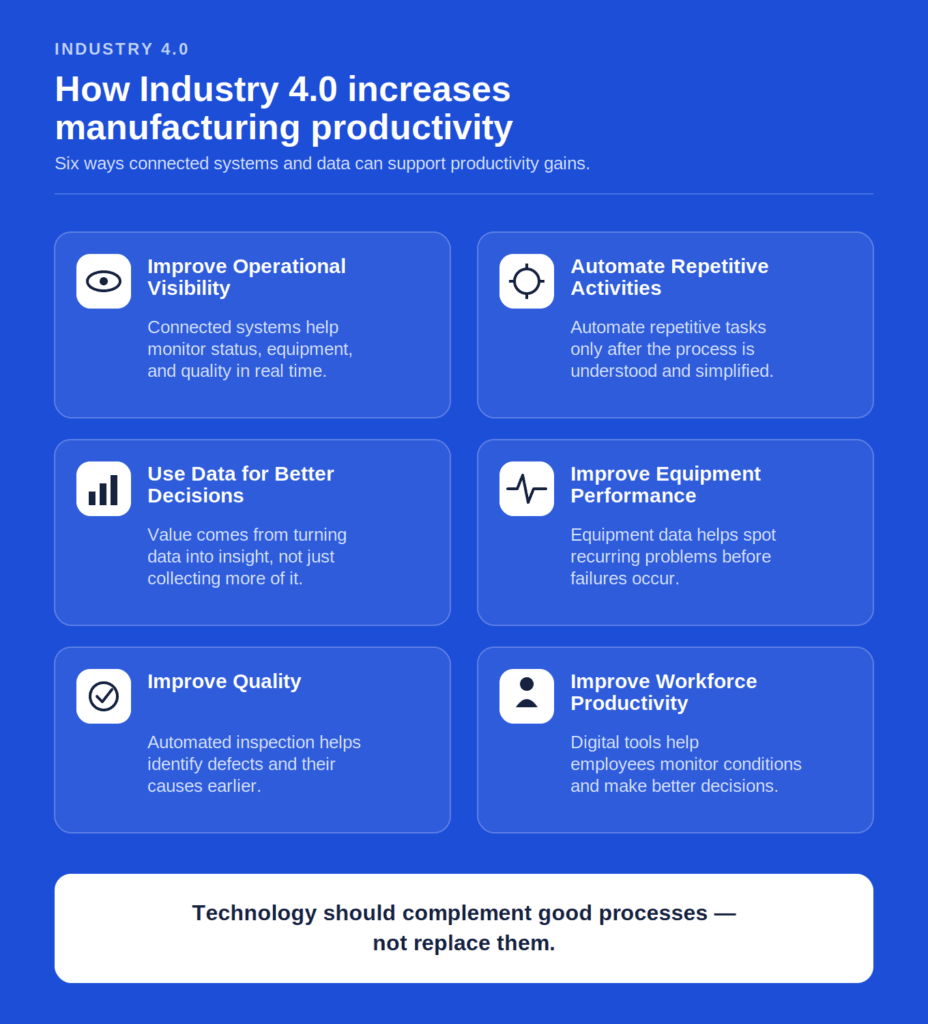
How Industry 4.0 Can Increase Manufacturing Productivity
1. Improve Operational Visibility
Manufacturers need visibility into what is happening across their production processes.
Connected systems can help organizations monitor relevant operational information more effectively.
Depending on the application, this may include:
- Production status
- Equipment condition
- Process performance
- Quality information
- Resource utilization
- Downtime
- Workflow status
Better visibility can help teams identify deviations and respond to problems more effectively.
This is particularly relevant to manufacturing efficiency initiatives in Saudi Arabia where organizations are looking to improve operational control and performance.
2. Automate Repetitive Activities
Automation can reduce the amount of manual effort required for appropriate manufacturing activities.
Potential applications include:
- Repetitive production tasks
- Material handling
- Data collection
- Inspection activities
- Reporting
- Workflow execution
However, automation should not be considered automatically beneficial.
A process should first be understood and improved.
If an inefficient process is automated without addressing its underlying problems, the organization may simply create a faster version of an inefficient process.
A stronger approach is:
Understand → Simplify → Standardize → Automate → Measure → Improve
3. Use Manufacturing Data for Better Decisions
Manufacturing generates information across many processes.
When this information is collected and analyzed effectively, it can help organizations understand performance patterns.
Data can support analysis of:
- Production performance
- Equipment behavior
- Quality trends
- Process variation
- Resource utilization
- Downtime
- Workflow performance
The value comes from turning information into actionable insight.
Simply collecting more data does not automatically improve productivity.
Organizations need to determine which information is relevant to the decisions they need to make.
4. Improve Equipment Performance
Equipment reliability is closely connected to manufacturing productivity.
Unexpected equipment interruptions can disrupt production flow and create additional maintenance and scheduling requirements.
Industry 4.0 technologies can support equipment monitoring by collecting relevant operating information and identifying changes in equipment behavior.
This can complement Total Productive Maintenance (TPM) practices.
For example, equipment data can help maintenance and operations teams better understand:
- Equipment operating conditions
- Recurring problems
- Performance changes
- Maintenance requirements
- Potential sources of equipment loss
Where appropriate, analytics can also help organizations identify patterns that may indicate developing equipment problems. This can support more informed maintenance planning.
However, organizations should assess whether sufficient data quality, equipment connectivity, analytical capability, and process maturity exist before implementing advanced maintenance applications.
5. Improve Quality
Quality improvement is an important part of manufacturing productivity.
Defects and rework consume time, materials, labor, and equipment capacity.
Industry 4.0 technologies can support quality improvement through:
- Automated inspection
- Process monitoring
- Data analysis
- Quality information integration
- Pattern identification
- Real-time or near real-time visibility
The objective is to identify problems earlier and understand their causes.
Technology can therefore complement established quality management and root cause problem solving practices.
6. Improve Workforce Productivity
Industry 4.0 does not eliminate the importance of people. Instead, technology can change how employees interact with manufacturing processes.
Employees may use digital systems to:
- Access production information
- Monitor process conditions
- Review performance
- Identify abnormalities
- Support problem solving
- Make operational decisions
The effectiveness of these systems depends partly on workforce capability.
Employees need appropriate training and clear understanding of how technology supports their responsibilities.
Technology adoption should therefore include people and process considerations, not only technical implementation.
Industry 4.0 and Lean Manufacturing
Industry 4.0 and Lean manufacturing can complement each other.
Lean helps organizations understand and improve processes.
Industry 4.0 can provide technologies that strengthen visibility, automation, data analysis, and process control.
A practical relationship can be described as:
Lean identifies improvement opportunities.
Industry 4.0 can provide technology to support selected improvements.
This prevents technology from becoming the starting point.
For example, an organization may first identify a recurring production visibility problem through process analysis. It can then evaluate whether connected monitoring or automated data collection would address that specific problem.
This approach is more effective than implementing technology without a defined operational purpose.
Industry 4.0 and Total Productive Maintenance
TPM focuses on improving equipment effectiveness through proactive maintenance, operator involvement, and continuous improvement.
Industry 4.0 technologies can complement these practices by improving access to equipment information.
Potential applications include:
- Equipment monitoring
- Condition data
- Maintenance information
- Performance analysis
- Automated alerts
- Maintenance planning support
The technology should strengthen the maintenance process rather than operate as a separate initiative.
This is especially important when organizations are seeking to increase productivity in Saudi manufacturing through TPM while also developing digital capabilities.
Industry 4.0 Technology Adoption in KSA
Organizations considering Industrial 4.0 technology adoption in KSA should begin with business and operational requirements.
A useful assessment can examine:
Process Readiness
Are the relevant processes understood and sufficiently stable?
Data Availability
Is the required information available at an appropriate level of quality?
System Integration
Can relevant systems exchange information effectively?
Workforce Capability
Do employees have the skills required to use and manage the technology?
Infrastructure
Does the organization have the necessary technical infrastructure?
Business Value
Can the technology address a clearly defined operational problem?
Scalability
Can the solution be expanded if it proves successful?
This assessment can help organizations avoid technology investments that are disconnected from operational needs.
Connected Manufacturing Systems Strategy
A connected manufacturing systems strategy should begin with the flow of information required to manage production effectively.
Organizations can examine:
- Where information originates
- Who needs the information
- When it is required
- How it is currently collected
- How it is transferred
- Where information gaps exist
- Which decisions depend on that information
This helps identify where connected systems can create value.
The objective should be useful connectivity rather than connectivity for its own sake.
Industrial Automation and Data Integration
Automation can improve productivity when it reduces unnecessary manual effort, improves consistency, or enables more effective process control.
Data integration can further improve efficiency by connecting information from relevant systems.
Together, automation and data integration can support:
- Better process visibility
- Reduced manual data entry
- Faster information flow
- Improved monitoring
- More consistent workflows
- Better decision support
However, integration should be planned carefully. Adding more systems does not necessarily create better information. The goal should be reliable information that supports specific operational decisions.
How to Implement Industry 4.0 for Manufacturing Productivity
Step 1: Define the Productivity Problem
Start with the operational challenge.
Examples can include:
- Limited production visibility
- Equipment interruptions
- Manual data collection
- Quality variation
- Repetitive activities
- Slow decision making
Step 2: Understand the Current Process
Map the relevant process and identify where the problem occurs.
Step 3: Determine the Root Cause
Technology should address an actual cause rather than simply treating a symptom.
Step 4: Evaluate Technology Options
Consider whether automation, connected systems, analytics, AI, or another technology is appropriate.
Step 5: Assess Readiness
Evaluate infrastructure, data, workforce capability, system integration, and process maturity.
Step 6: Start With a Defined Use Case
A focused implementation can make it easier to evaluate whether the technology creates meaningful value.
Step 7: Measure Performance
Compare performance against the original productivity objective.
Step 8: Standardize and Scale
If the solution produces the intended outcome, integrate it into normal operations and consider whether it can be expanded.
How to Measure Industry 4.0 Productivity Improvement
Technology adoption should produce measurable operational outcomes.
Depending on the application, organizations may monitor:
- Production output
- Cycle time
- Equipment availability
- Downtime
- Quality
- Rework
- Resource utilization
- Manual effort
- Process response time
The correct measures depend on the original problem.
For example, if the objective is reducing manual data collection, measuring production output alone may not demonstrate the full impact.
Technology performance should therefore be connected directly to the business case.
Common Industry 4.0 Adoption Mistakes
Adopting Technology Without a Defined Problem
Technology should solve a business or operational challenge.
Automating Inefficient Processes
Processes should be understood and simplified before automation.
Ignoring Data Quality
Poor data can undermine analytics and decision making.
Underestimating Workforce Requirements
Employees need appropriate skills, training, and support.
Creating Isolated Technology Systems
Disconnected systems can create additional information silos.
Measuring Technology Rather Than Business Outcomes
The number of systems implemented does not demonstrate productivity improvement.
The focus should remain on operational results.
Creating a Manufacturing Industry 4.0 Roadmap
A structured roadmap can help organizations connect technology adoption with productivity objectives.
Phase 1: Assess
Understand processes, performance, technology, data, and workforce capabilities.
Phase 2: Prioritize
Identify the productivity problems with the strongest potential improvement opportunities.
Phase 3: Select
Evaluate technology options according to operational requirements.
Phase 4: Implement
Deploy the selected solution with appropriate process and workforce support.
Phase 5: Measure
Evaluate the operational results against defined objectives.
Phase 6: Standardize
Integrate successful practices into normal operations.
Phase 7: Scale
Expand appropriate solutions where the results justify further adoption.
Conclusion
Industry 4.0 can provide manufacturers with new ways to increase productivity in manufacturing through automation, connected systems, data analysis, improved operational visibility, and intelligent decision support.
However, successful technology adoption begins with operational understanding.
Manufacturers should first identify where productivity is being lost, understand the underlying process, and then determine whether Industry 4.0 technology can address the problem effectively.
Lean manufacturing, TPM, quality improvement, workforce development, and Industry 4.0 should not be viewed as competing approaches. They can complement one another when connected to clearly defined productivity objectives.
For manufacturers in Saudi Arabia, the most effective path toward Industry 4.0 adoption is therefore not simply to acquire more technology. It is to build the processes, people, data, and management capabilities required to turn technology into measurable operational improvement.
Frequently Asked Questions
How can Industry 4.0 increase manufacturing productivity?
Industry 4.0 can increase productivity through automation, connected manufacturing systems, operational data, analytics, equipment monitoring, quality applications, and improved decision support.
What is Industrial 4.0 technology adoption in KSA?
Industrial 4.0 technology adoption in KSA refers to the adoption of connected, automated, data-driven, and intelligent manufacturing technologies to improve operational performance. The more established term is Industry 4.0.
Can Industry 4.0 reduce manufacturing costs?
Industry 4.0 can contribute to cost reduction by reducing manual effort, improving equipment performance, reducing process losses, improving quality, and strengthening resource utilization. Results depend on the specific application and implementation.
How does Industry 4.0 work with Lean manufacturing?
Lean manufacturing helps identify waste and process improvement opportunities, while Industry 4.0 can provide technologies that support selected improvements through automation, data visibility, analytics, and connected systems.