Lean manufacturing can help organizations in Saudi Arabia improve operational performance by reducing waste, strengthening process flow, improving quality, and creating a culture of continuous improvement. Its value extends beyond individual production processes. Lean can influence how organizations manage people, materials, information, equipment, and workflows.
For businesses pursuing Operational Excellence, Lean manufacturing provides a structured way to identify inefficiencies and address their root causes. When Lean principles are combined with appropriate technology and disciplined management systems, they can support sustainable productivity improvement across Saudi Arabia’s broader industrial environment.
Key Takeaways
- Lean manufacturing focuses on improving value flow while reducing unnecessary activities and waste.
- Lean transformation requires more than implementing individual tools.
- Standardized work, visual management, root cause analysis, and continuous improvement form important foundations.
- Lean can complement digital transformation and smart manufacturing when processes are improved before they are digitized.
- Sustainable Lean implementation depends on leadership commitment, workforce involvement, measurement, and consistent follow-through.
What Is Lean Manufacturing?
Lean manufacturing is an approach to improving processes by identifying and reducing activities that consume resources without creating corresponding value.
The concept is closely associated with the Toyota Production System and has since been adopted and adapted across many types of organizations.
Lean principles generally emphasize:
- Identifying customer value
- Understanding value streams
- Improving flow
- Establishing pull where appropriate
- Pursuing continuous improvement
Lean is not simply a collection of tools. It is a way of understanding how work is performed and how processes can continuously improve.
For organizations in Saudi Arabia, this distinction matters because sustainable transformation requires changes in processes, management practices, and employee behavior rather than isolated Lean initiatives.
Why Lean Manufacturing Matters for Saudi Arabia
Organizations operating in a competitive environment need to make effective use of available resources.
Operational inefficiencies can appear in many forms:
- Excessive movement
- Waiting
- Rework
- Unnecessary processing
- Excess inventory
- Process interruptions
- Poor information flow
- Unbalanced workloads
- Inconsistent work methods
These issues can influence productivity, cost, quality, lead time, and customer responsiveness.
Lean manufacturing initiatives can provide a structured approach to identifying these problems and improving the processes responsible for them.
The objective is not simply to work faster. The objective is to create better processes.
The Seven Common Forms of Lean Waste
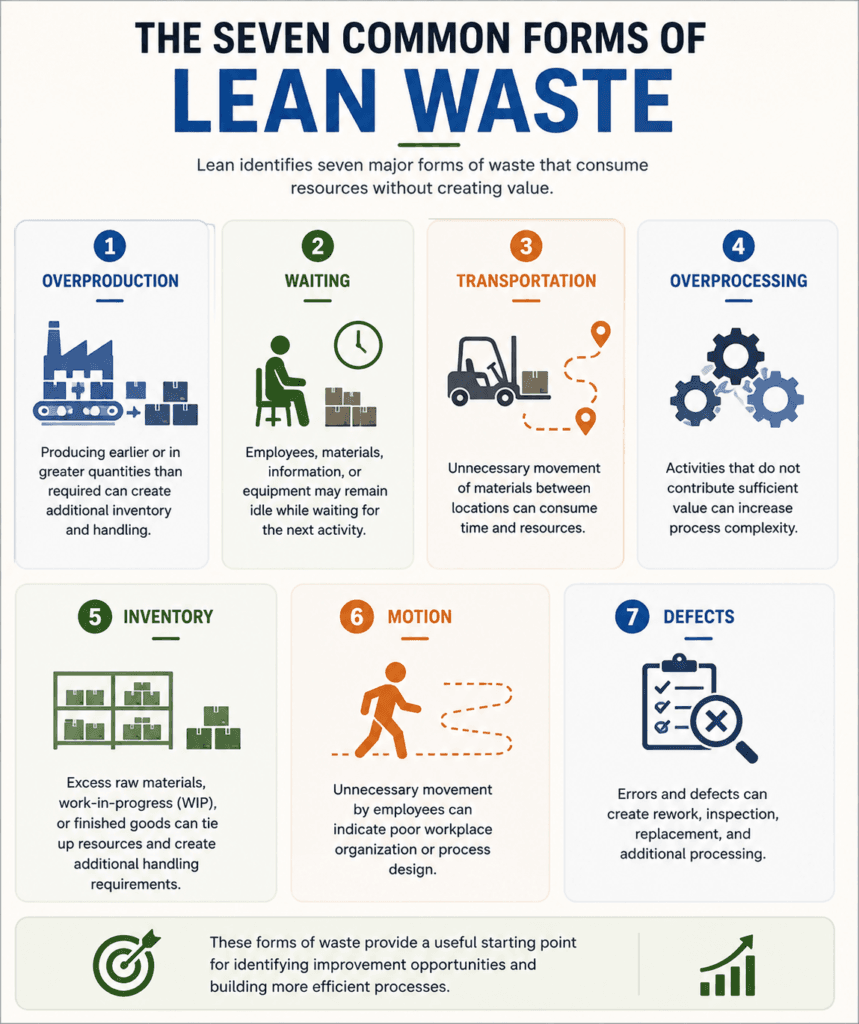
Lean traditionally identifies seven major forms of waste.
Overproduction
Producing earlier or in greater quantities than required can create additional inventory and handling.
Waiting
Employees, materials, information, or equipment may remain idle while waiting for the next activity.
Transportation
Unnecessary movement of materials between locations can consume time and resources.
Overprocessing
Activities that do not contribute sufficient value can increase process complexity.
Inventory
Excess raw materials, work-in-progress (WIP), or finished goods can tie up resources and create additional handling requirements.
Motion
Unnecessary movement by employees can indicate poor workplace organization or process design.
Defects
Errors and defects can create rework, inspection, replacement, and additional processing.
These forms of waste provide a useful starting point for process improvement.
How Lean Manufacturing Can Transform Operations in Saudi Arabia
Lean transformation can affect several dimensions of organizational performance.
1. Improving Process Flow
Poor flow can create waiting, queues, work in progress, and unnecessary movement.
Lean teams can map the movement of materials and information to understand where delays occur.
Value Stream Mapping (VSM) can help visualize the current state and identify opportunities to improve flow.
The objective is to reduce interruptions and create a more connected process.
2. Improving Productivity
Productivity is influenced by how effectively resources are converted into useful outputs.
Lean can support productivity improvement by addressing activities that consume time without creating value.
Examples include:
- Excess movement
- Waiting
- Rework
- Searching
- Repeated handling
- Unnecessary approvals
- Poorly organized workflows
The focus should be on improving the process rather than simply asking employees to increase their pace.
3. Improving Quality
Quality problems can create significant operational waste.
A defect may require:
- Rework
- Additional inspection
- Replacement
- Reprocessing
- Investigation
- Additional material
Lean organizations seek to identify why defects occur rather than repeatedly correcting them.
Root cause analysis can help teams distinguish symptoms from underlying causes.
4. Reducing Unnecessary Costs
Lean can contribute to cost improvement by reducing waste.
Potential areas include:
- Material consumption
- Rework
- Inventory
- Energy use
- Unnecessary movement
- Waiting
- Process delays
Cost improvement should come from improving the process rather than simply reducing resources without understanding the operational consequences.
5. Improving Workforce Productivity
Lean transformation should involve the people performing the work.
Employees often understand operational problems that are not immediately visible through reports or performance dashboards.
They may know:
- Where delays occur
- Which processes create repeated problems
- Where materials are difficult to access
- Which procedures create unnecessary work
- Which problems occur repeatedly
A Lean culture gives employees structured ways to identify and solve these problems.
Lean Management and Operational Excellence
Lean management and Operational Excellence are closely connected.
Lean provides methods for identifying waste and improving processes.
Operational Excellence provides a broader management perspective focused on consistent and sustainable performance.
Organizations pursuing Lean management Saudi Arabia initiatives can therefore connect Lean activities with:
- Performance management
- Process improvement
- Quality
- Workforce development
- Equipment reliability
- Continuous improvement
- Standardization
This prevents Lean from becoming an isolated improvement program.
Lean and Digital Transformation
Lean and digital transformation do not need to be competing approaches. In fact, they can complement one another.
A Lean approach can first identify what should be improved.
Digital technology can then help improve visibility, automate appropriate activities, or strengthen decision making.
Potential applications include:
- Production monitoring
- Data collection
- Performance dashboards
- Automated workflows
- Process analytics
- Connected systems
The sequence matters.
Digitizing an inefficient process does not automatically make the process efficient.
A useful principle is:
Improve the process first, then digitize where technology adds value.
This creates a practical foundation for Lean plus Industry 4.0 strategies for KSA industries.
How to Measure Lean Success in Saudi Organizations
Organizations need clear measures to determine whether Lean initiatives are producing meaningful improvement.
Potential measures include:
- Process lead time
- First-pass quality
- Defect levels
- Inventory
- Equipment performance
- Productivity
- Process cycle time
- On-time delivery
- Rework
- Workplace safety indicators
The right measures depend on the improvement objective.
For example, a project focused on material flow should not be evaluated only through financial measures.
A balanced measurement system should connect operational improvements with broader organizational objectives.
The Role of Leadership in Lean Transformation
Leadership is one of the most important factors in sustaining Lean.
Management needs to demonstrate that continuous improvement is part of normal organizational activity.
This can include:
- Regular performance reviews
- Problem-solving discussions
- Support for improvement activities
- Clear responsibilities
- Visible follow-up
- Investment in workforce capability
If management treats Lean as a temporary project, employees may also treat it as temporary.
Sustained transformation requires consistent leadership behavior.
The Role of Standardized Work
Standardization is sometimes misunderstood as restricting improvement.
In Lean, the opposite is generally true.
A standard provides a baseline.
Without a consistent method, it can be difficult to determine whether a change actually improved performance.
Standardized work can help establish:
- Defined process steps
- Expected sequence
- Required conditions
- Quality requirements
- Responsibilities
Once the process is standardized, teams can identify opportunities for improvement more reliably.
Overcoming Lean Challenges KSA Organizations May Face
Lean transformation can encounter several challenges.
Resistance to Change
Employees may be uncertain about new methods or responsibilities.
The response should involve communication, participation, training, and visible management support.
Tool-First Implementation
Organizations sometimes implement Lean tools without understanding the problem they are intended to solve.
A better approach is to identify the operational problem first.
Limited Management Follow-Through
Improvement activities can lose momentum if leadership does not consistently review progress.
Poor Measurement
Without reliable measures, organizations may struggle to determine whether improvement activities are working.
Lack of Standardization
Improvements may disappear when new practices are not documented and reinforced.
Treating Lean as a Cost-Cutting Program
Lean is fundamentally about improving value and reducing waste.
If employees associate Lean only with cost reduction, engagement can suffer.
How to Overcome Barriers to Lean Adoption in KSA
A practical Lean implementation approach can include several stages.
Stage 1: Assess
Understand current processes and performance.
Stage 2: Prioritize
Select improvement opportunities based on operational importance.
Stage 3: Engage
Involve employees and relevant stakeholders.
Stage 4: Improve
Apply appropriate Lean principles and tools.
Stage 5: Standardize
Document and reinforce successful practices.
Stage 6: Measure
Track the results using relevant operational indicators.
Stage 7: Sustain
Build continuous improvement into regular management practices.
This approach makes Lean part of the operating system rather than a standalone initiative.
The Role of Lean Consultants in Saudi Arabia
Organizations may have internal Lean capabilities or may seek external expertise for specific transformation requirements.
Lean consultants Saudi Arabia can support organizations with structured approaches to:
- Lean assessments
- Process improvement
- Value Stream Mapping
- Waste reduction
- Standardized work
- Performance improvement
- Continuous improvement
- Lean transformation
Lean consulting services for KSA should be based on the organization’s actual operational challenges rather than the assumption that every organization requires the same Lean tools.
A capable Lean management consultant should help connect improvement methods with measurable operational objectives.
What Makes Lean Transformation Sustainable?
Sustainable Lean transformation requires more than successful improvement projects.
Organizations need supporting systems.
These can include:
- Leadership routines
- Standardized work
- Visual management
- Employee involvement
- Performance measurement
- Problem-solving processes
- Continuous improvement routines
The objective is to create an organization that can continue identifying and solving problems without depending entirely on isolated improvement events.
Conclusion
Lean manufacturing can provide Saudi organizations with a structured approach to improving productivity, quality, flow, and operational performance.
Its greatest value does not come from implementing a checklist of Lean tools. It comes from changing how organizations identify problems, understand processes, involve employees, and pursue continuous improvement.
Lean manufacturing initiatives can address waste in material flow, information flow, workforce activities, equipment performance, and process design.
Lean can also complement smart manufacturing and digital transformation.
For organizations considering Lean manufacturing consultants or Lean consulting services in KSA, the focus should remain on practical improvement, measurable outcomes, workforce involvement, and sustainable management practices.
Lean transformation is ultimately an organizational capability. When Lean principles become part of everyday management and problem solving, continuous improvement can become a normal way of working rather than a temporary initiative.
Frequently Asked Questions
What is Lean manufacturing in Saudi Arabia?
Lean manufacturing is a systematic approach to improving processes by increasing value, reducing waste, improving flow, and supporting continuous improvement. In Saudi Arabia, organizations can adapt Lean principles to their specific operational requirements and improvement priorities.
What Lean techniques can Saudi organizations use?
Common Lean techniques include 5S, Value Stream Mapping, standardized work, visual management, Kaizen, root cause analysis, and Total Productive Maintenance (TPM). The appropriate technique depends on the problem being addressed.
How can organizations measure Lean success in Saudi Arabia?
Organizations can measure Lean success using indicators such as process lead time, productivity, quality, inventory, rework, equipment performance, cycle time, and delivery performance. Measures should be connected to the specific improvement objective.
How can organizations overcome Lean adoption challenges in KSA?
Organizations can overcome Lean adoption challenges through leadership commitment, workforce involvement, practical training, clear performance measures, standardized processes, structured problem solving, and consistent follow-through.
What role do Lean consultants play in Saudi organizations?
Lean consultants can provide structured expertise in areas such as process improvement, waste reduction, Value Stream Mapping, Lean assessments, standardized work, and continuous improvement. Their role should be aligned with the organization’s specific operational challenges and objectives.