
Lean manufacturing provides organizations with a structured way to identify waste, improve processes, strengthen flow, and support continuous improvement. However, Lean success does not come from using every available tool. The right technique depends on the problem an organization is trying to solve.
For organizations in Saudi Arabia, Lean tools can support improvements in workplace organization, process flow, quality, equipment reliability, productivity, and problem solving. The most effective approach is to select tools based on operational needs, establish clear standards, involve employees, and measure whether the changes actually improve performance.
Key Takeaways
- Lean tools should be selected according to specific operational problems.
- 5S, Value Stream Mapping (VSM), standardized work, and visual management provide important foundations.
- Root cause analysis and Kaizen help organizations solve problems and sustain continuous improvement.
- Total Predictive Maintenance (TPM), Kanban, and Just-in-Time (JIT) can strengthen equipment reliability and material flow when conditions support them.
- Lean tools work best when supported by leadership, workforce involvement, measurement, and standardization.
What Are Lean Tools and Techniques?
Lean tools are practical methods used to identify waste, improve processes, solve problems, and establish more consistent ways of working.
They support the broader principles of Lean management, including:
- Customer value
- Flow
- Pull
- Waste reduction
- Standardization
- Continuous improvement
A tool is not an objective by itself.
For example, implementing 5S does not automatically create Operational Excellence. Likewise, creating a Kanban system does not automatically establish an effective pull process.
The tool needs to address a real operational problem.
Why Lean Tools Matter for Saudi Organizations
Organizations operating in Saudi Arabia can face a wide range of operational challenges.
These may include:
- Process delays
- Excess movement
- Unnecessary inventory
- Quality problems
- Equipment interruptions
- Poor workplace organization
- Long process lead times
- Inconsistent work methods
- Weak performance visibility
Lean tools provide structured methods for understanding and addressing these issues.
The important question is not:
Which Lean tool should we implement?
It is:
Which operational problem are we trying to solve?
That distinction can prevent organizations from implementing Lean techniques without a clear purpose.
1. 5S for Workplace Organization
5S is one of the most widely recognized Lean techniques.
It provides a structured approach to organizing and maintaining work areas.
The five elements are commonly described as:
- Sort
- Set in Order
- Shine
- Standardize
- Sustain
What Problem Does 5S Solve?
5S can help address:
- Clutter
- Searching
- Poor organization
- Unclear storage
- Workplace inconsistency
- Difficulty identifying abnormalities
When Should Organizations Use 5S?
5S is particularly useful when workplace organization affects productivity, safety, quality, or material flow.
Common Mistake
Treating 5S as a cleaning exercise. The real purpose is to create a more organized and controlled work environment that makes abnormalities easier to identify.
2. Value Stream Mapping
Value Stream Mapping helps organizations visualize how materials and information move through a process.
It looks beyond individual activities and examines the broader value stream.
What Problem Does It Solve?
It can reveal:
- Waiting
- Inventory accumulation
- Process delays
- Bottlenecks
- Information gaps
- Unnecessary movement
- Repeated activities
When Should Organizations Use It?
Value Stream Mapping is particularly useful when a problem extends across multiple processes.
For example, if lead time is long but individual process times appear reasonable, the issue may be waiting between processes.
Common Mistake
Mapping the process without using the findings to develop improvement actions. The map should support decision making.
3. Standardized Work
Standardized work establishes a consistent method for performing a process. It creates a baseline for improvement.
What Problem Does It Solve?
It can help address:
- Process variation
- Inconsistent quality
- Training difficulties
- Unclear work methods
- Unpredictable process performance
When Should Organizations Use It?
Standardized work is valuable where multiple employees perform the same activity or where process variation affects quality or productivity.
Common Mistake
Creating standards that do not reflect actual working conditions. Employees should be involved in developing and improving standards.
4. Visual Management
Visual management makes important information easier to understand at the point of work. It can include:
- Performance boards
- Process status indicators
- Standard work displays
- Visual instructions
- Abnormality signals
What Problem Does It Solve?
Visual management can help reduce delays in identifying problems. It can also improve awareness of:
- Performance
- Work status
- Abnormal conditions
- Required actions
Common Mistake
Creating visual displays that contain too much information. The information should be relevant, clear, and actionable.
5. Kaizen
Kaizen is associated with continuous, incremental improvement. It encourages employees and teams to identify practical opportunities to improve processes.
What Problem Does It Solve?
Kaizen can address recurring operational inefficiencies that may not require major projects.
Examples include:
- Unnecessary movement
- Small process delays
- Repeated errors
- Workplace organization issues
- Material handling problems
When Should Organizations Use It?
Kaizen is appropriate when organizations want to build continuous improvement into everyday work.
Common Mistake
Treating Kaizen as a one-time event. The long-term objective is to create an ongoing improvement culture.
6. Root Cause Analysis
Root cause analysis helps organizations understand why problems occur. Common techniques include:
- 5 Whys
- Cause and effect analysis
- Structured problem solving
What Problem Does It Solve?
It can help address:
- Recurring defects
- Equipment interruptions
- Process failures
- Repeated delays
- Quality problems
When Should Organizations Use It?
Use root cause analysis when the same problem repeatedly occurs or when the visible symptom does not explain the underlying issue.
Common Mistake
Stopping at the first plausible explanation. A strong root cause analysis requires evidence and validation.
7. Kanban
Kanban is a visual method for managing work and replenishment.
It can support pull-based systems by providing signals for when work or materials should move or be replenished.
What Problem Does It Solve?
Kanban can help address:
- Excess inventory
- Unclear replenishment
- Poor material flow
- Unbalanced work movement
When Should Organizations Use It?
Kanban can be useful where demand and replenishment conditions are sufficiently understood.
Common Mistake
Implementing Kanban without first addressing inventory accuracy and process stability.
A visual signal cannot compensate for unreliable underlying processes.
8. Just-in-Time
Just-in-Time focuses on making materials available when they are required rather than maintaining unnecessary inventory.
What Problem Does It Solve?
JIT can support:
- Inventory reduction
- Improved material flow
- Better replenishment discipline
- Reduced unnecessary storage
When Should Organizations Use It?
JIT works best when organizations have appropriate process stability, reliable information, effective replenishment, and suitable supply conditions.
Common Mistake
Interpreting JIT as simply reducing inventory.
The objective is to improve flow and synchronization.
9. Total Productive Maintenance
Total Productive Maintenance focuses on improving equipment reliability and effectiveness while involving employees in equipment care.
TPM can include:
- Preventive maintenance
- Autonomous maintenance
- Planned maintenance
- Equipment inspections
- Root cause analysis
What Problem Does It Solve?
TPM can help address:
- Equipment interruptions
- Unplanned downtime
- Repeated equipment problems
- Poor equipment conditions
When Should Organizations Use It?
TPM is useful where equipment performance has a meaningful effect on process flow or productivity.
Common Mistake
Treating maintenance as the responsibility of the maintenance department alone.
TPM involves broader workforce participation.
10. Poka-Yoke
Poka-Yoke refers to mistake-proofing methods designed to prevent errors or make them immediately detectable.
What Problem Does It Solve?
It can help address:
- Incorrect assembly
- Incorrect sequence
- Missing steps
- Incorrect inputs
- Repeated human errors
When Should Organizations Use It?
Poka-Yoke is particularly useful when a recurring error can be prevented through a simple process or design change.
Common Mistake
Relying only on employee attention to prevent repeated errors.
A better solution is often to redesign the process so the error becomes difficult to make.
11. Heijunka and Production Leveling
Production leveling aims to create a more balanced production pattern rather than allowing large fluctuations in workflow.
What Problem Does It Solve?
It can help address:
- Uneven workloads
- Production fluctuations
- Excess inventory
- Resource imbalance
When Should Organizations Use It?
Production leveling can be considered where demand patterns and production requirements make a more balanced schedule practical.
Common Mistake
Attempting to level production without understanding actual demand and process capacity.
12. Gemba Walks
A Gemba Walk involves going to the place where work happens to observe the process directly. The purpose is not simply to inspect employees. It is to understand the actual process.
What Problem Does It Solve?
Gemba Walks can help leaders understand:
- Process obstacles
- Workplace conditions
- Material flow
- Abnormalities
- Standard work adherence
- Improvement opportunities
Common Mistake
Using Gemba Walks as a fault-finding exercise.
The objective should be learning and problem solving.
13. A3 Problem Solving
A3 is a structured approach to problem solving and communication.
It typically organizes information around:
- Problem definition
- Current condition
- Root cause
- Countermeasures
- Implementation
- Follow-up
What Problem Does It Solve?
A3 can help teams approach complex problems systematically.
It also creates a clear record of the reasoning behind an improvement.
Common Mistake
Treating A3 as a reporting template rather than a problem-solving process.
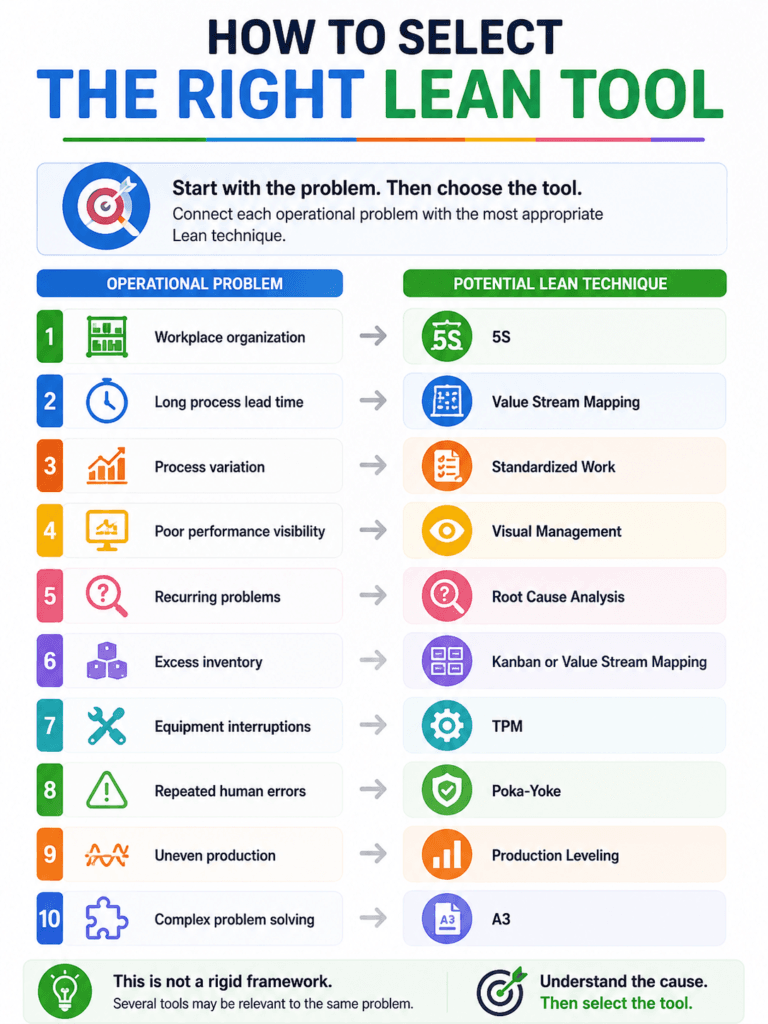
How to Select the Right Lean Tool
Organizations should avoid choosing tools based only on popularity.
A better approach is to connect each problem with the most appropriate method.
| Operational Problem | Potential Lean Technique |
| Workplace organization | 5S |
| Long process lead time | Value Stream Mapping |
| Process variation | Standardized Work |
| Poor performance visibility | Visual Management |
| Recurring problems | Root Cause Analysis |
| Excess inventory | Kanban or Value Stream Mapping |
| Equipment interruptions | TPM |
| Repeated human errors | Poka-Yoke |
| Uneven production | Production Leveling |
| Complex problem solving | A3 |
This is not a rigid framework. Several tools may be relevant to the same problem.
The important step is understanding the underlying cause first.
Lean Techniques KSA Organizations Can Combine
Lean tools are often more effective when they support one another.
For example:
5S → Standardized Work → Visual Management → Kaizen
This creates a foundation for workplace organization and continuous improvement.
Another sequence could be:
Value Stream Mapping → Root Cause Analysis → Process Improvement → Standardization
This can help organizations address broader flow problems.
For equipment-related challenges:
TPM → Standardized Maintenance → Visual Management → Continuous Improvement
The combination should reflect the organization’s actual operational requirements.
Lean and Smart Manufacturing
Lean and smart manufacturing can complement each other.
Lean methods help organizations understand processes and identify waste.
Technology can then provide additional capabilities such as:
- Automated data collection
- Real-time information
- Process monitoring
- Performance analysis
- Automated workflows
For example, a process may first be standardized manually. Once the process is stable, technology can be introduced to improve visibility or reduce repetitive activity.
This creates a practical foundation for Lean plus Industry 4.0 strategies for KSA industries.
The Role of Lean Consultants in Saudi Arabia
Organizations may develop internal Lean capability or seek support from Lean consultants in Saudi Arabia when they require structured expertise.
A Lean management consultant can potentially support areas such as:
- Lean assessments
- Process improvement
- Value Stream Mapping
- Waste reduction
- Standardized work
- Problem solving
- Continuous improvement
- Lean transformation
Lean manufacturing consultants should focus on understanding the organization’s operational challenges rather than recommending tools without context.
The right approach is problem-led:
Problem → Root Cause → Appropriate Tool → Improvement → Standardization → Measurement
How to Implement Lean Manufacturing in Saudi Industrial Plants
Organizations asking how to implement Lean manufacturing in Saudi industrial plants can use a structured sequence.
1. Assess the Current State
Understand existing processes and performance.
2. Identify Priority Problems
Select issues with meaningful operational impact.
3. Analyze Root Causes
Understand why the problems occur.
4. Select Appropriate Lean Techniques
Choose tools according to the problem.
5. Implement With Workforce Participation
Involve the people performing the work.
6. Measure the Change
Determine whether performance improved.
7. Standardize the Improvement
Create a repeatable method.
8. Continue Improving
Use the new standard as a foundation for further improvement.
Conclusion
The top Lean tools and techniques are not necessarily the tools that an organization should implement first.
The right tool depends on the operational problem. The most effective Lean techniques that KSA organizations use should therefore be selected based on actual operational requirements.
Lean is ultimately a management system and improvement philosophy, not simply a toolkit.
For organizations considering Lean consultants in Saudi Arabia, the emphasis should be on building practical improvement capability, solving real operational problems, involving employees, and creating systems that sustain improvement.
Frequently Asked Questions
What are the most important Lean tools for Saudi organizations?
Important Lean tools include 5S, Value Stream Mapping, standardized work, visual management, Kaizen, root cause analysis, Kanban, Just-in-Time, TPM, Poka-Yoke, Gemba Walks, and A3 problem solving. The right tools depend on the organization’s specific challenges.
Which Lean techniques can reduce cost and improve flow?
Value Stream Mapping, standardized work, 5S, Kanban, Just-in-Time, Kaizen, and root cause analysis can help organizations identify waste, improve flow, and address process inefficiencies.
How should organizations choose Lean tools?
Organizations should first identify the operational problem and its root cause. They can then select the Lean technique most appropriate for addressing that problem rather than implementing tools simply because they are widely used.
Can Lean tools work with Industry 4.0?
Yes. Lean can provide a foundation for understanding and improving processes, while Industry 4.0 technologies can support data collection, monitoring, analysis, and automation where appropriate.
What role do Lean consultants play in KSA?
Lean consultants can provide structured expertise in process improvement, waste reduction, Value Stream Mapping, Lean assessments, standardized work, problem solving, and continuous improvement. Their approach should be tailored to the organization’s operational needs.