Industry 4.0 is changing how manufacturing organizations monitor processes, manage equipment, analyze information, and improve operational performance. For organizations focused on operational efficiency in manufacturing Saudi Arabia, these technologies can provide better visibility into production while supporting faster and more informed decisions.
However, Industry 4.0 is not simply about adding more technology to a manufacturing environment. The real objective is to use digital and automated capabilities to solve operational problems, improve process performance, reduce waste, and support continuous improvement.
For organizations pursuing smart manufacturing in KSA, this distinction is important. Technology can strengthen an efficient process, but it cannot compensate for poorly understood processes, unreliable data, or weak improvement practices.
Industry 4.0 in Manufacturing and Operational Efficiency
Integrating Digital Technologies and Data Analytics to Drive Value
Industry 4.0 integrates digital technologies, automation, connected systems, data analytics, and intelligent decision-support capabilities into manufacturing operations. By enhancing process visibility, these technologies: including production monitoring, automated data collection, equipment performance analysis, advanced automation, quality monitoring, predictive maintenance, production planning, process analytics, and AI-supported decision-making; aim to create measurable operational value rather than digitize every activity.
This technology directly impacts operational efficiency by optimizing resources like equipment, workforce time, materials, and energy. By making operational losses like downtime, defects, and inefficiencies visible, tools such as automated production monitoring, advanced analytics, and AI-enabled analysis empower teams to uncover patterns, examine large datasets, and continuously improve processes.
Key Industry 4.0 Technologies for Manufacturing
1. Advanced Automation
Automation is one of the most visible components of Industry 4.0.
Automated systems can perform repetitive, highly controlled, or data-intensive activities with greater consistency.
Applications may include:
- Material handling
- Assembly activities
- Inspection
- Packaging
- Process control
- Repetitive production tasks
Automation can support operational efficiency by reducing unnecessary manual effort and improving process consistency.
However, automation should be introduced selectively. Automating an inefficient process can simply make the existing inefficiency happen faster. A process should therefore be understood and improved before determining whether automation is appropriate.
2. Automated Data Collection
Manufacturing operations generate information throughout the production process.
Manual collection can be time-consuming and may result in inconsistent records.
Automated data collection can capture selected information directly from equipment and processes. This can support:
- Production tracking
- Downtime analysis
- Quality monitoring
- Performance measurement
- Maintenance analysis
- KPI reporting
For KSA organizations pursuing manufacturing technology initiatives, this capability can create a stronger foundation for data-driven manufacturing.
The important consideration is not how much data can be collected. It is whether the information helps teams make better decisions.
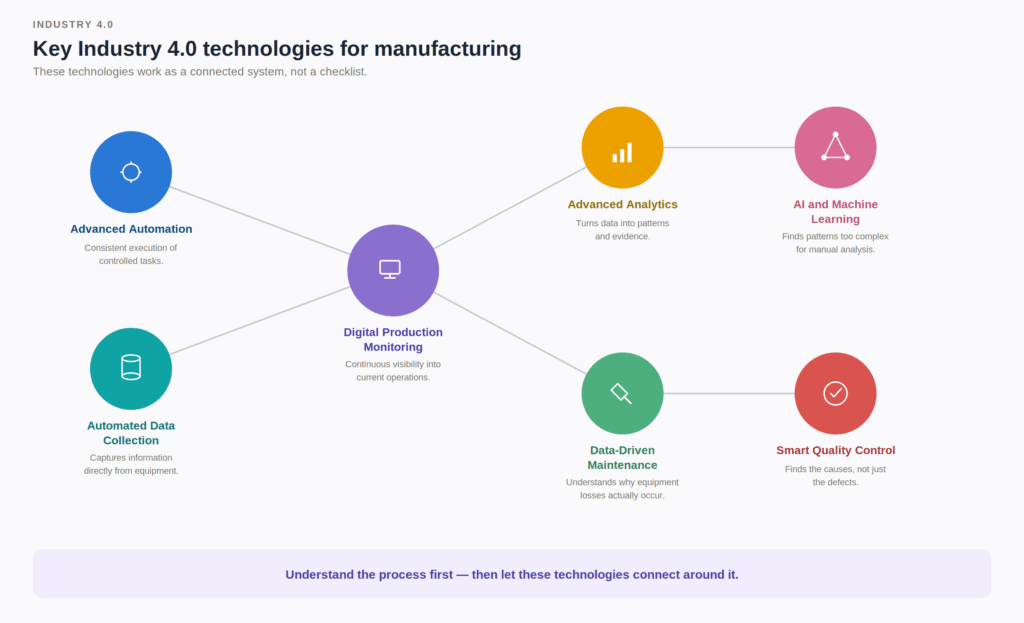
3. Advanced Analytics
Data becomes more valuable when organizations can analyze it to identify patterns and relationships. Advanced analytics can help teams examine operational information across different conditions.
For example, an organization may investigate whether certain process conditions are associated with defects or whether particular patterns occur before equipment interruptions.
This can help shift improvement discussions from assumptions toward evidence. It can also support more focused problem-solving by helping teams identify which operational losses deserve attention.
4. AI and Machine Learning
AI and machine learning can extend manufacturing analytics by helping systems identify patterns within large datasets. Potential applications include:
- Quality analysis
- Equipment monitoring
- Demand forecasting
- Production planning
- Process analysis
- Decision support
AI can be particularly useful where operational information is too large or complex for manual analysis.
However, AI should not replace operational expertise. Teams still need to understand the process, validate findings, and determine whether a recommendation is practical.
Reliable data is also essential. Poor-quality information can limit the usefulness of even sophisticated analytical systems.
5. Digital Production Monitoring
Digital production monitoring provides greater visibility into the status and performance of manufacturing processes. Instead of relying exclusively on end-of-shift reports, organizations can monitor selected indicators more continuously.
Depending on the application, teams may be able to observe:
- Production progress
- Equipment status
- Downtime
- Cycle times
- Process interruptions
- Quality information
This can support faster identification of abnormal conditions. It can also strengthen daily performance management by giving teams a more consistent view of current operations.
6. Data-Driven Maintenance
Equipment reliability has a direct relationship with operational efficiency. Unexpected interruptions can affect production schedules, workforce utilization, process flow, and delivery performance.
Industry 4.0 technologies can support maintenance by making equipment information easier to collect and analyze. Teams can examine:
- Failure patterns
- Downtime frequency
- Equipment conditions
- Maintenance history
- Recurring interruptions
This can complement established approaches such as Total Productive Maintenance.
The objective is to move beyond reacting to failures and develop a stronger understanding of why equipment losses occur.
7. Smart Quality Control
Quality problems can generate scrap, rework, additional inspection, and process delays. Digital quality systems can improve how organizations collect, analyze, and respond to quality information.
Automated inspection and process monitoring can support more consistent detection of selected quality conditions.
Advanced analytics can also help identify relationships between process variables and quality outcomes.
The strongest approach is still prevention. Technology should help organizations identify and address the causes of quality problems rather than simply detect defects after they occur.
How Industry 4.0 Improves Productivity in Saudi Factories
The relationship between Industry 4.0 and productivity is not automatic. Technology improves productivity when it helps an organization produce the required output with better use of available resources.
For example, better equipment monitoring may help reduce avoidable downtime. Automated data collection can reduce time spent preparing manual reports. Advanced analytics can help improvement teams prioritize recurring losses. Automation can reduce unnecessary manual effort in appropriate processes.
These individual improvements can contribute to broader operational efficiency efforts in manufacturing across Saudi Arabia. The key is to connect each technology with a measurable operational objective.
Industry 4.0 and Lean Manufacturing
Industry 4.0 and Lean manufacturing initiatives in Saudi Arabia should not be treated as competing approaches. They can reinforce each other.
Lean helps organizations identify waste, improve flow, standardize processes, and investigate operational problems. Industry 4.0 technologies can provide better information about where those problems occur.
Consider a process with recurring waiting. A Lean assessment may identify waiting as a major source of waste. Digital monitoring can then provide more detailed information about when the waiting occurs and which process stages are involved.
The improvement team can investigate the cause and determine whether a process change, organizational change, or technology intervention is appropriate.
The principle is simple:
Use Lean to understand the problem and technology to strengthen the solution where appropriate.
How Saudi Companies Can Use Technology to Enhance Manufacturing Operations
Organizations considering Industry 4.0 adoption should avoid starting with technology selection. Instead, begin with the operational problem.
A practical sequence is:
Step 1: Identify the Performance Gap
Determine what is affecting efficiency.
This could be downtime, quality variation, production delays, excessive manual reporting, or poor process visibility.
Step 2: Understand the Current Process
Observe how work is actually performed.
Step 3: Establish a Baseline
Measure current performance before making significant changes.
Step 4: Identify the Technology Opportunity
Determine whether a digital or automated solution can address the identified problem.
Step 5: Test the Application
Start with a focused implementation where the outcome can be evaluated.
Step 6: Measure the Result
Compare the new performance with the original baseline.
Step 7: Standardize and Scale
If the technology produces measurable value, integrate it into the improved process and consider applying the approach elsewhere.
This provides a practical roadmap for Industry 4.0 adoption without treating digital transformation as an end in itself.
Measuring Industry 4.0 Impact
Technology investments should be evaluated using operational measures. Depending on the objective, organizations may track:
- OEE
- Cycle time
- Throughput
- Downtime
- Defects
- Rework
- Scrap
- Process lead time
- Production interruptions
- Productivity
For example, if the objective is improving equipment performance, OEE and downtime may be relevant. If the objective is reducing quality losses, defects and rework may be more appropriate.
This creates a direct link between Industry 4.0 manufacturing initiatives and measurable operational improvement in Saudi Arabia.
Conclusion
Industry 4.0 technologies can create significant opportunities for improving operational efficiency in manufacturing.
For organizations pursuing smart manufacturing in KSA, however, technology should always be connected to a specific operational objective.
The strongest approach is not to adopt every available technology.
It is to identify where performance is being lost, understand the process, establish a baseline, select the appropriate technology, measure the result, and continuously improve.
This creates a practical connection between Industry 4.0 adoption, digital transformation, Lean manufacturing, and long-term manufacturing efficiency.
Frequently Asked Questions
What Industry 4.0 technologies improve manufacturing efficiency?
Advanced automation, automated data collection, production monitoring, advanced analytics, AI-enabled analysis, data-driven maintenance, and smart quality systems can support manufacturing efficiency when applied to appropriate operational problems.
How does Industry 4.0 improve productivity in Saudi factories?
Industry 4.0 can improve productivity by reducing manual effort, improving process visibility, supporting equipment performance, identifying recurring losses, and enabling better operational decisions.
How does Industry 4.0 support Lean manufacturing?
Lean identifies waste and process problems, while Industry 4.0 can provide better information about where and when those problems occur. Together, they can support more targeted and measurable process improvement.
What should manufacturers consider before Industry 4.0 adoption?
Organizations should first identify the operational problem, understand the current process, establish a performance baseline, assess data quality, determine workforce requirements, and then select technology based on the expected operational value.
How can companies measure the success of Industry 4.0 initiatives?
Success can be measured using operational indicators such as OEE, downtime, cycle time, throughput, defects, rework, process lead time, and productivity. The selected KPI should directly relate to the objective of the technology initiative.