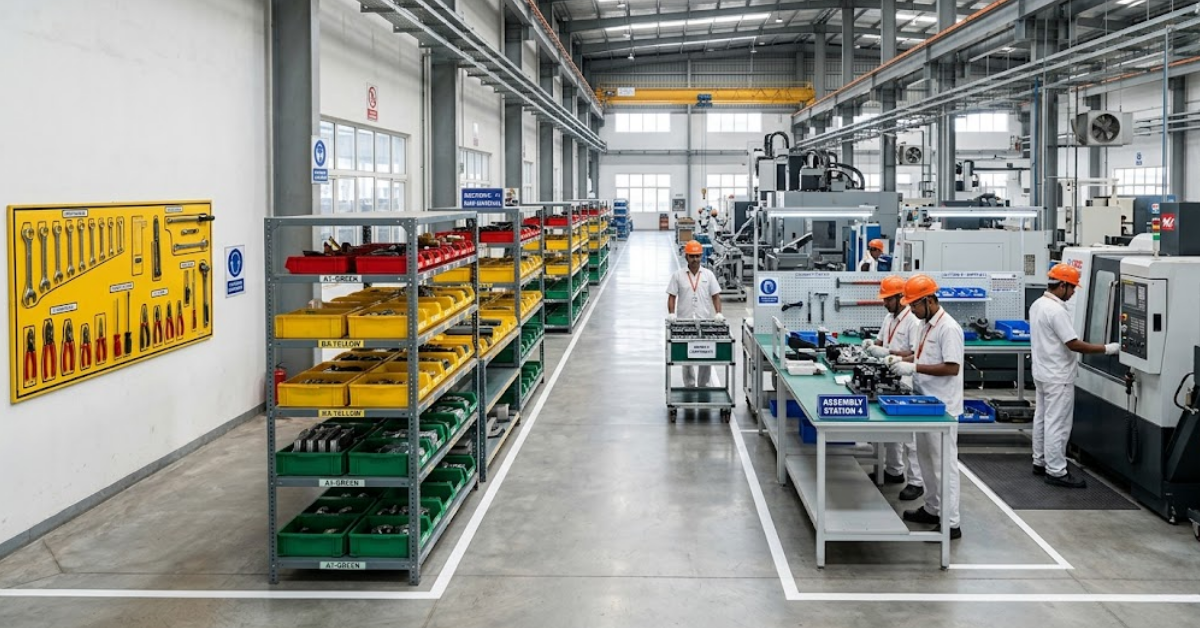
Rising input prices, energy volatility, supply chain disruptions, and labor inefficiencies are putting pressure on margins across the manufacturing industry in India. Yet, many plants continue to operate below their true potential.
According to the McKinsey & Company, productivity improvements of 15–30% are achievable in manufacturing with structured operational interventions. Similarly, insights from Confederation of Indian Industry suggest that lean-driven operational efficiency improvement can reduce conversion costs by 10–25% in Indian plants.
At Faber Infinite Consulting, we have worked across multiple industries implementing cost reduction strategies in manufacturing that deliver measurable and sustainable outcomes. This blog shares structured case studies, expert-backed frameworks, and actionable insights to help leaders understand how to reduce manufacturing costs in India without compromising quality or growth.
Why Cost Reduction in Manufacturing Industry Matters
Cost reduction is not about cutting budgets blindly. It is about:
- Improving operational efficiency
- Eliminating waste
- Optimizing resources
- Increasing productivity
- Strengthening competitiveness
In India’s competitive manufacturing landscape, manufacturing cost optimization directly impacts EBITDA, pricing flexibility, and export competitiveness.
Case Studies: Cost Reduction Success Stories in Indian Manufacturing
Below are real-world style case summaries based on structured engagements delivered by Faber Infinite Consulting across Indian manufacturing sectors.
Case Study 1: Lean-Led Waste Reduction in an FMCG Plant
| Parameter | Details |
| Industry | FMCG Manufacturing |
| Challenge | High material waste, excess WIP inventory |
| Intervention | Lean manufacturing India framework, Value Stream Mapping |
| Focus Areas | Waste reduction techniques, layout optimization |
| Results | 18% material cost reduction, 22% lead time reduction |
Experience Insight
During plant observation, we found excessive material movement contributing to hidden logistics costs. By redesigning the layout and implementing flow-based production, material travel distance reduced by 35%.
Expertise Applied
- Lean manufacturing India principles
- Manufacturing process optimization
- Production cost control metrics
- Standard work implementation
According to Lean Enterprise Institute, structured lean implementation can reduce waste by up to 30% in process industries.
Trust Factor
Savings were validated through:
- Pre and post cost benchmarking
- OEE tracking
- Financial audit verification
Case Study 2: TPM in Manufacturing for Engineering Sector
| Parameter | Details |
| Industry | Heavy Engineering |
| Challenge | Frequent breakdowns, high maintenance cost |
| Intervention | TPM in manufacturing, OEE improvement |
| Focus Areas | Preventive maintenance, downtime analysis |
| Results | 28% downtime reduction, 15% maintenance cost saving |
Experience Insight
Breakdowns were reactive, not preventive. Machine logs revealed recurring failures that were never root-caused.
Expertise Applied
- Total Productive Maintenance
- Root Cause Analysis (RCA)
- Predictive maintenance scheduling
- Operator skill development
Research from Japan Institute of Plant Maintenance shows that mature TPM implementation can improve equipment productivity by 20–40%.
Authoritative Outcome
- OEE improved from 58% to 74%
- Spare inventory optimized by 12%
- Production cost control strengthened
Case Study 3: Quality Cost Reduction in Auto Components
| Parameter | Details |
| Industry | Auto Component Manufacturing |
| Challenge | High rejection rates and rework costs |
| Intervention | Statistical process control & quality cost reduction |
| Focus Areas | Defect analysis, process stabilization |
| Results | 32% rejection reduction, 8% direct cost saving |
Experience Insight
Cost of Poor Quality (COPQ) was not visible in financial reports. Once mapped, hidden rework costs became measurable.
Expertise Applied
- SPC implementation
- Control charting
- Process capability improvement
- Operator training
Studies from American Society for Quality indicate that quality failures can consume 15–20% of total sales in manufacturing firms.
Trust Element
Financial dashboards were redesigned to track:
- Cost saving in manufacturing industry
- Scrap rate per shift
- Defect trends
Case Study 4: Energy Optimization in Process Industry
| Parameter | Details |
| Industry | Chemical Manufacturing |
| Challenge | Rising energy costs |
| Intervention | Energy audit and process redesign |
| Focus Areas | Load balancing, utility optimization |
| Results | 12% energy cost reduction annually |
Experience Insight
Energy was treated as a fixed overhead, not a controllable variable.
Expertise Applied
- Energy mapping
- Consumption benchmarking
- Utility cost modeling
Data from Bureau of Energy Efficiency shows that structured energy optimization programs can reduce industrial energy costs by 10–20%.
Core Cost Reduction Strategies in Manufacturing
Below is a structured summary of high-impact manufacturing cost reduction techniques for Indian plants:
| Strategy | Impact Area | Typical Savings Range |
| Lean manufacturing | Waste reduction | 10–30% |
| TPM in manufacturing | Equipment efficiency | 15–25% |
| Layout optimization | Material cost & time | 10–20% |
| Quality cost reduction | Rework & scrap | 5–15% |
| Energy optimization | Utility cost | 10–20% |
| Workforce productivity improvement | Labor cost | 8–18% |
How Faber Infinite Consulting Drives Manufacturing Cost Optimization
At Faber Infinite Consulting, our approach to cost reduction in manufacturing industry in India follows a structured path:
Step-by-Step Framework
- Diagnostic assessment
- Data-driven loss mapping
- Financial impact quantification
- Implementation roadmap
- Capability building
- Sustainability tracking
Our Focus Areas
- Operational efficiency improvement
- Production cost control
- Waste reduction techniques
- Productivity improvement
- Quality cost reduction
- Manufacturing process optimization
Unlike short-term cost cutting, our interventions ensure sustainable manufacturing cost optimization strategies in India.
Common Mistakes in Manufacturing Cost Reduction
- Cutting workforce without process redesign
- Ignoring data-based decisions
- Focusing only on procurement cost
- Not measuring hidden costs
- No sustainability mechanism
Cost saving in manufacturing industry must be systematic, not reactive.
Conclusion: Actionable Takeaways
If you are evaluating cost reduction strategies for manufacturing companies in India, consider these steps:
- Start with data, not assumptions
- Map hidden losses
- Implement lean manufacturing India principles
- Strengthen TPM in manufacturing
- Track cost saving through measurable KPIs
- Build internal capability
Sustainable manufacturing cost reduction is achievable when strategy, process, and people align.
For structured transformation support, connect with Faber Infinite Consulting to design a roadmap tailored to your plant.
FAQs
- What are the most effective cost reduction strategies in manufacturing?
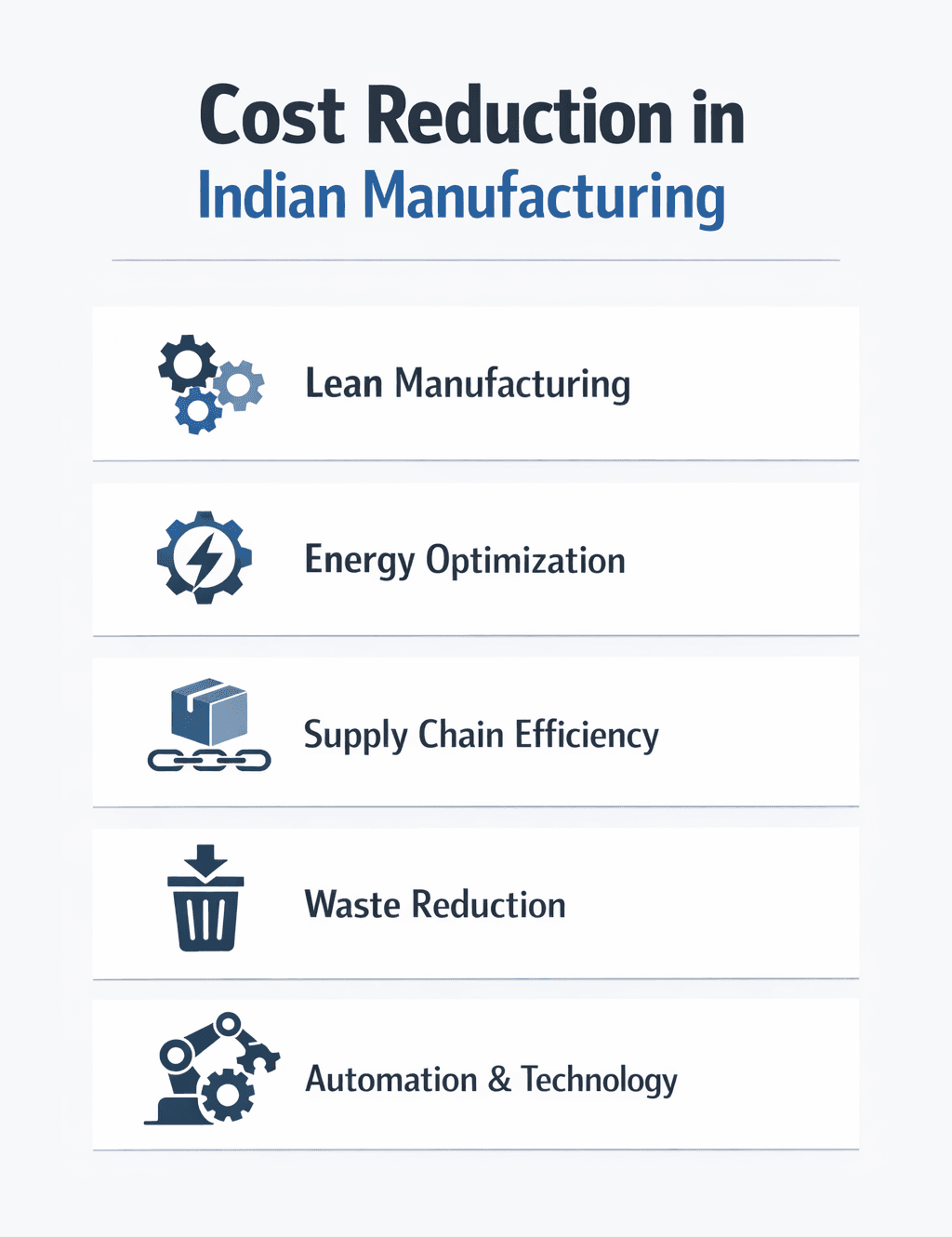
Lean manufacturing, TPM in manufacturing, quality cost reduction, and energy optimization are proven methods for manufacturing cost optimization.
- How much cost reduction is possible in Indian manufacturing plants?
With structured interventions, plants can achieve 10–30% cost reduction depending on maturity level and operational discipline.
- How to reduce manufacturing costs in India without layoffs?
Focus on waste reduction techniques, productivity improvement, and process optimization rather than workforce reduction.
- What is cost reduction through lean manufacturing in India?
It involves eliminating non-value-added activities, improving flow, reducing inventory, and increasing operational efficiency improvement.
- How long does manufacturing cost optimization take?
Initial visible results can appear within 3–6 months, while full transformation may take 12–18 months depending on scale.