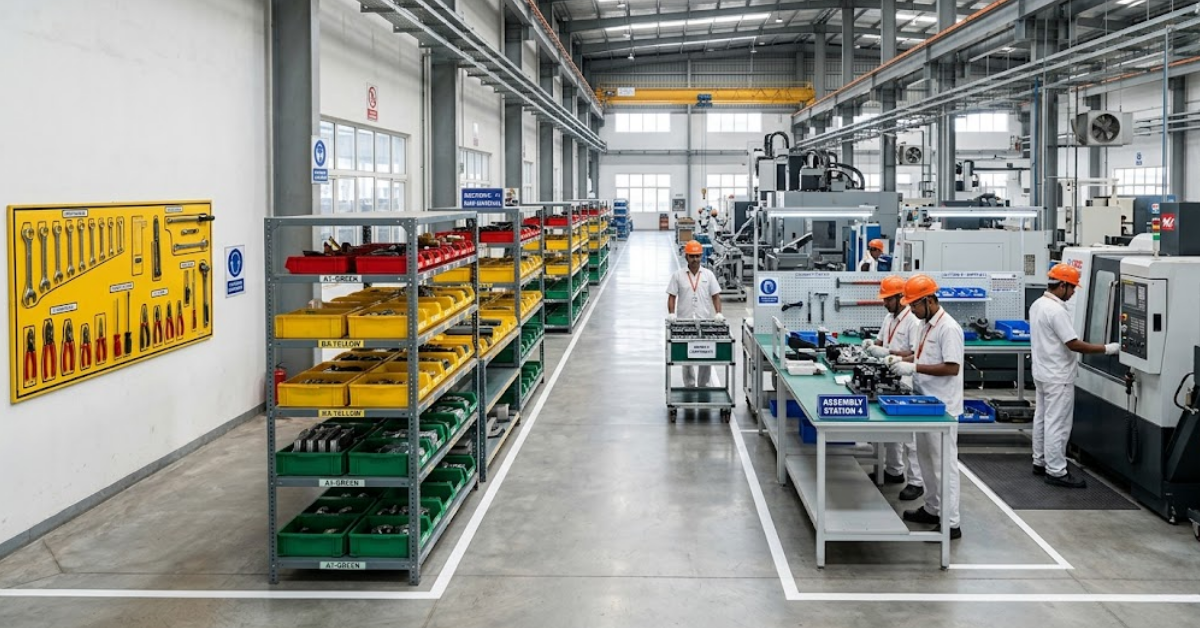
In today’s competitive manufacturing environment, every second on the shop floor matters. Yet, many companies conduct a time and motion study only to see minimal or short-term gains. Why? Because the execution is flawed.
At Faber Infinite Consulting, we have led multiple industrial time study and work measurement projects across sectors including FMCG, packaging, heavy engineering, and process industries. In our experience, the issue is rarely the intent—it’s the methodology.
This blog explores the most common mistakes companies make in conducting a time and motion study, supported by industry standards, expert insights, and real-world experience.
Understanding Time & Motion Study
A time and motion study combines:
- Time Study – Measuring the time required to perform a task.
- Motion Study – Analyzing movements to eliminate waste and improve motion efficiency.
The foundation of modern work measurement comes from pioneers like Frederick Winslow Taylor (Scientific Management) and Frank B. Gilbreth (Motion Economy Principles).
Today, industrial time study practices are aligned with standards such as:
- International Labour Organization (ILO) – Work Study guidelines
- American Society for Quality (ASQ) – Productivity and quality frameworks
- Lean Manufacturing methodologies
When done right, a time and motion analysis improves:
- Labor productivity
- Capacity utilization
- Standardization
- Cost control
- Operational transparency
But when done incorrectly, it creates resistance, flawed standards, and management distrust.
Common Mistakes Companies Make in Conducting Time & Motion Study
Below is a crisp, structured breakdown of common errors and practical solutions.
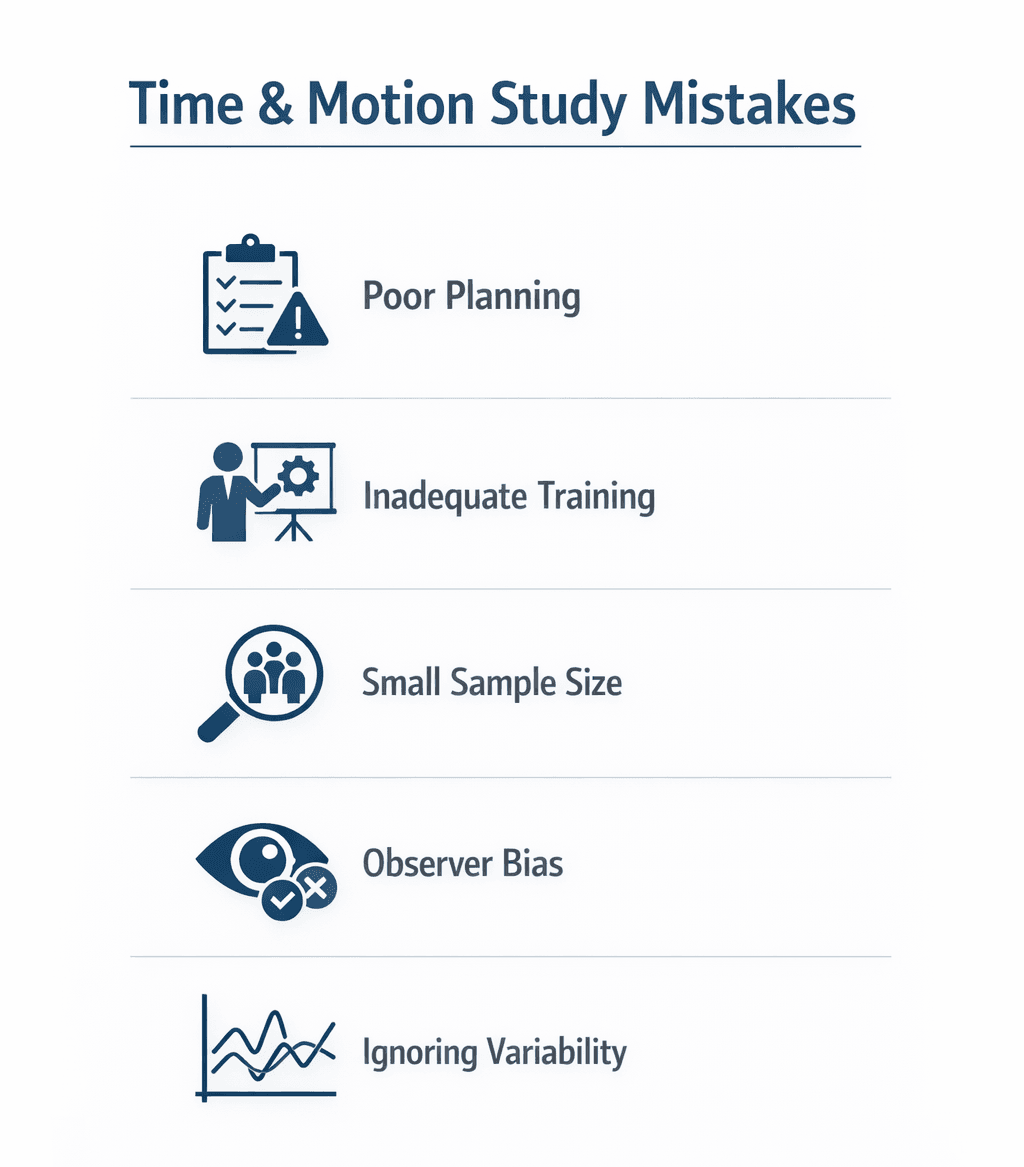
| Mistake | What Companies Do Wrong | Why It Fails | Expert Correction (Best Practice) |
| 1. Treating It as a Cost-Cutting Tool Only | Focus only on reducing manpower | Creates fear among operators | Position as productivity improvement, not headcount reduction |
| 2. No Proper Method Study Before Time Study | Measure time of an inefficient method | Standardizes waste | Conduct method study first, then time study |
| 3. Poor Sampling Size | Take 2–3 observations only | Results lack statistical reliability | Use statistically valid sample size (ILO guidelines) |
| 4. Ignoring Operator Performance Rating | Record raw time without rating | Produces unrealistic standards | Apply performance rating & normalize time |
| 5. No Allowance Calculation | Ignore fatigue & unavoidable delays | Standards become impractical | Add PFD allowances (Personal, Fatigue, Delay) |
| 6. One-Time Exercise | Conduct study once and forget | Standards become obsolete | Review periodically with process changes |
| 7. Lack of Worker Involvement | No operator communication | Resistance & hidden inefficiencies | Engage operators in improvement discussions |
| 8. Not Linking to Lean Goals | Standalone study | No strategic alignment | Integrate with Lean manufacturing & capacity planning |
| 9. Observer Bias | Inconsistent stopwatch timing | Data inconsistency | Train certified industrial engineers |
| 10. No Data Validation | No cross-check with output data | Unrealistic targets | Validate with actual production records |
Real-World Experience from Faber Infinite Consulting
In one packaging manufacturing plant, management conducted an internal time study in manufacturing and concluded that manpower was 30% excess.
When we reviewed:
- No performance rating was applied
- No fatigue allowance included
- Observation was done only during peak performance
- No motion study conducted
After a structured industrial time study:
- Standard time increased by 12% (more realistic)
- Layout changes improved motion efficiency by 18%
- Labor productivity improved 22%
- Zero manpower reduction required
The difference? Scientific work measurement study vs superficial timing.
Mistake #1: Skipping Method Study
Before measuring time, the method must be optimized.
As emphasized by the International Labour Organization, method study precedes time study in proper work-study techniques.
If you time a poor method, you standardize inefficiency.
Example:
- Operator walking 8 meters repeatedly
- Material not positioned ergonomically
- Tools not within reach
Without motion economy principles, time measurement becomes meaningless.
Mistake #2: Not Following Scientific Work Measurement
A proper work measurement study includes:
- Task breakdown into elements
- Stopwatch or digital time recording
- Performance rating
- Normal time calculation
- Standard time calculation
- Allowance addition
Skipping any step results in distorted standards.
Formula Used in Industrial Time Study:
Standard Time = (Observed Time × Rating Factor) + Allowances
This aligns with global industrial engineering practices and ASQ guidelines.
Mistake #3: Ignoring Motion Efficiency Study
Motion study principles introduced by Frank Gilbreth emphasize eliminating:
- Unnecessary reaching
- Bending
- Searching
- Walking
- Idle waiting
A motion efficiency study improves output without increasing workload.
Lean manufacturing applications of time and motion study focus on eliminating:
- Muda (Waste)
- Mura (Unevenness)
- Muri (Overburden)
Mistake #4: Poor Communication with Shopfloor
Time and motion analysis often fails due to trust issues.
Operators fear:
- Job loss
- Unrealistic targets
- Surveillance
At Faber Infinite, we begin every work-study project with:
- Awareness sessions
- Transparent objective sharing
- Assurance of no arbitrary downsizing
This builds cooperation and authentic data.
Difference Between Time Study and Motion Study Explained
| Time Study | Motion Study |
| Measures time taken | Analyzes movements |
| Focus on speed | Focus on efficiency |
| Stopwatch-driven | Process-driven |
| Output improvement | Effort reduction |
| Quantitative | Qualitative + Quantitative |
Both are essential for true productivity improvement.
Mistake #5: No Integration with Capacity Planning
A work measurement study must connect with:
- Line balancing
- Capacity utilization
- Production planning
- Costing models
Without integration, the study remains theoretical.
How to Conduct a Time and Motion Study Step by Step
Here is a simplified, structured approach:
- Select process or workstation
- Break task into elements
- Conduct method study
- Record multiple cycle times
- Apply operator performance rating
- Calculate normal time
- Add allowances
- Validate with actual production
- Implement improvements
- Review periodically
This approach aligns with global work-study techniques.
Benefits of Time and Motion Study in Manufacturing Industry
When done correctly:
- 15–30% labor productivity improvement
- Improved capacity utilization
- Standardized costing
- Balanced workloads
- Reduced fatigue
- Improved safety
At Faber Infinite Consulting, our structured motion study approach often unlocks hidden capacity without capital investment.
Conclusion: What Should Companies Do Differently?
A time and motion study is not just a stopwatch exercise. It is a strategic productivity tool.
Actionable Takeaways:
- Always conduct method study before time study
- Use statistically valid sampling
- Apply performance rating scientifically
- Include PFD allowances
- Involve operators
- Link results to Lean manufacturing goals
- Review standards periodically
When executed correctly, an industrial time study becomes a powerful driver of operational excellence—not workforce anxiety.
At Faber Infinite Consulting, we combine experience, engineering expertise, and data-driven methodologies to deliver measurable productivity improvement.
FAQs
- What is the difference between time study and motion study?
Time study measures how long a task takes. Motion study analyzes movements to eliminate waste and improve efficiency.
- How to conduct a time and motion study step by step?
Break tasks into elements, observe cycles, apply performance rating, calculate standard time, add allowances, validate data, and integrate improvements.
- What are the benefits of time and motion study in manufacturing industry?
Improved labor productivity, better capacity utilization, standardized costing, workload balancing, and process optimization.
- What is operator performance rating in work measurement?
It adjusts observed time based on the operator’s working speed compared to standard performance.
- How often should industrial time study be reviewed?
Whenever there are changes in process, layout, product design, or technology.