
Egypt is currently witnessing a massive industrial transformation. With the expansion of the Suez Canal Economic Zone and new industrial cities, manufacturers are under pressure to move beyond traditional setups and embrace global standards. Achieving operational excellence in this competitive landscape starts with the physical foundation of the business: the factory floor.
Effective factory layout design is not just about placing machines in a room; it is a strategic exercise in spatial optimization and flow. This guide explores how Egyptian manufacturers can leverage modern methodologies like Lean and Industry 4.0 to create world-class facilities.
Why is strategic factory layout design in Egypt critical for growth?
In the Egyptian market, where land costs and energy prices are rising, every square meter of a facility must justify its existence. A poorly planned plant layout often results in “hidden” costs, such as excessive material handling, bottlenecking, and safety hazards. By prioritizing layout design, manufacturers can ensure that their physical space supports their production goals rather than hindering them.
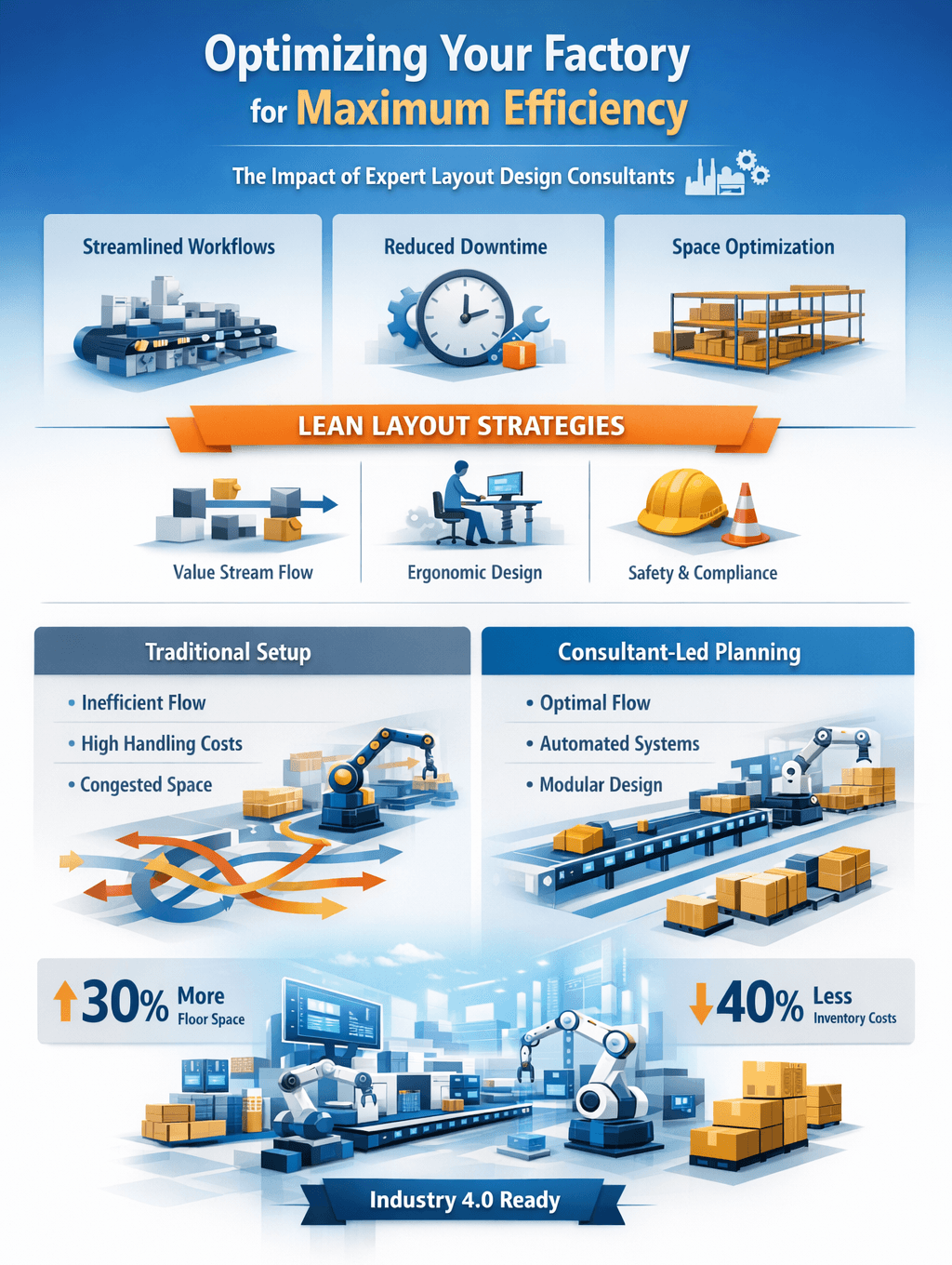
Statistical evidence from Lean Facility Design principles suggests that a transition from a traditional functional layout to a flow-based design can yield significant gains. For instance, in complex manufacturing environments, a redesign often results in a 30% to 50% reduction in required floor space. For an Egyptian firm looking to expand without moving to a larger, more expensive plot, this space reclamation is invaluable. Furthermore, optimizing the travel distance of parts can reduce total material handling time by up to 40%, directly impacting the bottom line.
How does industrial layout design in Egypt influence manufacturing efficiency?
When discussing industrial layout design in Egypt, the primary objective is manufacturing efficiency. Efficiency is the ratio of output to input, and a layout dictates the “input” of time and labor. If a worker has to walk twenty meters to retrieve a component that could have been placed two meters away, that is wasted motion, a core tenet of Lean waste.
By analyzing the relationship between different workstations, engineers can create a “U-shaped” or “I-shaped” flow that minimizes backtracking. In high-volume production settings, implementing these flow-oriented designs has been shown to improve labor productivity by 20% to 25%. This is achieved by balancing the work across the line, ensuring that no single station becomes a bottleneck while others sit idle.
What are the core steps for effective factory layout planning in Egypt?
The process of factory layout planning in Egypt must be data-driven rather than intuitive. It begins with value stream mapping, a tool used to visualize the flow of materials and information from the raw material stage to the finished product.
- Data Collection: Analyze product variety and volume (P-Q Analysis).
- Process Mapping: Identify every step in the manufacturing sequence.
- Relationship Diagramming: Determine which departments or machines need to be adjacent based on the frequency of interaction.
- Block Layout: Create high-level spatial allocations.
- Detail Layout: Specific placement of equipment, utilities, and operator paths.
A critical aspect often overlooked in the Egyptian context is the integration of utilities. Proper planning ensures that electrical, pneumatic, and water lines are accessible but do not obstruct the waste reduction efforts on the floor.
Can a manufacturing plant layout in Egypt support digital manufacturing?
Modern facilities are no longer just mechanical; they are digital. A manufacturing plant layout in Egypt must now account for digital manufacturing infrastructure. This includes the placement of sensors, automated guided vehicles (AGVs), and centralized data hubs.
Integrating technology into the layout allows for real-time monitoring of machine performance. When the layout is designed with data transparency in mind, supervisors can identify delays instantly. In facilities that have integrated digital tracking with a Lean layout, lead times have been known to drop by as much as 60%, as the system eliminates the “wait time” between disconnected processes.
How do you transition toward a smart factory layout in Egypt?
The move toward a smart factory layout in Egypt involves the marriage of Lean principles with Industry 4.0. A “smart” layout is flexible. Instead of bolting machines to the floor in a permanent configuration, modern manufacturers are using modular stations that can be reconfigured based on changing market demands.
In a smart environment, the layout supports the “Pull” system. Materials are only moved when the subsequent station signals a need. This connectivity reduces Work-in-Process (WIP) inventory. Data from advanced facility designs indicates that shifting to a connected, smart flow can reduce WIP levels by 35% to 50%, freeing up significant working capital that would otherwise be tied up in unfinished goods.
What are the advantages of implementing a lean factory layout in Egypt?
A lean factory layout in Egypt focuses exclusively on the movement of value. Anything that does not add value to the product is considered waste. By focusing on waste reduction, a Lean layout addresses the eight typical wastes: overproduction, waiting, transport, extra processing, inventory, motion, defects, and unused talent.
- Standardized Work: A Lean layout makes it easy for operators to follow standardized procedures.
- Visual Management: In a Lean facility, you should be able to “see” the status of production just by looking at the floor.
- Point-of-Use Storage: Raw materials are stored exactly where they are used, eliminating the need for large, centralized warehouses that require heavy forklift traffic.
By implementing these strategies, manufacturers often see a 15% reduction in defect rates, as shorter travel distances and smaller batches allow for quicker identification of quality issues.
Why is a lean manufacturing layout in Egypt the gold standard for ROI?
Investing in a lean manufacturing layout in Egypt provides one of the highest returns on investment (ROI) because it optimizes existing assets. Instead of buying a new machine to increase capacity, a layout redesign might reveal that the current machine is only being utilized 50% of the time due to poor material feed.
Statistical benchmarks from Lean Facility Design projects show that optimizing the throughput of an existing facility can increase total output by 20% without adding a single new piece of production equipment. This “found capacity” is the most cost-effective way to grow a business.
FAQs
How does factory layout design improve productivity in Egypt?
By minimizing the “non-value-added” time, specifically the time spent moving, waiting, and searching, a layout ensures that labor and machinery are focused on production. This streamlined flow can boost overall plant productivity by 25% to 40% compared to a disorganized or functional-siloed layout.
What is Industry 4.0 factory layout design in Egypt?
It is a design approach that incorporates IIoT (Industrial Internet of Things), automated systems, and data analytics. It ensures the physical space has the bandwidth and accessibility for smart technologies, allowing for a “self-optimizing” floor where machines and operators communicate seamlessly.
Is reducing manufacturing costs through factory layout design in Egypt possible?
Absolutely. Costs are reduced through three main avenues: lower material handling labor, reduced floor space requirements (lowering overhead/rent), and significant decreases in WIP inventory, which improves cash flow.
Who are the top lean factory layout design consultants in Egypt?
Consultants specializing in Lean Facility Design focus on using quantitative tools like Relationship Grids and String Diagrams to prove the effectiveness of a layout before a single machine is moved. They bridge the gap between architectural design and industrial engineering.
Are there factory layout redesign case studies in Egypt?
Many firms in the consumer goods and automotive components sectors in Egypt have successfully redesigned their floors. In one instance, a facility was able to consolidate two separate production buildings into one through better spatial planning, saving the company millions in annual operational costs and utility overhead.
Conclusion
The transformation of a manufacturing facility starts with a commitment to operational excellence. For Egyptian manufacturers, the path forward involves moving away from “the way we’ve always done it” and toward data-backed factory layout design. Whether you are building a new site in the 10th of Ramadan City or optimizing an existing plant in Alexandria, the principles of Lean and flow are your most powerful tools for global competitiveness.