
As a business management consultant with a deep focus on the East African industrial landscape, I’ve observed that many Kenyan manufacturers are currently operating within facilities that effectively “tax” their daily output. In a market where operational costs are rising and regional competition is intensifying in 2026, the physical arrangement of your machinery and personnel is no longer just a logistical detail; it is a core strategic lever.
Optimizing a plant layout is about more than fitting machines into a room; it’s about architecting a flow that minimizes waste and maximizes manufacturing efficiency.
Is your current factory layout design Kenya-ready for the efficiency demands of 2026?
For many local enterprises, the existing factory layout design in Kenya relies on legacy structures that prioritize individual machine placement over integrated material flow. However, data from high-performing facilities indicates that layout optimization can lead to a 30% reduction in production waste and a significant 20% decrease in operational delays.
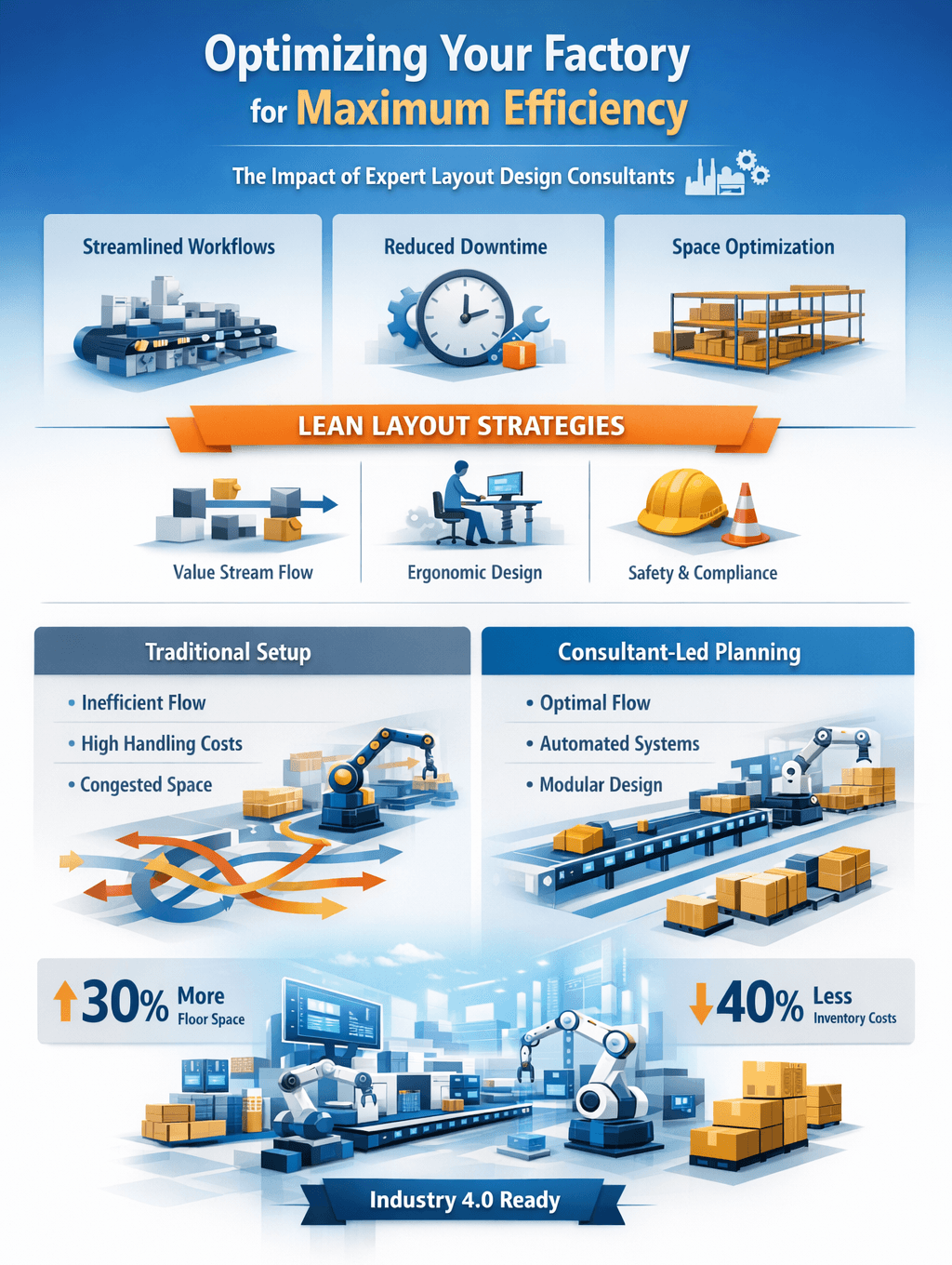
When we look at the core principles of effective design, we see a shift toward “Flow-Based Planning.” By reducing the “spaghetti-like” travel paths of raw materials, companies have successfully achieved operational cost reduction of up to 25% without purchasing a single new piece of equipment. The key lies in the systematic arrangement of resources to ensure that every movement, whether by a forklift or a human hand, adds direct value to the final product.
Why are factory planning consultants in Kenya essential for modernizing brownfield sites?
Expanding an existing facility often results in “layout drift,” where departments grow in silos, leading to bottlenecks and excessive material handling. This is where factory planning consultants in Kenya provide their greatest value. Professional consultants use sophisticated modeling to ensure that “form follows function,” preventing the unplanned growth that often complicates future scalability.
By engaging with specialists, local firms can transition from reactive troubleshooting to a state of operational excellence. Case studies from regional industrial hubs show that professional planning leads to:
- 40% faster manufacturing ramp-ups during product launches.
- 15-point improvements in Overall Equipment Effectiveness (OEE) sustained over three years.
- Significant capital savings by utilizing modular facility designs that double production flexibility.
How can industrial planning consultants in Kenya de-risk your Industry 4.0 transition?
The “Smart Factory” is no longer a distant concept; it is the 2026 reality for Kenya’s leading manufacturers. Industrial planning consultants in Kenya are now integrating digital-physical infrastructure from the blueprint stage. This means designing floors that are already equipped for IoT sensors, automated guided vehicles (AGVs), and real-time data tracking.
When a facility is designed for connectivity, it enables “Predictive Visibility.” Instead of discovering a bottleneck at the end of a shift, managers can use data-driven insights to adjust the flow in real-time. This level of productivity improvement is only possible when the physical layout is designed to support, rather than hinder, the integration of new technologies.
What are the tangible benefits of implementing a smart factory layout in Kenya?
A smart factory layout in Kenya utilizes data to dictate the physical arrangement. By mapping out the value stream mapping of a product, smart layouts ensure that high-interaction zones are physically closer, reducing the time spent on “non-value-adding” transportation.
Research into automated facilities has shown that smart layout interventions can lead to a 50% reduction in manufacturing cycle times. Furthermore, by integrating automated quality checks directly into the line flow, firms can maintain high throughput while simultaneously reducing defect rates. This creates a resilient production environment that can pivot as quickly as the market shifts.
Can a lean factory layout in Kenya really eliminate over 50% of your labor waste?
Adopting a lean factory layout in Kenya is perhaps the most powerful way to address labor inefficiencies. Lean design moves away from massive batch production and toward “Cellular Manufacturing.” In a cellular layout, all equipment needed for a specific process is grouped in a “U-shape” or a “Cell.”
This arrangement allows operators to handle multiple tasks with minimal movement, often leading to a 54% improvement in labor productivity. By eliminating the need for workers to walk across the factory floor to retrieve parts or tools, the lean approach ensures that human effort is concentrated entirely on the transformation of the product.
How does a lean manufacturing layout in Kenya drive sustainable cost savings?
The ultimate goal of a lean manufacturing layout in Kenya is the relentless pursuit of waste reduction. Every square meter of unused space is a cost, and every minute a part sits in a queue is a delay in revenue.
By redesigning the shop floor to facilitate “One-Piece Flow,” manufacturers can achieve:
- Lower Inventory Levels: WIP (Work-in-Progress) is kept to a minimum, freeing up working capital.
- Increased Space Utilization: Often, lean redesigns allow companies to fit 50% more production capacity into the same physical footprint.
- Enhanced Quality: Problems are detected immediately at the source because there is no large pile of inventory to hide errors.
The transition to a lean environment is not just about moving machines; it’s about shifting the organizational culture toward continuous improvement. When the layout is clear, clean, and organized (following 5S principles), the path to cost savings and profitability becomes visible to every employee on the floor.
FAQs
How does factory layout improve productivity in Kenyan factories?
In Kenya, where logistics and utility costs are high, a well-planned layout minimizes the “internal logistics” of the factory. By reducing the distance materials travel between workstations, factories can lower their energy consumption and reduce the wear and tear on material handling equipment. This direct reduction in “travel waste” leads to an immediate and measurable productivity improvement.
Role of factory planning consultants in Kenya?
Factory planning consultants in Kenya provide the technical expertise to bridge the gap between business strategy and physical operations. They assist with site analysis, investment planning, and the detailed arrangement of functional areas. Their involvement ensures that a facility is “future-proofed,” meaning it can adapt to new products or technologies without requiring expensive structural changes.
Why hire industrial planning consultants in Kenya for greenfield projects?
Hiring industrial planning consultants in Kenya for new builds ensures that you don’t inherit the inefficiencies of the past. They apply “VDI 5200” standards and systematic planning to ensure that the material flow, ergonomics, and scalability are optimized from day one, which typically saves up to 25% in initial capital requirements through modular architectures.
What makes Industry 4.0 factory planning consultants in Kenya different?
These specialists focus on “Digital Twin” integration and the “Smart Data Path.” They don’t just plan for machines; they plan for the data those machines produce. They ensure the facility has the necessary robust connectivity (Edge computing) and secure storage (Cybersecurity) to support AI-driven decision-making and automated processes.
Is reducing production cost through factory layout design in Kenya a long-term process?
While some changes take time, many “Quick Wins” can be achieved in weeks. Simply rearranging workstations into cells or implementing “Visual Management” can lead to immediate cost savings. Long-term layout optimization, however, provides a sustainable foundation for operational cost reduction that compounds over the life of the facility.
Are there lean factory layout design consultants in Kenya for small industries?
Yes, lean principles are highly scalable. Specialized lean factory layout design consultants in Kenya help SMEs implement tools like 5S and Value Stream Mapping. This allows smaller manufacturers to compete with larger firms by achieving similar levels of manufacturing efficiency and waste reduction with fewer resources.
How do Kenyan factories improve productivity through layout design?
By moving away from functional layouts (where all like-machines are together) to process-oriented or cellular layouts, Kenyan firms have reduced their “lead times” by as much as 50%. This allows them to respond to customer orders faster and reduces the need for expensive, large-scale warehousing.
Conclusion
The modernization of Kenya’s industrial sector is well underway, and your facility layout is the foundation upon which your success will be built. Whether you are looking to trim costs or prepare for full-scale automation, the way you organize your floor today will dictate your profitability tomorrow.