
In the current era of Saudi Vision 2030, the manufacturing landscape is shifting from traditional production to high-tech, high-efficiency ecosystems. This transition is not merely about purchasing new machinery; it is about how that machinery is integrated into a cohesive, logical, and scalable environment. Factory planning consultants are the bridge between a vision and a high-performing reality. They specialize in the physical and operational architecture of a plant, ensuring that every square meter is designed to maximize output and minimize cost.
A factory is essentially a machine for production. If the “parts” of this machine—the workstations, storage zones, and logistics paths, are poorly aligned, the entire system suffers from “friction” in the form of wasted time and movement. By leveraging manufacturing consulting expertise, businesses can transform their operations from chaotic setups into streamlined powerhouses. This professional oversight is particularly critical in KSA, where industrial cities are expanding rapidly, and the competition for operational dominance is at an all-time high.
How Can Layout Design Consultants in Saudi Arabia Redefine Your Plant’s Efficiency?
The core mission of layout design consultants in Saudi Arabia is to eliminate the invisible barriers to productivity. Many facilities operate with a “spaghetti flow,” where materials crisscross paths, causing delays and increasing the risk of accidents. Consultants utilize advanced tools like flow-rate analysis and relationship charting to create a “Straight-Line” or “U-Shaped” flow that facilitates a logical sequence of operations.
A well-engineered layout addresses more than just the machines. It considers the plant layout planning of utilities, safety zones, and maintenance access. For instance, strategically placing maintenance bays near high-wear equipment can reduce repair downtime by up to 20%. Similarly, by optimizing the proximity of raw material stores to the first production stage, manufacturers often see a 15% reduction in internal logistics costs. These marginal gains, when compounded across a 24/7 operation, lead to massive shifts in profitability.
Critical Pillars of Professional Layout Design:
- Sequential Flow: Ensuring materials move forward without backtracking.
- Ergonomic Integration: Designing workstations that reduce operator fatigue, which is a major driver of productivity improvement.
- Safety Clearances: Meeting Saudi Civil Defence standards while maintaining a high density of equipment.
- Visual Management: Creating a floor that “speaks” through clear markings and status indicators.
Why Is Partnering with Expert Factory Layout Consultants in KSA a High-ROI Decision?
For any industrial leader, the decision to engage factory layout consultants in KSA is an investment in long-term cost reduction. The cost of a poorly planned facility is not just the initial construction; it is the “tax” paid every day in the form of extra forklift trips, excess work-in-progress (WIP) inventory, and underutilized space.
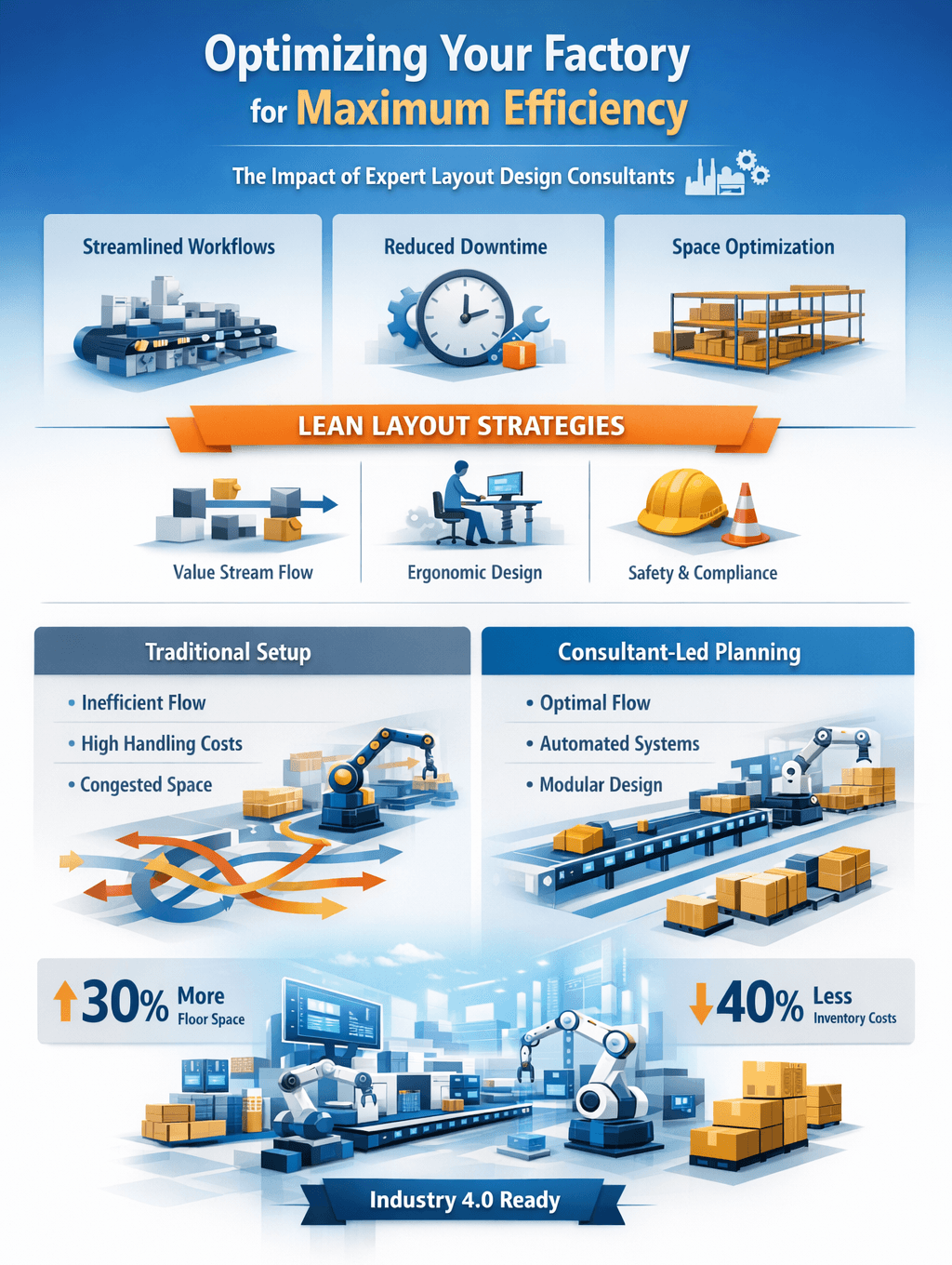
Research into high-performance facilities has shown that expert-led plant layout design can recover up to 30% of floor space that was previously considered “full.” This recovered space allows for the addition of new production lines without the need for expensive building expansions. Furthermore, these consultants ensure that the facility is “Lean-ready,” meaning it is built to support a pull-based production system rather than a push-based one, which can slash inventory holding costs by nearly 40%.
What Role Does Manufacturing Layout Design in Saudi Arabia Play in Industry 4.0?
The Kingdom’s move toward smart manufacturing necessitates a new breed of facility. Manufacturing layout design in Saudi Arabia must now account for automated guided vehicles (AGVs), collaborative robots (cobots), and IoT-enabled monitoring stations. A layout designed in 2010 cannot simply be retrofitted with these technologies without significant friction.
Consultants ensure that the digital and physical worlds are synchronized. This includes planning for stable Wi-Fi/5G coverage across the floor, modular power grids that allow machines to be moved as production needs change, and dedicated paths for autonomous logistics. Facilities that integrate these “smart” considerations during the planning phase report a 25% faster ramp-up time for new technologies compared to those that treat automation as an afterthought. This foresight is the hallmark of operational excellence.
How Can Lean Layout Design Consultants in KSA Help You Achieve Waste-Free Production?
The philosophy of “Lean” is simple: if the customer isn’t willing to pay for it, it is waste. Lean layout design consultants in KSA specialize in identifying and removing the “Eight Wastes,” such as over-processing and unnecessary motion. By restructuring a plant into “Cellular Manufacturing” units, consultants enable operators to perform multiple tasks in a condensed space.
Statistics from various industrial optimizations indicate that transitioning to a lean layout can reduce total travel distance for a single product by over 50%. This doesn’t just save time; it reduces the energy consumption of material handling equipment and lowers the risk of product damage. When every movement is calculated, the plant achieves a state of “Flow” where products move from raw material to finished goods with zero stagnation. This level of precision is only possible through rigorous manufacturing consulting and data-driven design.
Strategic Advantages: A Comparison of Planning Approaches
| Operational Feature | Traditional “Ad-Hoc” Planning | Consultant-Led Factory Planning |
| Space Utilization | Usually 60-70% (congested) | 85-95% (optimized density) |
| Material Handling | High (frequent manual moves) | Low (automated/synchronized) |
| Scalability | Difficult (requires shutdowns) | Built-in (modular design) |
| Safety Compliance | Reactive (added after setup) | Proactive (integrated into flow) |
FAQs
How do layout design consultants improve factory efficiency in KSA?
By implementing “Value Stream-Based” layouts, consultants align the physical floor with the actual value-adding steps of production. This eliminates “islands of automation” where one machine runs fast but the product sits in a queue at the next station. In several Saudi-based projects, this synchronization has improved overall throughput by 18-25% without adding a single new machine.
How does lean layout design reduce waste in KSA factories?
Lean design focuses on the “Point-of-Use” principle. By ensuring that tools and components are stored at the exact location where they are needed, consultants eliminate the waste of “Motion.” Data shows that operators in a non-optimized plant can walk up to 5 kilometers a day just searching for parts; a lean layout reduces this by 70%, directly boosting productivity improvement.
What is the benefit of value stream-based layout planning for Saudi manufacturers?
This approach views the factory as a single flowing stream rather than a collection of departments. It allows manufacturers to see where time is being lost between processes. For KSA manufacturers aiming for global export, this level of efficiency is vital to keep lead times competitive and costs low.
What are the best factory planning strategies for new and existing Saudi plants?
For new “Greenfield” plants, the best strategy is “Inside-Out Design,” where the process is perfected before the building is designed. For “Brownfield” (existing) plants, consultants use “Debottlenecking” to identify the one or two critical areas where a layout change will yield the highest ROI with the least disruption to ongoing work.
How do layout design consultants improve productivity in KSA factories?
Consultants utilize “Takt Time” analysis to balance the work across all stations. When every station takes the same amount of time to complete its task, there is no waiting and no overproduction. This balance is the secret to operational excellence, ensuring the plant produces exactly what is needed, when it is needed.
What is the role of factory planning consultants in Saudi manufacturing?
They serve as strategic navigators. Beyond just floor plans, they provide the feasibility data for investments, ensure compliance with local regulations, and design the facility to be a recruitment tool; clean, organized, and high-tech environments attract the best talent in the Kingdom.