
Why Should Manufacturers Prioritize Factory Planning Before Integrating Industry 4.0?
In the modern industrial landscape, the rush to adopt automation often overshadows a fundamental truth: high-tech machinery cannot fix a low-tech physical flow. The physical configuration of a production facility remains the primary determinant of operational success, serving as the essential foundation for any digital transformation. A well-engineered factory layout design ensures that every square meter of space is dedicated to value creation, providing the necessary spatial logic that Industry 4.0 technologies require to function effectively.
Many facilities operate under legacy arrangements that were never intended to handle the high-velocity data and material requirements of a smart factory. These “evolved” layouts, where equipment is positioned based on immediate availability rather than logical sequence, create invisible barriers to growth and digital integration. By prioritizing strategic factory planning, manufacturers can transform their physical environment into a high-velocity asset. This proactive approach ensures that before sensors and robotics are deployed, the underlying floor plan is already optimized for long-term profitability and agility.
Why Should You Partner with Professional Factory Planning Consultants?
The complexities involved in establishing or expanding a manufacturing unit require a level of precision that goes beyond simple spatial arrangement. Factory planning consultants provide the analytical framework necessary to align physical assets with production objectives. They analyze the intricate relationships between material flow, personnel movement, and equipment utility to create a synchronized ecosystem.
Engaging an expert ensures that facility layout planning is data-driven and forward-looking. These specialists utilize simulation and modeling to identify potential bottlenecks before a single machine is installed. In an environment where industrial real estate costs are high, maximizing plant efficiency through expert intervention is often the difference between a facility that merely functions and one that excels. Professional consultation provides the necessary oversight to ensure that the production environment is optimized for both current needs and future technological integrations.
How Does Industrial Factory Design Minimize Operational Waste?
At the core of high-quality industrial factory design is the philosophy of lean manufacturing. This methodology focuses on the systematic identification and removal of “Muda” (waste), any activity that consumes resources without adding value to the end product. Common forms of waste in unoptimized layouts include excessive material handling, redundant motion, and unnecessary wait times.
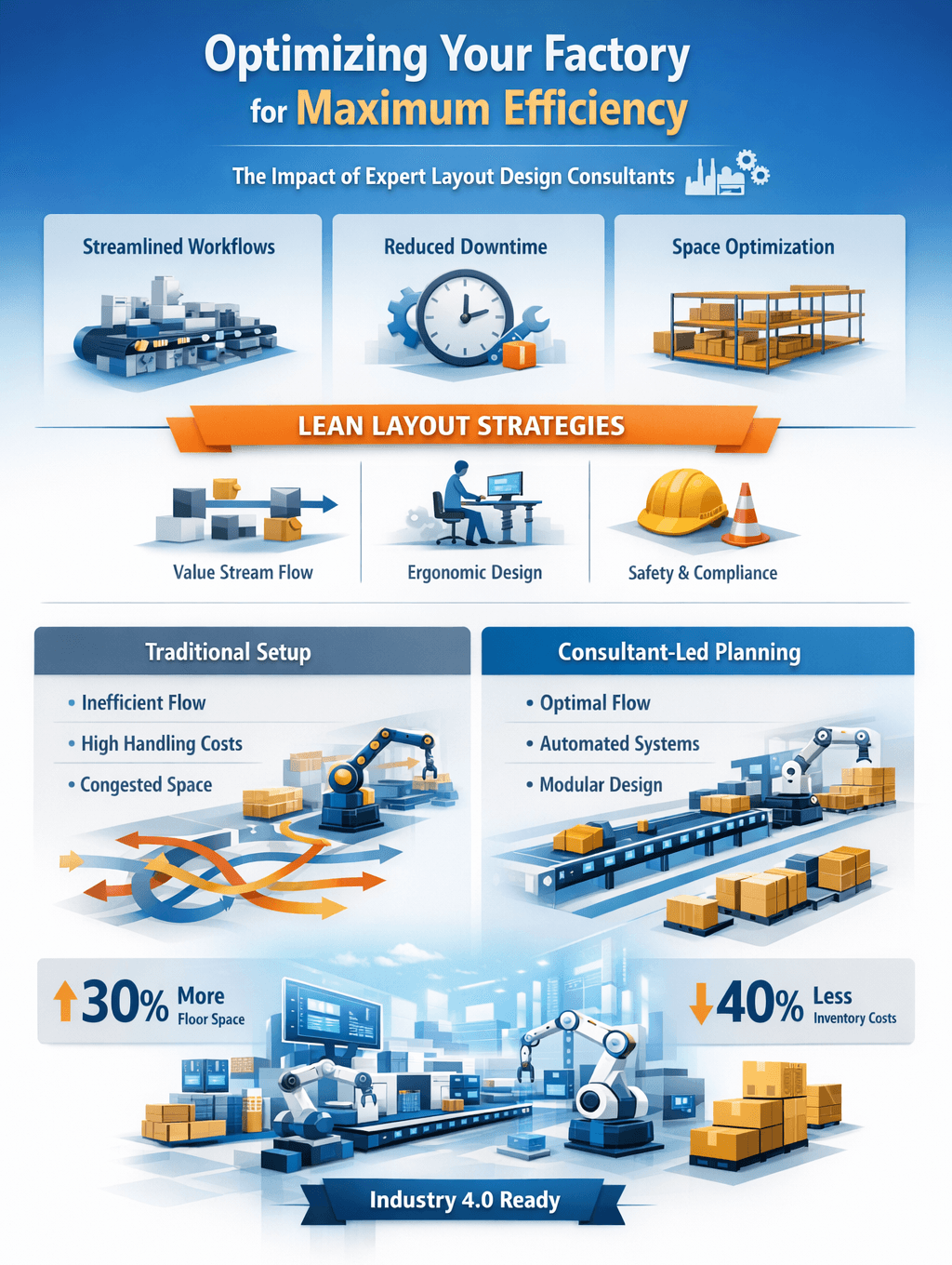
A strategic manufacturing plant layout ensures that the flow of work is continuous and unobstructed. In traditional, unoptimized settings, material handling and transit can account for nearly 30% to 70% of total operating costs. By arranging the facility so that sequential processes are physically adjacent, manufacturers can dry up these hidden costs. A lean-focused design ensures that the production path is direct and visual, effectively eliminating the backtracking and “search time” that often plague disorganized shop floors.
What Are the Tangible Benefits of Factory Layout Design Services?
Investing in professional factory layout design services provides a comprehensive roadmap for operational excellence. These services focus on developing a smart factory layout that is inherently prepared for the next generation of industrial technology. By reclaiming floor area previously lost to disorganized storage and inefficient pathways, these services create room for expansion without the need for new civil construction.
The impact of such spatial optimization is quantifiable. Professional redesigns have successfully achieved a 65.8% reduction in total travel distance for materials while simultaneously reclaiming 13.2% of the existing floor space. Such improvements allow for the integration of additional production lines within the original footprint, providing a massive boost to capacity.
- Improved Employee Morale: An organized, ergonomic layout reduces the physical strain on the workforce, leading to higher focus and lower error rates.
- Enhanced Safety Compliance: Strategic planning separates pedestrian zones from heavy forklift traffic, a critical factor for maintaining workplace safety and passing regulatory audits.
- Manufacturing Cost Reduction: By optimizing the density of production zones, facilities have seen a 17% production capacity enhancement within the same building area.
Why Do Manufacturers Require Factory Planning Consulting Services?
Rapidly scaling production often leads to spatial congestion if the growth is not managed through factory planning consulting services. When new equipment is squeezed into an existing manufacturing plant layout without a master plan, it inevitably creates bottlenecks that slow down the entire facility. Consultants act as the bridge between production targets and physical reality, offering cost-effective planning that maximizes every square meter of available space.
One of the most effective strategies employed by these consultants is the transition to cellular manufacturing. Instead of grouping machines by their function, consultants design integrated work cells where a product moves through its entire lifecycle within a compact radius. This approach drastically reduces lead times. In high-precision engineering environments, this shift has directly resulted in a 62% increase in revenue per square meter, proving that floor space efficiency is a direct lever for financial performance.
Can Industrial Factory Planning Consultants Drive Production Scalability?
The primary role of industrial factory planning consultants is to ensure that a facility is not only efficient today but also scalable for tomorrow. A high-quality manufacturing plant layout design emphasizes modularity. In a volatile market, a facility must be able to pivot its product mix or scale its volume with minimal downtime.
Specialists design these layouts to be flexible, allowing for the seamless integration of Industry 4.0 technologies and automation. The agility provided by advanced layout principles is evident in large-scale specialized facilities, where optimized designs have reduced storage footprints by 30% and cut tied-up working capital by 50%. Furthermore, by minimizing the physical distance materials travel, facilities have seen production cycles shrink significantly, in some instances, reducing a 9-month lead time to just 5 months, representing a 40% improvement in total throughput.
FAQ: Optimizing Productivity through Strategic Factory Planning
How do factory planning consultants for Industry 4.0 manufacturing help?
Consultants ensure that the physical infrastructure, including power distribution, network cabling, and robotic clearances, is integrated into the layout from the start. This makes the transition to Industry 4.0 seamless, allowing for real-time data tracking and automation without the need for expensive structural retrofitting later.
How factory layout design improves productivity?
It improves productivity by minimizing the total travel distance for both materials and personnel. By placing sequential processes in immediate proximity, you eliminate the waste of waiting and transportation. Optimized designs have been shown to reduce material flow distance by over 60%, directly increasing the speed and output of the entire production line.
What are the common factory planning mistakes manufacturers should avoid?
The most common mistake is “land-locking” key processes, which prevents them from being expanded without moving the entire plant. Another is failing to utilize the “vertical cube,” the height of the factory shed, for storage or utilities. Finally, many facilities fail to properly segregate material flows, leading to safety hazards and internal traffic congestion.
Why hire factory planning consultants for sustainable manufacturing?
Sustainability is a natural byproduct of high efficiency. By reducing the physical footprint through better space utilization, a facility requires less energy for lighting, temperature control, and maintenance. Optimized layouts ensure that manufacturing cost reduction aligns with a smaller environmental footprint.
Are there factory planning solutions for small manufacturing companies?
Absolutely. For smaller enterprises, cost-effective planning is even more critical because resources are limited. Consultants help small firms organize their space to handle high-volume flows similar to larger competitors. A professional factory layout design company for industrial facilities can help a small firm double its output without the massive overhead of moving to a larger location.
Conclusion: Transforming the Floor into a Strategic Asset
In the modern industrial sector, the physical layout of a facility is either a bottleneck or a catalyst for growth. By partnering with professional industrial factory planning consultants, manufacturers can unlock latent capacity that is currently being lost to wasted motion and backtracking. Whether developing a greenfield project or modernizing an existing legacy site, the expertise of a factory layout design specialist is the most direct route to achieving a high-velocity, high-profit production environment.
Contact us