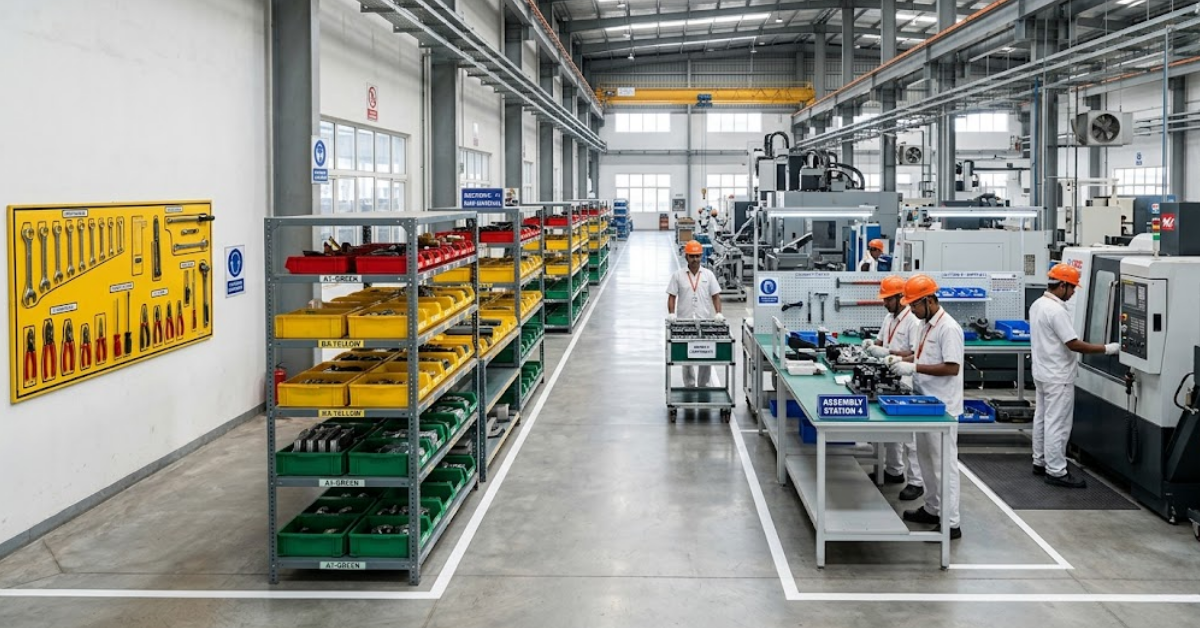
The Competitive Advantage Formula
Cost Leadership = Lower Cost Structure + Higher Productivity + Stable Quality + Reliable Delivery
When manufacturing cost optimization is executed correctly:
- You can price aggressively when needed
- You protect margins during raw material volatility
- You invest more in technology and growth
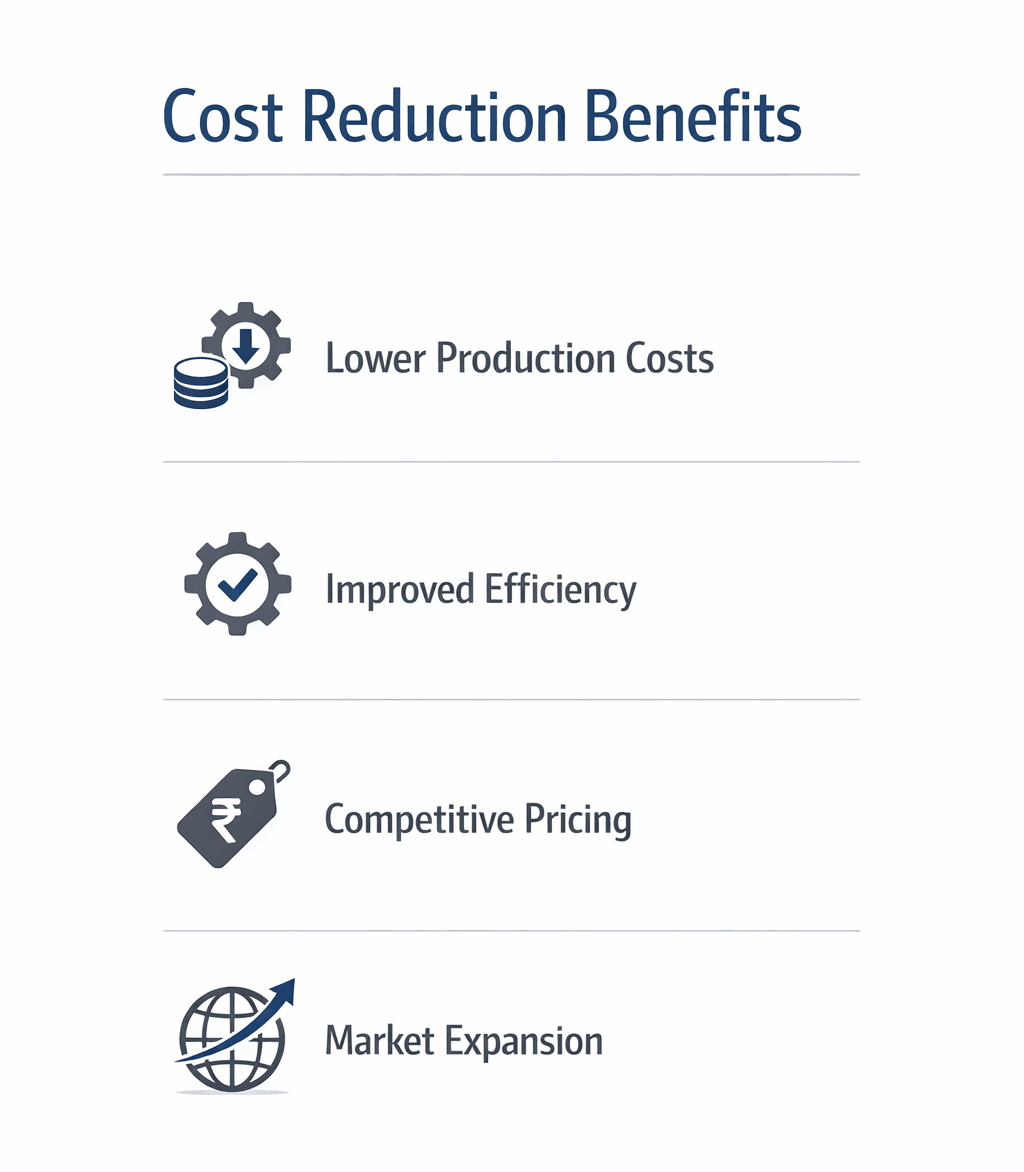
This is how cost reduction improves competitiveness of Indian manufacturers.
Actionable Takeaways In today’s hyper-competitive landscape, Indian manufacturers are not competing only with local players. They are competing with supply chains in China, Vietnam, Eastern Europe, and beyond. Margins are shrinking. Customer expectations are rising.
The difference between market leaders and struggling plants often comes down to one thing: manufacturing cost optimization.
Cost reduction in manufacturing industry is no longer about cutting expenses blindly. It is about building operational strength, improving productivity, and creating sustainable competitiveness.
At Faber Infinite Consulting, we have worked with manufacturers across automotive, FMCG, heavy engineering, packaging, and process industries. One clear pattern emerges: plants that treat cost reduction as a strategic lever consistently outperform their competitors.
Why Cost Reduction Is Critical for Indian Manufacturers
According to McKinsey & Company, manufacturing productivity improvements can reduce operating costs by 15–30% in traditional plants.
Additionally, World Economic Forum highlights that operational excellence and digital adoption are key drivers of global manufacturing competitiveness.
For Indian manufacturers, cost saving in manufacturing industry directly impacts:
- Pricing power in domestic and export markets
- Working capital efficiency
- Capacity utilization
- EBITDA margins
- Long-term survival during demand slowdowns
Cost reduction in manufacturing industry in India is not optional — it is foundational to growth.
How Cost Reduction Improves Competitiveness
Below is a structured overview of how manufacturing cost reduction translates into competitive advantage.
| Area of Improvement | Cost Reduction Lever | Business Impact | Example from Indian Plants |
| Production Efficiency | Lean manufacturing India, line balancing | Higher output with same resources | 22% productivity improvement through layout redesign |
| Maintenance | TPM in manufacturing | Reduced downtime & repair costs | 35% drop in breakdown hours |
| Quality | Quality cost reduction, root cause analysis | Lower rework & scrap | Scrap reduced from 8% to 3% |
| Inventory | Production cost control & pull systems | Reduced working capital | 28% inventory reduction |
| Energy | Energy audits & process optimization | Lower overhead cost | 12% energy cost savings |
| Workforce | Time & Motion Study | Labor cost optimization | 18% manpower productivity gain |
Each of these improvements strengthens price competitiveness without compromising margins.
Real Experience: What We See on the Shopfloor
Case Insight 1: Layout Inefficiency
In one heavy engineering plant, material movement distance was 1.8 km per product assembly. After manufacturing process optimization and flow redesign:
- Travel distance reduced by 42%
- WIP reduced by 30%
- Throughput increased by 18%
This was not capex-driven. It was design-driven.
Case Insight 2: Hidden Cost of Downtime
An FMCG packaging unit believed its issue was demand fluctuation. However, data revealed 23% of production loss was due to micro-stoppages. After implementing TPM in manufacturing:
- OEE improved from 58% to 72%
- Annual savings crossed ₹3.2 crore
Manufacturing cost reduction techniques for Indian plants must begin with visibility, not assumptions.
Key Cost Reduction Strategies in Manufacturing
- Lean Manufacturing India
Lean manufacturing focuses on eliminating non-value-added activities. Waste reduction techniques include:
- Overproduction elimination
- Motion reduction
- Waiting time removal
- Standard work implementation
Cost reduction through lean manufacturing in India has shown 15–25% cost impact across sectors.
- Production Cost Control via Data
Real-time monitoring enables:
- Faster decision-making
- Reduction in quality defects
- Better capacity planning
According to Boston Consulting Group, digital-enabled plants improve productivity by 20–25%.
Manufacturing cost optimization strategies in India increasingly rely on data visibility.
- Total Productive Maintenance (TPM)
Unplanned downtime directly inflates cost per unit. TPM focuses on:
- Autonomous maintenance
- Preventive scheduling
- Root cause elimination
Effective TPM in manufacturing improves reliability and stabilizes cost structures.
- Quality Cost Reduction
Poor quality can consume 5–15% of sales revenue. Reducing:
- Rework
- Scrap
- Warranty claims
Improves margins without changing pricing.
- Workforce Productivity Improvement
Labor cost remains significant in Indian plants. However, the solution is not reduction — it is optimization.
Time & Motion Studies and structured manpower deployment often result in:
- 15–20% manpower productivity gains
- Lower overtime
- Better shift utilization
Operational efficiency improvement is sustainable when workforce is aligned, not downsized blindly.
Cost Reduction in Manufacturing Industry in India: Strategic View
Cost reduction strategies for manufacturing companies in India must be aligned to:
- Demand volatility
- Energy costs
- Skilled labor availability
- Export competitiveness
- ESG compliance
Manufacturing cost reduction is not a one-time event. It requires:
- Structured assessment
- Baseline data
- Cross-functional alignment
- Continuous monitoring
Plants that institutionalize manufacturing process optimization build long-term resilience.
- Start with a cost structure diagnostic — identify top 3 cost drivers.
- Measure OEE before assuming demand problems.
- Map material flow distance — redesign for flow.
- Implement TPM in manufacturing to stabilize downtime.
- Focus on productivity improvement before adding new capacity.
Cost reduction in manufacturing industry in India is most effective when it is systematic, data-driven, and leadership-led.
For structured support, explore our Operational Excellence frameworks at Faber Infinite Consulting.
FAQs
- What is cost reduction in manufacturing industry in India?
Cost reduction in manufacturing industry in India refers to systematic efforts to lower production expenses without affecting quality, safety, or delivery performance.
- How to reduce manufacturing costs in India effectively?
Effective methods include lean manufacturing India, production cost control systems, TPM implementation, layout optimization, and workforce productivity improvement.
- What are the best cost reduction strategies for manufacturing companies in India?
The most impactful strategies include manufacturing process optimization, waste reduction techniques, quality cost reduction, and data-driven operational efficiency improvement.
- How much cost saving is possible in Indian plants?
Industry studies suggest 15–30% cost savings are achievable through structured cost reduction strategies in manufacturing, depending on plant maturity.
- Is cost reduction the same as downsizing?
No. Sustainable manufacturing cost reduction focuses on productivity and waste elimination, not workforce cuts. The goal is manufacturing cost optimization, not short-term expense trimming.
If you are evaluating manufacturing cost optimization strategies in India, the right question is not “Can we reduce cost?”
It is — “Where are we losing cost without realizing it?”
Contact us