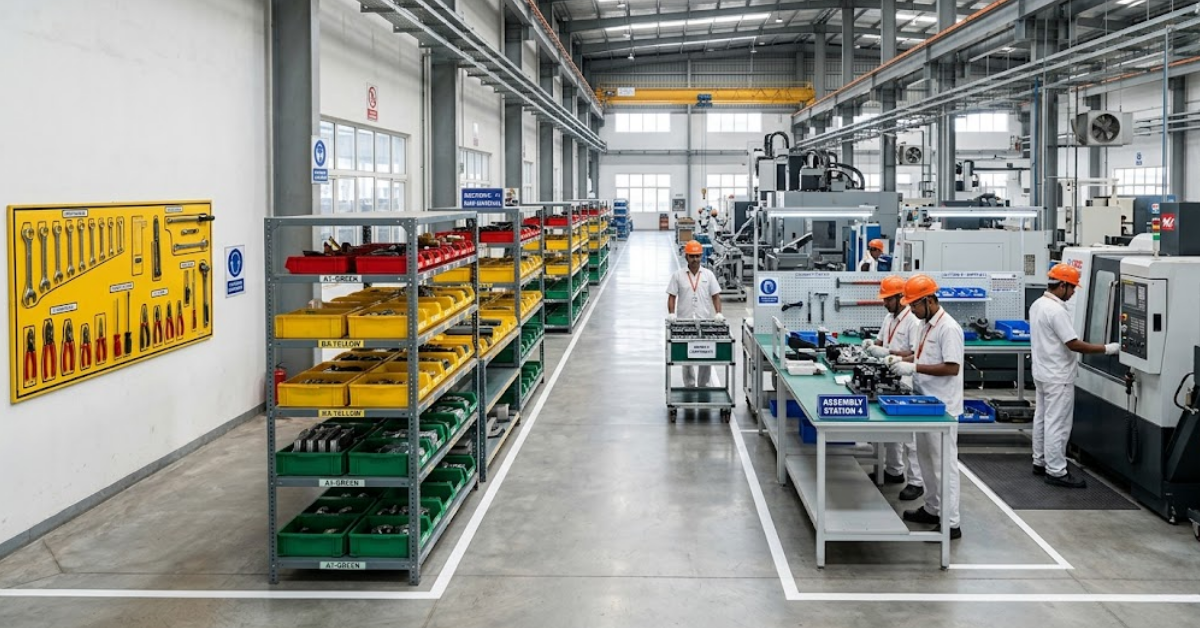
In today’s competitive manufacturing and supply chain environment, profits are often hidden in one place—your inventory. Excess stock blocks working capital. Stock-outs damage customer trust. Inaccurate data disrupts planning.
Yet many organizations treat inventory audits as compliance exercises instead of strategic growth tools.
At Faber Infinite Consulting, we have seen firsthand how structured inventory audits unlock operational efficiency, improve cash flow, and strengthen supply chain performance. This blog explains how inventory audits drive measurable results—supported by industry standards, proven methodologies, and real implementation experience.
What Is an Inventory Audit?
An inventory audit is a structured evaluation of stock accuracy, storage practices, movement patterns, and control systems. It ensures that physical inventory matches system records and identifies inefficiencies in:
- Excess inventory management
- Warehouse management
- Supply chain & inventory consulting practices
- Inventory control techniques
According to the Institute of Management Accountants, inventory typically represents 20–30% of total assets in manufacturing businesses—making it one of the largest working capital components.
That’s why a well-designed audit is not just operational—it’s financial strategy.
Why Inventory Audits Matter for Operational Efficiency
| Operational Challenge | Impact on Business | How Inventory Audit Solves It |
| Excess inventory | High carrying costs, blocked cash | Identifies slow-moving & obsolete stock |
| Stock discrepancies | Production delays | Improves data accuracy |
| Poor warehouse layout | Increased handling time | Optimizes storage flow |
| Lack of visibility | Poor planning decisions | Enhances reporting & tracking |
| Unstructured replenishment | Stock-outs & overstock | Standardizes reorder controls |
Real Experience: A Manufacturing Case Insight
At Faber Infinite Consulting, we worked with a mid-sized FMCG manufacturer facing:
- 18% excess inventory
- Frequent stock mismatches
- Low warehouse productivity
What We Did:
- Conducted full physical audit & ABC classification
- Applied cycle counting strategy
- Mapped material movement flow
- Identified obsolete SKUs
- Redesigned warehouse zoning
Results Achieved:
- 22% reduction in excess inventory
- 15% improvement in warehouse productivity
- 30% reduction in stock variance
This wasn’t just a stock check—it was a transformation in inventory optimization solutions for manufacturing companies.
How Inventory Audits Improve Efficiency (Step-by-Step)
- Improve Data Accuracy
Inventory audits reconcile ERP data with physical stock. According to the APICS (now part of Association for Supply Chain Management), companies with high inventory accuracy achieve better production planning reliability.
Impact:
- Reduced emergency procurement
- Fewer production stoppages
- Better demand forecasting
- Reduce Excess Inventory Costs
Excess stock ties up working capital and increases storage costs. Inventory consulting services identify:
- Slow-moving items
- Dead stock
- Over-purchased materials
| Cost Area | Without Audit | With Audit |
| Storage cost | High | Optimized |
| Working capital | Blocked | Released |
| Obsolescence | Frequent | Controlled |
This is how inventory consultants reduce excess stock costs—through structured analysis, not guesswork.
- Strengthen Supply Chain Visibility
One of the biggest gaps in manufacturing operations is limited real-time visibility.
Inventory audits help:
- Align procurement with demand
- Improve material traceability
- Enable supply chain optimization
The Council of Supply Chain Management Professionals emphasizes visibility as a key driver of supply chain resilience.
With proper inventory management services, companies gain:
- Real-time stock status
- Better vendor coordination
- Improved customer fulfillment rates
- Optimize Warehouse Operations
Inventory audits reveal inefficiencies in warehouse management:
- Poor layout design
- Inefficient picking routes
- Lack of bin discipline
- Improper labeling
Best Practices for Inventory Control and Warehouse Operations
| Technique | Benefit |
| ABC analysis | Prioritize high-value items |
| Cycle counting | Continuous accuracy |
| FIFO/FEFO methods | Reduce expiry losses |
| Lean inventory strategies | Lower carrying cost |
Lean inventory strategies for cost reduction are aligned with principles from Lean Enterprise Institute, which promotes waste elimination across operations.
- Improve Cash Flow & ROI
Inventory is cash sitting on shelves.
A structured inventory optimization consultant approach improves:
- Inventory turnover ratio
- Working capital cycle
- Return on assets
According to global supply chain research, companies that optimize inventory can reduce carrying costs by 10–25%.
Inventory audits are not expenses—they are investments with measurable ROI.
Key Inventory Control Techniques Used by Experts
| Technique | Purpose | Efficiency Impact |
| EOQ (Economic Order Quantity) | Optimal reorder size | Reduces overstock |
| Safety stock calculation | Buffer against demand variability | Prevents stock-outs |
| Demand forecasting | Predict future needs | Improves planning |
| SKU rationalization | Remove redundant items | Reduces complexity |
| Digital inventory dashboards | Real-time tracking | Better decisions |
These inventory optimization solutions for manufacturing companies combine data analytics with operational expertise.
Common Inventory Audit Mistakes to Avoid
| Mistake | Consequence |
| Treating audits as compliance only | No strategic benefit |
| One-time annual physical check | Recurring inaccuracies |
| Ignoring root causes | Problem repetition |
| No KPI tracking | No measurable improvement |
Inventory management consultant teams must go beyond counting—they must redesign processes.
How Consultants Improve Supply Chain and Inventory Visibility
Professional inventory consulting services provide:
- Process mapping
- ERP system alignment
- Control framework development
- Performance KPI dashboards
- Training for warehouse teams
At Faber Infinite Consulting, we integrate inventory audits with:
- Operational excellence frameworks
- Lean manufacturing practices
- Supply chain & inventory consulting strategy
This ensures improvements are sustainable—not temporary.
Measurable KPIs Improved After Inventory Audit
| KPI | Typical Improvement Range |
| Inventory turnover | +15% to +30% |
| Excess stock reduction | 10% to 25% |
| Warehouse productivity | 10% to 20% |
| Order fulfillment rate | +5% to +12% |
| Stock accuracy | Above 98% |
These benchmarks align with global best practices in supply chain optimization.
Why Businesses Need an Inventory Optimization Consultant
Managing inventory internally without structured methodology often results in:
- Bias in assessment
- Lack of benchmarking
- Resistance to change
An experienced inventory management consultant brings:
- Cross-industry experience
- Data-driven analysis
- Proven frameworks
- Accountability
Especially in manufacturing environments where raw material variability affects production flow.
Actionable Takeaways
If your organization is facing rising costs or working capital pressure, consider these steps:
- Conduct a structured inventory audit beyond physical counting.
- Implement ABC analysis and cycle counting.
- Measure inventory turnover monthly.
- Eliminate obsolete SKUs quarterly.
- Partner with professional inventory consulting services for sustainable improvement.
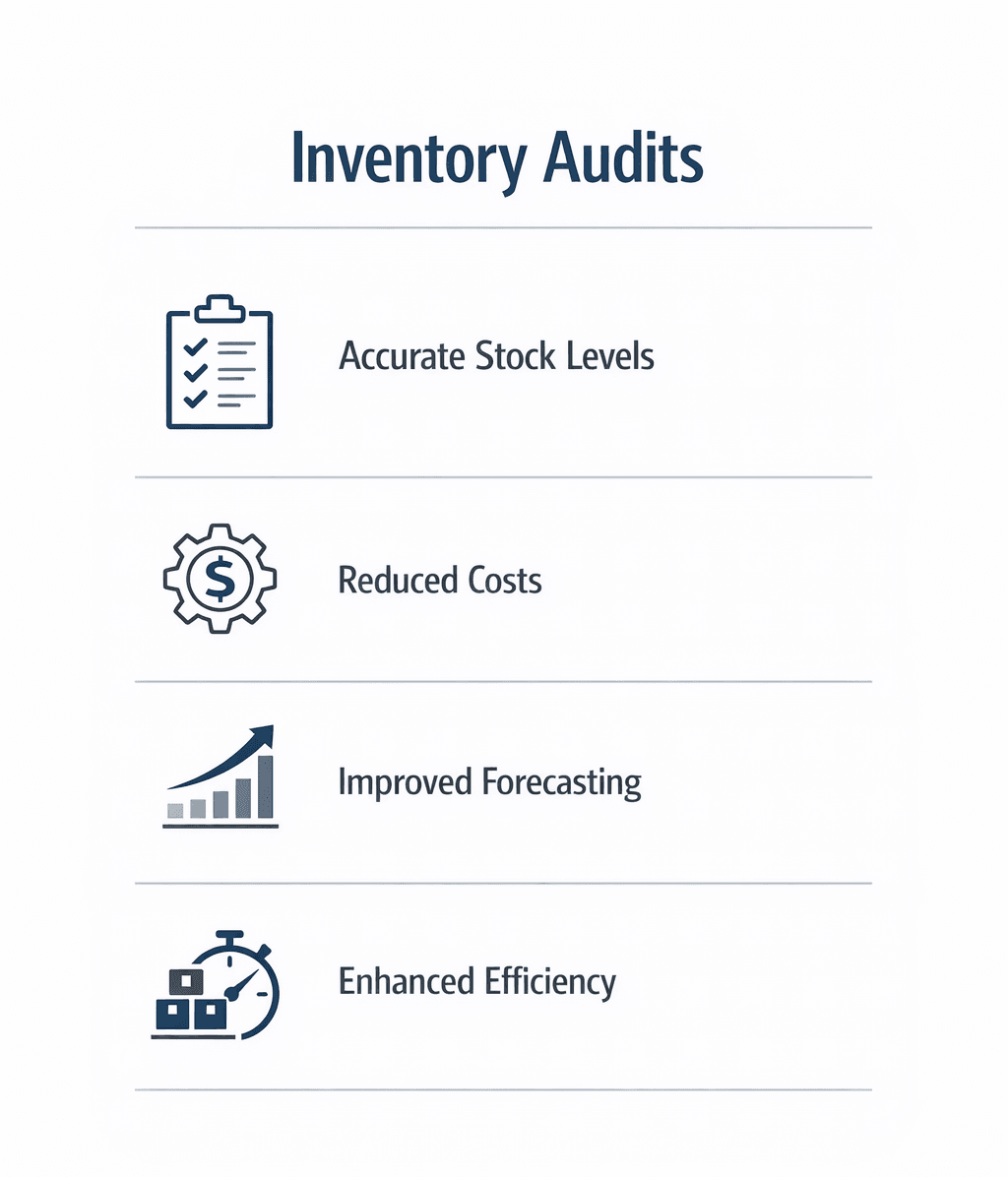
Inventory audits are not about counting stock.
They are about unlocking operational efficiency.
FAQs
- How inventory consultants reduce excess stock costs?
Inventory consultants analyze demand patterns, eliminate obsolete SKUs, optimize reorder quantities, and align procurement with real consumption to reduce carrying costs.
- What are inventory optimization solutions for manufacturing companies?
These include ABC classification, safety stock modeling, ERP integration, lean inventory strategies, and warehouse layout optimization.
- What are best practices for inventory control and warehouse operations?
Cycle counting, FIFO/FEFO methods, standardized bin systems, and real-time dashboards are considered global best practices.
- How often should an inventory audit be conducted?
Comprehensive audits annually, with cycle counting monthly or quarterly depending on SKU criticality.
- How do consultants improve supply chain and inventory visibility?
By integrating digital tracking systems, implementing KPI dashboards, improving data accuracy, and aligning procurement with demand forecasts.
Final Thoughts
Inventory is not just a storage function—it is a strategic lever for profitability.
Organizations that treat inventory audits as a continuous improvement tool gain:
- Stronger cash flow
- Higher operational efficiency
- Improved supply chain performance
With the right inventory management services and expert-led supply chain & inventory consulting, businesses can transform stock from a liability into a competitive advantage.
Contact us