In today’s competitive industrial landscape, manufacturing productivity is no longer driven by machines alone. It is driven by the strength of your supply chain.
Delayed raw materials, excess inventory, long lead times, and poor production planning can silently reduce output—even when machines and manpower are available. At Faber Infinite Consulting, we have seen this first-hand across Indian and global manufacturing facilities: when supply chains improve, production productivity follows.
This blog explains how supply chain optimization directly increases productivity in manufacturing, supported by industry research, real-world experience, and globally accepted standards.
Why Supply Chain Optimization Matters for Manufacturing Efficiency
Supply chain optimization refers to aligning procurement, inventory, logistics, production planning, and distribution to eliminate waste, reduce delays, and improve responsiveness.
According to the World Economic Forum, digitally enabled supply chains can reduce operational costs by up to 30% and increase efficiency significantly through improved visibility and planning.
Similarly, research from McKinsey & Company shows that companies that integrate supply chain planning with production systems improve service levels by 15–20% while reducing inventory by 20–30%.
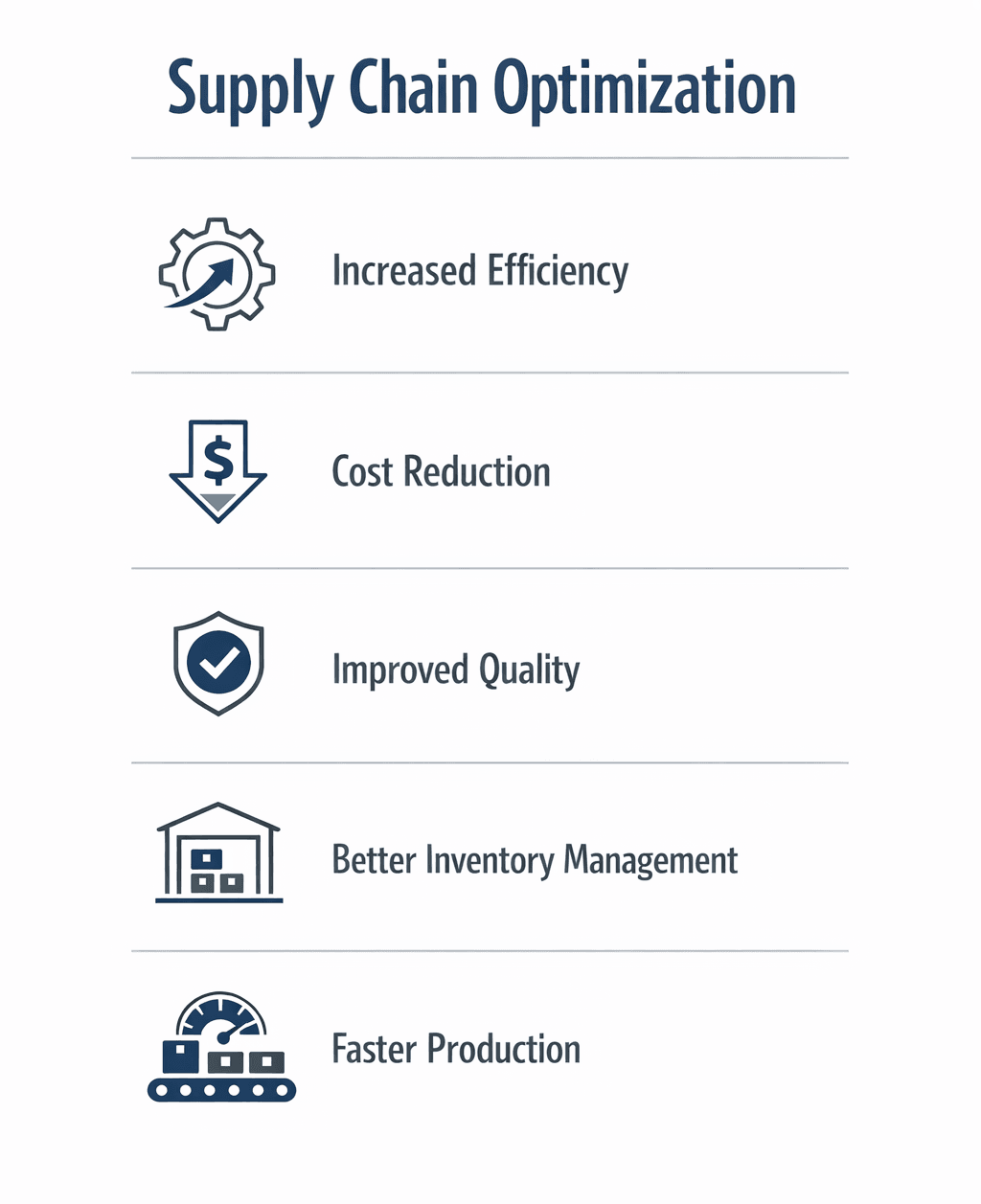
When supply chains are optimized:
- Raw materials arrive on time
- Inventory levels are balanced
- Machines run without interruptions
- Production planning becomes stable
- Output increases without adding capital
This is the foundation of manufacturing efficiency.
How Supply Chain Optimization Improves Manufacturing Output
Below is a structured breakdown of how optimized supply chains drive factory productivity improvement.
| Supply Chain Area | Optimization Strategy | Impact on Manufacturing Productivity | Measurable Outcome |
| Procurement | Strategic sourcing & vendor integration | Reduced material shortages | 10–25% downtime reduction |
| Inventory | Just-in-time (JIT) & demand forecasting | Lower working capital & better flow | 20–30% inventory reduction |
| Production Planning | Integrated planning systems | Stable production scheduling | 15–20% increase in production productivity |
| Logistics | Route optimization & tracking | Faster inbound/outbound movement | Reduced lead time by 10–15% |
| Maintenance | TPM integration with supply data | Higher machine uptime | OEE improvement of 8–15% |
| Digital Integration | Industry 4.0 visibility systems | Real-time decision-making | 5–10% output growth |
Experience: Real-World Insights from Faber Infinite Consulting
Case Example 1: FMCG Manufacturing Plant – India
A leading FMCG manufacturer was struggling with inconsistent production productivity despite having adequate capacity.
Problem Identified:
- Frequent stock-outs of critical raw materials
- Excess slow-moving inventory
- Reactive production planning
Intervention:
- End-to-end supply chain mapping
- Vendor performance tracking
- Integrated production planning system
- Waste reduction workshops
Results (within 6 months):
- 18% increase in manufacturing productivity
- 22% reduction in inventory
- 12% improvement in on-time delivery
The machines were not the issue—the supply chain flow was.
Case Example 2: Engineering Manufacturing Facility
A mid-sized engineering unit aimed for factory productivity improvement but faced:
- Long changeover delays due to material unavailability
- Maintenance delays from spare part shortages
- Poor coordination between stores and production
We implemented:
- Structured production planning dashboards
- Spare parts forecasting
- Integration of Japan Institute of Plant Maintenance guidelines for total productive maintenance (TPM)
Results:
- 14% increase in OEE
- 20% reduction in machine idle time
- 16% growth in monthly output
Supply chain visibility strengthened TPM effectiveness.
The Role of Lean Manufacturing Productivity
Supply chain optimization is deeply connected to lean manufacturing productivity.
Lean principles—originating from the Toyota Motor Corporation production system—focus on eliminating waste (Muda), unevenness (Mura), and overburden (Muri).
When applied to supply chains, lean enables:
- Waste reduction in transportation
- Reduced excess inventory
- Shorter lead times
- Balanced production flow
Lean manufacturing techniques to improve productivity include:
- Value Stream Mapping (VSM)
- Kanban systems
- Pull-based replenishment
- Supplier integration
These practices directly improve production productivity without increasing workforce or capital expenditure.
How TPM Improves Productivity and Machine Efficiency
Total Productive Maintenance (TPM) plays a critical role in supply chain optimization.
According to International Organization for Standardization frameworks aligned with operational reliability standards, equipment uptime is a critical driver of output.
When supply chains support TPM:
- Spare parts are available on time
- Preventive maintenance schedules are predictable
- Breakdown frequency decreases
This results in:
- Higher machine efficiency
- Stable production planning
- Increased manufacturing efficiency
Without supply chain alignment, TPM initiatives struggle to deliver full results.
Industry 4.0 Solutions to Increase Manufacturing Productivity
Digital transformation Industry 4.0 enhances supply chain optimization through:
- Real-time inventory visibility
- IoT-based machine monitoring
- Predictive maintenance
- AI-driven demand forecasting
According to Deloitte, manufacturers adopting Industry 4.0 technologies see productivity improvements between 10–20%.
At Faber Infinite Consulting, we integrate:
- ERP-based planning systems
- Digital dashboards
- Real-time KPI monitoring
- Data-driven continuous improvement
This strengthens both supply chain performance and operational excellence.
Best Strategies to Increase Productivity in Manufacturing Facilities
Here are practical, actionable strategies:
- Align Production Planning with Demand Forecasting
- Integrate sales forecasts with production schedules
- Reduce overproduction and underproduction
- Reduce Inventory Without Risk
- Apply ABC analysis
- Implement safety stock optimization
- Strengthen Vendor Partnerships
- Evaluate supplier performance quarterly
- Introduce collaborative planning
- Integrate TPM with Supply Planning
- Ensure spare parts availability
- Track machine downtime data
- Adopt Continuous Improvement Culture
- Monthly KPI reviews
- Structured root cause analysis
- Cross-functional improvement teams
These strategies help answer the critical question:
How to increase productivity in manufacturing industries sustainably?
Measurable Impact of Supply Chain Optimization
When properly implemented, organizations typically observe:
- 15–25% increase in manufacturing productivity
- 10–20% improvement in manufacturing efficiency
- 20–30% reduction in working capital
- 10–15% improvement in quality improvement metrics
- Stronger operational excellence alignment
The key is integration—not isolated improvements.
Internal Link Suggestion
For deeper insights into production systems, read our related blog on Lean & TPM for Manufacturing Productivity Improvement (internal link).
Conclusion: From Flow to Output
Supply chain optimization is not just a logistics function—it is a strategic productivity lever.
When procurement, production planning, TPM, digital transformation, and lean practices work together, production productivity rises without heavy capital investment.
At Faber Infinite Consulting, our experience across multiple industries confirms this:
The fastest way to increase productivity in manufacturing is to improve flow before expanding capacity.
Actionable Takeaways:
- Map your end-to-end supply chain
- Integrate demand planning with production
- Implement lean manufacturing productivity tools
- Align TPM with spare parts planning
- Adopt Industry 4.0 visibility systems
Optimize flow. Stabilize production. Increase output.
FAQs
- How to increase productivity in manufacturing industries?
Focus on supply chain optimization, lean manufacturing techniques, production planning alignment, and TPM integration to reduce downtime and waste.
- How TPM improves productivity and machine efficiency?
TPM reduces breakdowns, improves equipment uptime, and ensures preventive maintenance—leading to higher production productivity.
- What are the best strategies to increase productivity in manufacturing facilities?
Implement lean manufacturing, digital transformation Industry 4.0 tools, optimize inventory, and strengthen supplier coordination.
- How does Industry 4.0 increase manufacturing productivity?
Industry 4.0 enables real-time data visibility, predictive maintenance, and AI forecasting—leading to faster decisions and improved output.
- What is the link between supply chain optimization and factory productivity improvement?
An optimized supply chain ensures uninterrupted material flow, stable production planning, and higher machine utilization—directly improving factory productivity.
Contact us