In today’s competitive business environment, productivity is no longer just about working harder — it’s about working smarter. Organizations across manufacturing, logistics, FMCG, and services often ask one crucial question:
How do we measure productivity accurately and improve it sustainably?
At Faber Infinite Consulting, our experience as productivity consultants shows that most organizations track output — but fail to measure efficiency, utilization, and value creation systematically. This blog explains how to measure productivity effectively using structured metrics, industry standards, and consulting-driven frameworks aligned with operational excellence and continuous improvement.
Why Measuring Productivity Matters
According to the Organisation for Economic Co-operation and Development (OECD), productivity growth remains the primary driver of long-term economic performance and competitiveness. Organizations that consistently track productivity metrics outperform peers in profitability and operational efficiency.
Similarly, research from McKinsey & Company highlights that companies with structured productivity improvement systems achieve 20–30% higher operational efficiency compared to those relying on ad-hoc performance reviews.
The key difference?
They measure what truly matters.
H2: What Is Productivity in Organizational Context?
Productivity is not just “output per employee.” It is the relationship between output generated and resources consumed — including time, labor, capital, energy, and materials.
Core Productivity Formula
| Component | Explanation |
| Output | Units produced, revenue generated, service delivered |
| Input | Labor hours, machine time, capital investment |
| Productivity | Output ÷ Input |
However, modern business productivity consulting goes deeper than this basic formula.
H2: Types of Productivity Metrics Organizations Must Track
Effective measurement requires multiple productivity metrics aligned to business goals.
H3: 1. Labor Productivity
| Metric | Formula | Use Case |
| Output per Labor Hour | Total Output ÷ Total Labor Hours | Manufacturing & Services |
| Revenue per Employee | Total Revenue ÷ Total Employees | Corporate Performance |
| Value Added per Employee | (Revenue – Input Cost) ÷ Employees | Strategic Analysis |
Real Insight from Faber Infinite Consulting:
In one FMCG plant, we observed that labor productivity appeared high on paper. However, time-motion studies revealed 22% hidden idle time between process handoffs. After lean restructuring, productivity improved by 18% without additional manpower.
H3: 2. Operational Productivity
Operational productivity consultants focus on process flow efficiency.
| Metric | What It Measures | Impact |
| Overall Equipment Effectiveness (OEE) | Availability × Performance × Quality | Manufacturing optimization |
| Throughput Rate | Units processed per hour | Flow efficiency |
| Cycle Time | Time taken per process | Bottleneck detection |
| Capacity Utilization | Actual Output ÷ Maximum Capacity | Asset productivity |
OEE methodology is widely promoted by the International Society of Automation as a core benchmark in industrial environments.
H3: 3. Financial Productivity
| Metric | Formula | Strategic Value |
| Cost per Unit | Total Cost ÷ Units Produced | Cost reduction strategies |
| Contribution Margin | Revenue – Variable Cost | Profit analysis |
| Return on Assets (ROA) | Net Income ÷ Total Assets | Capital productivity |
H2: How Productivity Consultants Improve Workplace Performance
Professional productivity consultant services take a structured, data-backed approach.
Step-by-Step Consulting Framework
| Phase | Activity | Outcome |
| Diagnostic Study | Time-motion study, process mapping | Baseline productivity |
| Data Collection | KPI measurement, operational audits | Gap identification |
| Root Cause Analysis | Lean tools, Pareto, Fishbone | Bottleneck clarity |
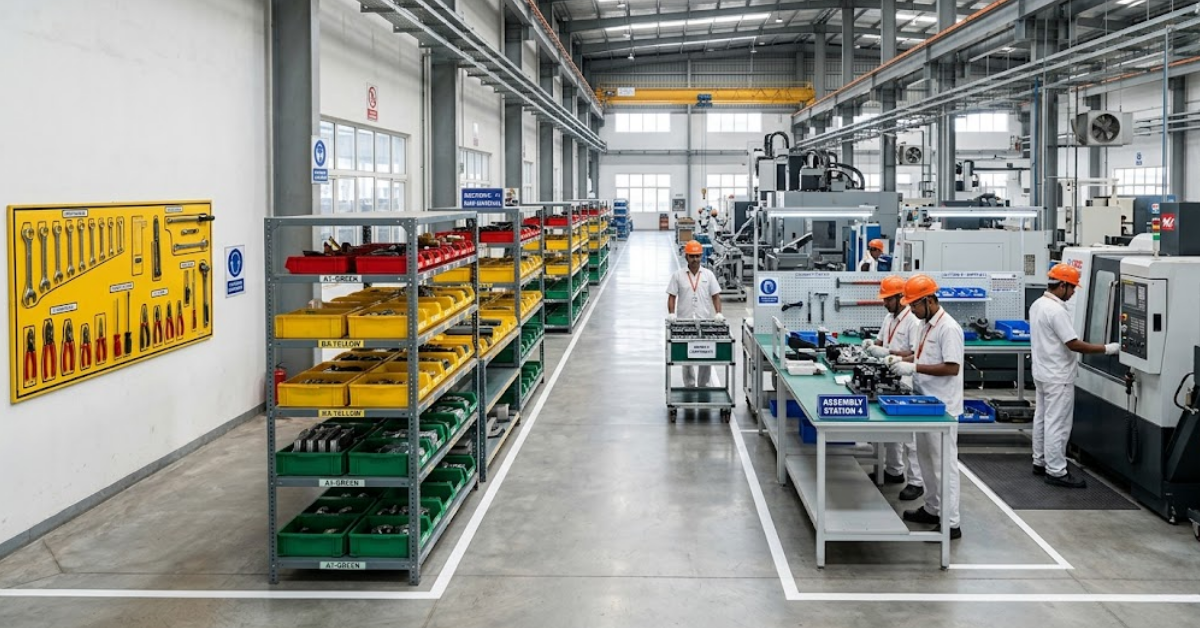
| Implementation | Lean techniques, TPM, 5S | Efficiency gains |
| Monitoring | Daily work management systems | Sustained improvement |
At Faber Infinite Consulting, our workplace productivity consultants combine Lean Manufacturing, TPM, and performance dashboards to deliver measurable gains across sectors.
H2: Lean Techniques Used by Productivity Consultants
Lean methodologies remain foundational for productivity improvement consulting.
Core Lean Tools
| Lean Tool | Purpose | Productivity Impact |
| 5S | Workplace organization | Reduced search time |
| Kaizen | Continuous improvement | Small daily gains |
| SMED | Quick changeovers | Increased uptime |
| Value Stream Mapping | End-to-end flow analysis | Waste elimination |
| TPM | Total Productive Maintenance | Higher OEE |
The Toyota Production System, developed by Toyota Motor Corporation, remains a global benchmark in operational productivity and lean efficiency.
H2: Case Study: Productivity Improvement Through Consulting
Industry: Packaging Manufacturing
Challenge:
- Rising manpower costs
• Low machine utilization
• Inconsistent output
Intervention by Faber Infinite Consulting:
- Time-motion study
• OEE tracking implementation
• Line balancing
• Daily KPI review structure
Results:
| Metric | Before | After | Improvement |
| OEE | 58% | 76% | +18% |
| Labor Productivity | 1.8 tons/worker | 2.3 tons/worker | +27% |
| Cost per Unit | ₹100 | ₹84 | -16% |
The improvement was achieved without capital expansion — purely through structured business productivity consulting and continuous improvement methods.
H2: How to Measure Productivity Efficiency in Organizations
A clear, structured measurement system includes:
- Define Clear KPIs
Align metrics with strategy — growth, cost leadership, or innovation.
- Establish Baseline Data
Measure at least 3 months of operational data before intervention.
- Benchmark Against Industry
Use credible benchmarks from:
- World Economic Forum
- International Labour Organization
- Implement Visual Dashboards
Daily performance tracking increases accountability.
- Review and Improve Continuously
Productivity measurement is not a one-time audit — it is a management discipline.
H2: Common Mistakes in Productivity Measurement
| Mistake | Why It Fails |
| Measuring output only | Ignores resource efficiency |
| Focusing only on manpower | Machines & systems matter too |
| No real-time tracking | Delayed corrective action |
| Ignoring employee engagement | Productivity drops long-term |
| One-time improvement projects | No sustainability |
H2: Role of Operational Productivity Consultants
Operational productivity consultants bring:
- Structured diagnostic capability
- Cross-industry benchmarking
- Proven cost reduction strategies
- Lean and continuous improvement frameworks
- Implementation discipline
Without expert intervention, many organizations struggle to convert productivity metrics into actionable improvements.
H2: Building a Culture of Continuous Improvement
Continuous improvement methods for productivity enhancement include:
| Method | Impact |
| Daily Work Management | Accountability |
| Skill Matrix Development | Multi-skilling |
| Performance Review Cadence | Strategic alignment |
| Leadership Gemba Walks | Real-time visibility |
According to studies published by Harvard Business Review, organizations with strong performance management systems show significantly higher productivity growth rates.
H2: Conclusion: Measure Smart. Improve Faster.
Measuring productivity effectively requires:
✔ Clear productivity metrics
✔ Accurate baseline data
✔ Lean implementation
✔ Continuous improvement systems
✔ Expert guidance from productivity consultants
At Faber Infinite Consulting, we help organizations transform productivity measurement into measurable business growth. Whether through workplace productivity consultants, operational efficiency diagnostics, or business productivity consulting frameworks — the goal is simple:
Higher Output. Lower Waste. Sustainable Growth.
H2: Frequently Asked Questions (FAQs)
- How productivity consultants improve workplace performance?
They conduct diagnostic studies, identify bottlenecks, implement lean techniques, and establish KPI tracking systems to deliver measurable operational efficiency improvements.
- What are the most important productivity metrics?
Labor productivity, OEE, cost per unit, throughput rate, and capacity utilization are critical productivity metrics.
- How to measure productivity efficiency in organizations?
Divide output by input, track operational KPIs, benchmark against industry standards, and implement continuous improvement systems.
- What is the difference between efficiency and productivity?
Efficiency focuses on minimizing waste; productivity measures output relative to input. Both are interlinked.
- Why should companies hire operational productivity consultants?
External consultants bring structured frameworks, cross-industry expertise, objective analysis, and faster implementation capability.
If your organization is looking to improve operational efficiency, implement cost reduction strategies, and build a culture of continuous improvement — Faber Infinite Consulting can help you measure, improve, and sustain productivity growth.