In today’s competitive manufacturing environment, productivity improvement is no longer optional it is survival. Rising labor costs, tight delivery schedules, and margin pressure demand scientific performance measurement.
At Faber Infinite Consulting, we have seen firsthand how a structured time and motion study can unlock 15%–35% productivity gains without major capital investment. This blog explores real case studies, proven frameworks, and expert-backed methodologies that demonstrate how time study in manufacturing transforms operational performance.
What Is a Time & Motion Study?
A time and motion study is a structured work measurement study used to analyze the time taken to perform tasks and evaluate the efficiency of movements involved.
| Component | Focus Area | Outcome |
| Time Study | Measures task duration | Standard time setting |
| Motion Study | Analyzes operator movements | Eliminates wasteful motions |
| Industrial Time Study | Applied in production setups | Improves labor productivity |
| Work Measurement | Establishes performance benchmarks | Capacity utilization planning |
The concept was pioneered by Frederick Winslow Taylor and later expanded through motion efficiency research by Frank B. Gilbreth and Lillian M. Gilbreth.
Today, it is a core component of Lean Manufacturing, endorsed by global bodies such as International Labour Organization for systematic work-study techniques.
Why Time & Motion Study Matters Today
According to research, manufacturing productivity can improve by 20–30% through structured operational optimization.
Our experience across FMCG, automotive, packaging, and across 40+ industries have confirms similar outcomes when industrial time study is implemented correctly.
Key benefits include:
- Accurate operator performance rating and work measurement methods
- Improved capacity utilization
- Reduced idle time
- Balanced line efficiency
- Improved labor productivity
- Scientific manpower planning
Real Case Studies: Productivity Gains Through Time & Motion Study
Below are real-world examples from Faber Infinite Consulting engagements.
Case Study 1: Automotive Sector
Problem
-
The client (an OEM supplier of cooling systems, gaskets & rubber products) faced several shop floor challenges across all 4 production and assembly lines:
- Shop floor efficiency issues across all production lines
- Imbalanced operations creating Muda (waste), Mura (unevenness), and Muri (overburden)
- Ergonomic workstation design issues
- Absence of standard operating procedures (SOPs)
Approach (Time and Motion Analysis)
| Step | Action Taken |
|---|---|
| Time & Motion Study | Defined standard times per ILO standards; video-recorded operations; broke tasks into sub-elements |
| Waste Analysis | Identified and eliminated Muda, Mura & Muri across all lines |
| Line Balancing | Identified bottleneck operations; created workstation combinations to reduce manpower |
| Workstation Design | Redesigned for ergonomics to cut fatigue and excess movement |
| NVA Elimination | Removed non-value-adding activities (excess walking, tool search, improper tools) using 5S, Kanban, VSM |
| Changeover Reduction | Applied Quick Changeover (SMED) tools |
Result
| Metric | Radiator Lines | Compressor Line |
|---|---|---|
| Productivity Improvement | +20% (avg. across 8 models) | +50% (2 → 3 units/shift) |
| Labor Cost Reduction | 25% | 50% |
| Work Content Reduction | — | 40% |
| Workstations Reduced | 4 per model (avg.) | 10 ergonomic stations designed |
Sustenance Plan
Results were maintained through Daily Work Management (DWM) and Systematic Audit & Improvement Loop (SAIL) to ensure continuous monitoring and long-term stability.
Case Study 2: Engineering Sector
Challenge
• Assembly line was unable to meet increased market
demand
• Rising issues of product quality
• No standard operating procedure in place
• Imbalanced operations creating Muda, Mura, Muri
• Work station design issues
Approach
| Tool / Method | Details |
|---|---|
| Time & Motion Study | Define standard times (fair day’s work) per ILO standards; list work elements; video shoot operations; calculate cycle time with performance & allowance factors |
| Waste Study | Study all Muda, Mura, Muri in the process and find ways to eliminate them |
| Lean Tools | Apply SMED, 5S (+safety), Kanban, 2 Bin system, Layout design, Incentive scheme, Logistics management to eliminate NVA |
| Line Balancing | Calculate TAKT time based on customer demand; rebalance the line accordingly |
| Workstation Design | Redesign workstations to eliminate fatigue and improve ergonomics |
Results
| Metric | Result |
|---|---|
| Throughput | Improved from 2 compressors/shift → 3 compressors/shift |
| Work Content | Reduced by 40% |
| Total Labor Cost | Reduced by 50% |
| Productivity | Improved by 50% |
| Workstation Layouts | 10 workstation layouts designed as per ergonomic standards |
Difference Between Time Study and Motion Study Explained
| Parameter | Time Study | Motion Study |
| Focus | Time duration | Movement efficiency |
| Objective | Set standard time | Reduce wasted motion |
| Output | Standard time sheet | Optimized method |
| Tools | Stopwatch, software | Video analysis, ergonomics |
Both together form time and motion analysis, a powerful productivity improvement tool.
Expert Insights & Industry Standards
The International Labour Organization (ILO) recommends work-study techniques to improve industrial competitiveness.
Research from Harvard Business Review highlights that data-driven performance management significantly improves operational results.
In Lean systems inspired by Toyota Motor Corporation, standardized work and motion optimization are foundational to achieving operational excellence.
At Faber Infinite Consulting, we integrate:
- Lean Manufacturing
- TPM (Total Productive Maintenance)
- Standardized Work
- Industrial Engineering tools
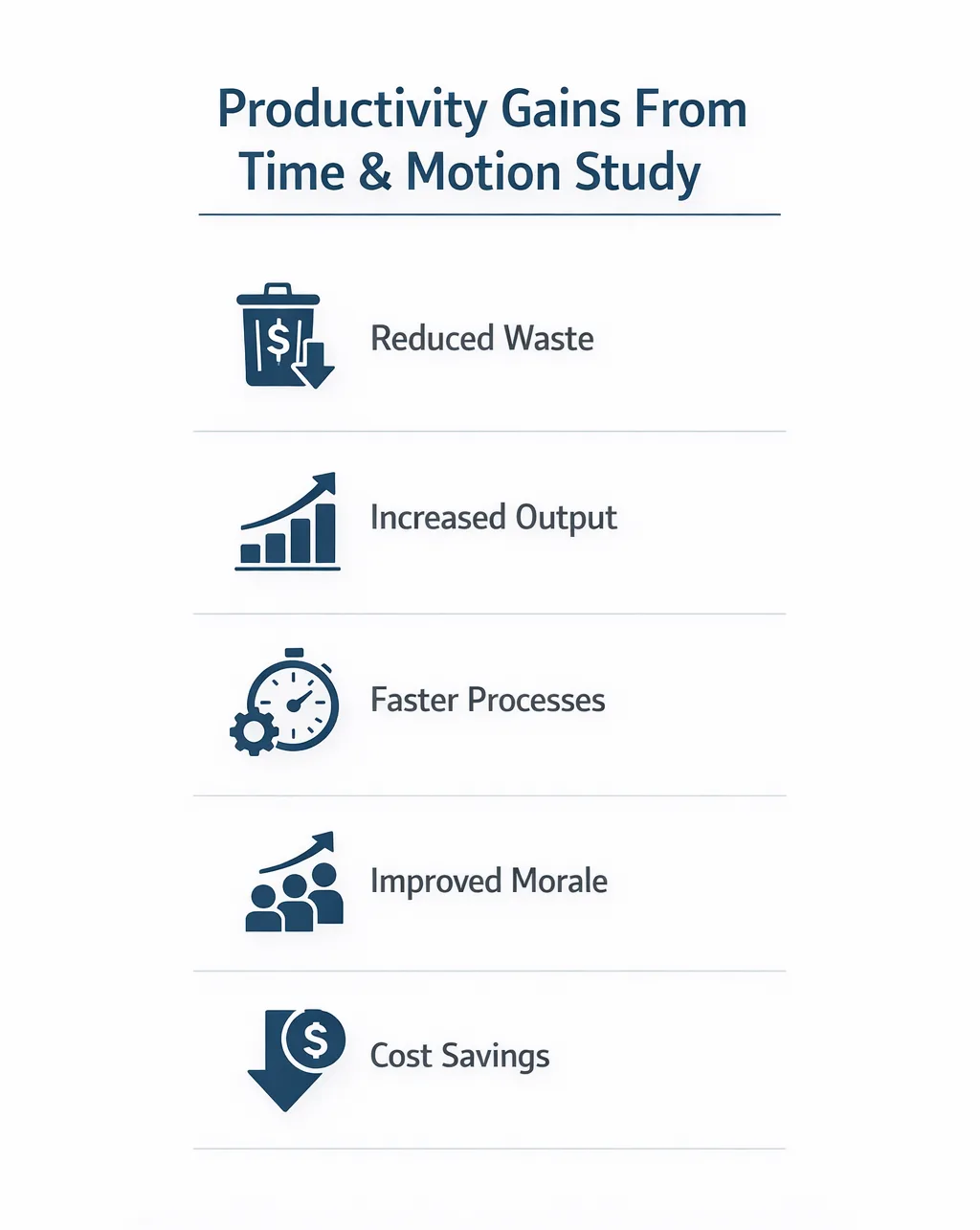
Benefits of Time & Motion Study in Manufacturing Industry
| Benefit | Business Impact |
| Improved labor productivity | Higher output per employee |
| Reduced cycle time | Faster deliveries |
| Better manpower planning | Controlled labor cost |
| Scientific performance targets | Fair evaluation |
| Increased capacity utilization | Improved ROI |
| Reduced fatigue | Safer workplace |
Common Mistakes to Avoid
- Measuring without method study
- Ignoring performance rating
- Not including allowances
- Poor communication with operators
- Treating it as a cost-cutting exercise only
Trust and transparency are critical for success.
Actionable Takeaways
- Start with one critical bottleneck process.
- Conduct structured work measurement study.
- Apply motion economy principles.
- Set realistic standard times.
- Align with Lean manufacturing goals.
- Track productivity weekly.
- Reinforce with continuous improvement culture.
When done correctly, time and motion study becomes a strategic growth accelerator not just an industrial engineering tool.
FAQs
- What is the main purpose of a time and motion study?
It helps measure task duration and eliminate inefficient movements to improve labor productivity and capacity utilization.
- How long does it take to conduct an industrial time study?
Typically 1–4 weeks depending on process complexity and data collection scope.
- What is the difference between time study and motion study?
Time study measures task duration; motion study analyzes movement efficiency. Together they optimize work methods.
- Can time study be applied in non-manufacturing sectors?
Yes. It is widely used in logistics, healthcare, warehouses, and service operations.
- Is time and motion study relevant in Lean manufacturing?
Absolutely. It supports standardized work, waste elimination, and continuous improvement.
Contact Us