Manufacturers often invest in new machines, advanced software, and skilled manpower. Yet, productivity gaps persist. Why?
Because productivity is not just about producing more — it’s about producing consistently, efficiently, and without disruption.
One of the most powerful frameworks to achieve this is Total Productive Maintenance (TPM) — a structured approach that aligns people, processes, and machines to maximize manufacturing productivity and ensure long-term operational excellence.
At Faber Infinite Consulting, we have seen firsthand how TPM transforms production productivity across industries — from FMCG to packaging and process manufacturing. This blog explains how TPM enhances manufacturing efficiency, supported by real experience, industry standards, and practical insights.
What is Total Productive Maintenance (TPM)?
Japan Institute of Plant Maintenance defines total productive maintenance (TPM) as a holistic approach to equipment management that aims to achieve:
- Zero breakdowns
- Zero defects
- Zero accidents
TPM evolved from the Toyota Production System and integrates deeply with lean manufacturing productivity principles.
At its core, TPM focuses on improving Overall Equipment Effectiveness (OEE) — a globally accepted performance metric measuring:
| OEE Component | Focus Area | Impact on Productivity |
| Availability | Downtime reduction | Increases production hours |
| Performance | Speed losses | Improves output rate |
| Quality | Defect reduction | Enhances usable output |
When OEE improves, factory productivity improvement follows naturally.
Why Manufacturing Productivity Suffers
Across Indian manufacturing facilities, common challenges include:
- Reactive maintenance culture
- Frequent machine breakdowns
- Low operator ownership
- Inconsistent production planning
- High changeover losses
- Quality rejections
According to World Economic Forum reports on global manufacturing competitiveness, productivity gaps are often linked to underutilized assets rather than lack of capacity.
This is where TPM plays a decisive role.
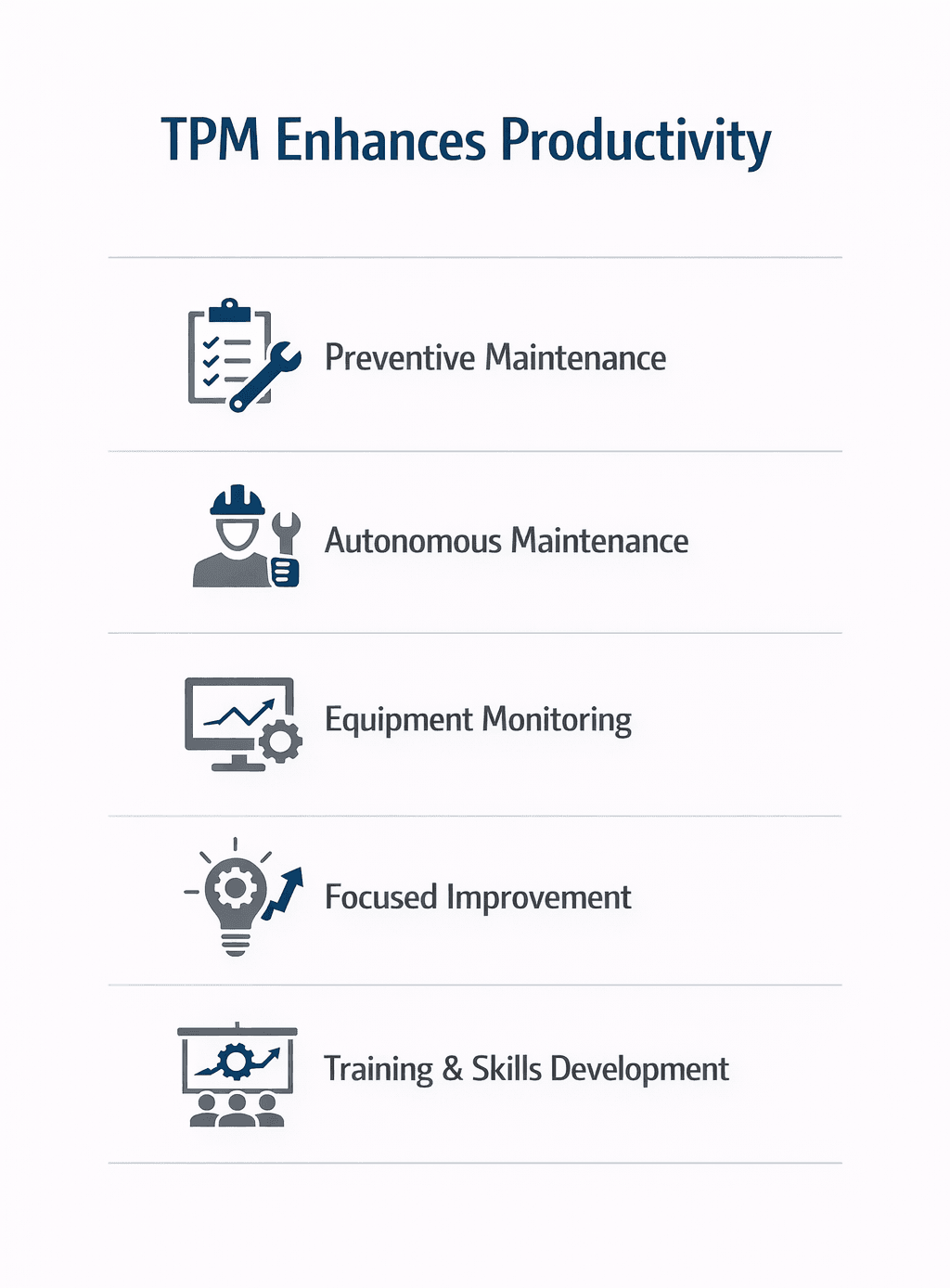
How TPM Enhances Manufacturing Productivity
Below is a structured breakdown of how TPM drives productivity improvement in manufacturing.
- Autonomous Maintenance: Operator Ownership
What it means: Operators take responsibility for routine maintenance like cleaning, inspection, lubrication, and tightening.
Impact on Manufacturing Efficiency:
| Before TPM | After TPM |
| Hidden defects | Early detection |
| Frequent minor stoppages | Stable production flow |
| Maintenance dependency | Shared accountability |
Experience Insight (Faber Infinite Consulting):
In one packaging plant, operators were trained under autonomous maintenance. Within 90 days:
- Minor stoppages reduced by 28%
- Breakdown frequency reduced by 18%
- Production productivity increased by 12%
This directly improved manufacturing efficiency without new capital investment.
- Planned Maintenance: From Reactive to Predictive
Reactive maintenance leads to unexpected downtime.
Planned maintenance uses data to predict failures before they occur.
With the integration of digital transformation Industry 4.0, manufacturers now use:
- Condition monitoring sensors
- Predictive analytics
- CMMS systems
This supports long-tail goals like:
industry 4.0 solutions to increase manufacturing productivity
Resulting Benefits:
- Reduced emergency repairs
- Lower maintenance cost
- Higher equipment availability
- Stable production planning
- Focused Improvement (Kaizen)
TPM promotes small, structured improvements targeting chronic losses.
Common Losses in Production Productivity:
- Startup losses
- Speed losses
- Changeover delays
- Micro stoppages
When addressed systematically, organizations experience measurable productivity improvement in manufacturing.
Case Insight:
In an FMCG facility supported by Faber Infinite Consulting:
- Changeover time reduced by 35%
- Line balancing improved by 20%
- Output per shift increased by 15%
This demonstrates how lean manufacturing techniques to improve productivity integrate seamlessly with TPM.
- Quality Maintenance
Machine instability often leads to defects.
TPM ensures:
- Equipment precision
- Standard parameter control
- Early detection of abnormality
This directly improves quality improvement metrics and reduces rework, which enhances manufacturing productivity.
According to industry benchmarks by International Organization for Standardization, process stability is a core requirement for consistent output and defect reduction.
- Training & Skill Development
TPM emphasizes multi-skilled operators.
When workforce capability improves:
- Machine handling becomes efficient
- Troubleshooting time reduces
- Production losses decrease
This strengthens operational excellence culture and supports long-term factory productivity improvement.
- Safety, Health & Environment
Accidents reduce production productivity significantly.
TPM’s zero-accident approach ensures:
- Reduced lost-time incidents
- Higher employee morale
- Stable shop-floor operations
Safe factories are productive factories.
TPM and Lean Manufacturing Productivity
TPM is not separate from Lean — it strengthens it.
| Lean Principle | TPM Contribution |
| Waste reduction | Eliminates downtime waste |
| Continuous improvement | Structured pillar system |
| Standardization | Preventive routines |
| Flow optimization | Stable machine uptime |
Together, they answer one of the most searched queries:
how to increase productivity in manufacturing industries
Measuring TPM Impact on Production Productivity
Key KPIs to track:
| KPI | Target Impact |
| OEE | > 85% world-class benchmark |
| MTBF (Mean Time Between Failures) | Increase trend |
| MTTR (Mean Time To Repair) | Reduce trend |
| Breakdown Hours | 20–40% reduction |
| Defect Rate | Continuous decline |
Organizations that sustain TPM for 2–3 years typically observe:
- 15–30% increase in manufacturing productivity
- 20–40% downtime reduction
- 10–25% cost savings
(Industry benchmarks based on global TPM implementation case studies.)
TPM + Industry 4.0: The Future of Factory Productivity
With digital transformation Industry 4.0, TPM becomes smarter.
Integration includes:
- IoT-enabled machines
- Real-time dashboards
- AI-based predictive maintenance
- Automated root cause analysis
This accelerates:
- Production planning accuracy
- Manufacturing efficiency
- Continuous improvement culture
Modern TPM is data-driven, not paper-based.
Real Experience: TPM Implementation Framework at Faber Infinite Consulting
At Faber Infinite Consulting, TPM implementation follows a structured roadmap:
| Phase | Focus |
| Phase 1 | Loss Mapping & OEE Baseline |
| Phase 2 | Autonomous Maintenance Training |
| Phase 3 | Planned Maintenance System |
| Phase 4 | Kaizen & Focused Improvement |
| Phase 5 | Performance Review & Digital Integration |
In one commercial manufacturing facility:
- OEE improved from 58% to 74% in 9 months
- Annual savings crossed ₹2.4 crore
- Production productivity stabilized with predictable planning
This demonstrates best strategies to increase productivity in manufacturing facilities without aggressive capital expenditure.
Why TPM Builds Trust and Sustainability
TPM is not a quick fix.
It builds:
- Ownership culture
- Equipment reliability
- Transparent performance tracking
- Sustainable productivity improvement in manufacturing
It aligns perfectly with operational excellence and long-term competitiveness.
Conclusion: Actionable Takeaways
If you want to increase productivity in manufacturing, start with equipment reliability.
Action Steps:
- Measure current OEE
- Identify top 5 recurring losses
- Train operators in autonomous maintenance
- Implement structured planned maintenance
- Integrate digital monitoring tools
TPM is not maintenance improvement — it is business performance improvement.
Manufacturing productivity improves when machines, people, and processes work in harmony.
FAQs
- How TPM improves productivity and machine efficiency?
TPM reduces breakdowns, eliminates speed losses, improves quality stability, and increases equipment availability, leading to higher production productivity.
- What is the difference between TPM and preventive maintenance?
Preventive maintenance focuses only on scheduled maintenance. TPM involves operators, management, and cross-functional teams for holistic productivity improvement in manufacturing.
- How long does TPM take to show results?
Initial improvements appear within 3–6 months. Sustainable factory productivity improvement requires 12–24 months of disciplined implementation.
- Can small manufacturers implement TPM?
Yes. TPM can be scaled. Even small manufacturing facilities can improve manufacturing efficiency by focusing on autonomous maintenance and basic OEE tracking.
- How does TPM support digital transformation Industry 4.0?
TPM provides structured data for predictive maintenance, IoT integration, and analytics, strengthening industry 4.0 solutions to increase manufacturing productivity.
Contact us