
Walk into any high-performing factory, and you’ll notice one thing immediately—everything has a place, and everything is in its place. That’s not by chance; it’s the result of the Five S methodology in lean manufacturing.
At Faber Infinite Consulting, we’ve seen firsthand how structured workplace organization can transform operations.
The truth is simple: productivity doesn’t always require big investments—it often starts with better organization.
What is Five S Methodology? (Quick Overview)
| S | Japanese Term | Meaning | Objective |
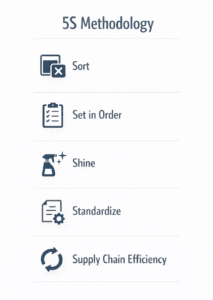
| 1 | Seiri | Sort | Remove unnecessary items |
| 2 | Seiton | Set in Order | Arrange for easy access |
| 3 | Seiso | Shine | Clean and inspect |
| 4 | Seiketsu | Standardize | Maintain consistency |
| 5 | Shitsuke | Sustain | Build discipline |
Why Five S in Manufacturing India Matters Today
- Rising competition and cost pressure demand efficiency
- Labor productivity gaps still exist in many Indian plants
- Safety and compliance requirements are increasing
- Lean transformation is becoming a necessity, not a choice
According to the Lean Enterprise Institute, organizations implementing lean tools like 5S report up to 20–30% improvement in productivity.
Step-by-Step Guide to Five S Methodology Implementation
-
SORT (Seiri) – Eliminate the Waste
| Action | Practical Implementation | Expected Impact |
| Identify unnecessary items | Red tag unused tools/materials | Reduce clutter by 20–40% |
| Remove excess inventory | Dispose, relocate, or recycle | Free up floor space |
| Classify items | Keep only essentials near workstations | Improve accessibility |
Experience Insight:
In a packaging plant, removing obsolete dies freed up 15% floor space, enabling smoother material flow.
-
SET IN ORDER (Seiton) – Organize Smartly
| Action | Practical Implementation | Expected Impact |
| Define locations | Label racks, tools, and storage | Reduce search time |
| Visual management | Color coding, shadow boards | Improve efficiency |
| Workflow alignment | Place items near point of use | Minimize motion waste |
Expert Tip:
Use visual management systems for 5S like floor markings and digital boards to maintain clarity.
-
SHINE (Seiso) – Clean to Inspect
| Action | Practical Implementation | Expected Impact |
| Deep cleaning | Schedule daily/weekly cleaning | Improve safety |
| Inspection routines | Identify leaks, wear, defects | Prevent breakdowns |
| Ownership culture | Assign cleaning responsibilities | Increase accountability |
Case Example:
A chemical plant reduced machine downtime by 22% after linking cleaning with inspection.
-
STANDARDIZE (Seiketsu) – Create Consistency
| Action | Practical Implementation | Expected Impact |
| SOP creation | Document best practices | Reduce variation |
| Visual standards | Before-after images, checklists | Ensure uniformity |
| Audit systems | Weekly 5S audits | Sustain improvements |
-
SUSTAIN (Shitsuke) – Build Culture
| Action | Practical Implementation | Expected Impact |
| Training programs | Regular employee training | Improve discipline |
| Leadership involvement | Daily Gemba walks | Stronger adoption |
| Performance tracking | KPI dashboards | Continuous improvement |
Common 5S Implementation Challenges & Solutions
| Challenge | Root Cause | Solution |
| Lack of sustainment | No leadership follow-up | Daily audits + leadership involvement |
| Employee resistance | Change fatigue | Training + engagement |
| Poor standardization | No clear SOPs | Visual and documented standards |
| Initial enthusiasm fades | No tracking metrics | KPI-based monitoring |
Why the Five S Methodology Fails Without Leadership Buy-In
From our experience across 40+ industries, the biggest failure reason is simple—lack of ownership at the top.
Leaders must:
- Participate in audits
- Reinforce standards
- Recognize teams
Without this, 5S becomes a one-time activity instead of a culture.
How 5S Improves Employee Safety in India
| Safety Area | Improvement via 5S |
| Slips & falls | Clear pathways |
| Fire hazards | Removal of clutter |
| Equipment safety | Regular inspection |
| Ergonomics | Organized workstations |
According to Occupational Safety and Health Administration, organized workplaces significantly reduce accident risks.
Real Business Impact of 5S (Lean Manufacturing Results)
| Metric | Before 5S | After 5S |
| Search time | High | Reduced by 30–50% |
| Machine downtime | Frequent | Reduced by 15–25% |
| Workplace accidents | Moderate | Reduced significantly |
| Productivity | Average | Improved by 20%+ |
How to Implement Five S Methodology in Your Small Factory
- Start with one pilot area
- Train supervisors first
- Use visual tools instead of complex systems
- Conduct weekly audits
- Scale gradually across departments
Role of Management in 5S Success
| Role | Responsibility |
| Top Management | Vision and commitment |
| Middle Management | Execution and monitoring |
| Shopfloor Teams | Daily adherence |
Why Choose Five S Methodology Consultants
Working with five s methodology consultants like Faber Infinite Consulting helps you:
- Avoid trial-and-error
- Achieve faster results
- Build sustainable systems
- Align 5S with business KPIs
Conclusion: Small Changes, Big Productivity Gains
The five s methodology implementation is not just about cleaning—it’s about creating a culture of discipline, efficiency, and continuous improvement.
Actionable Takeaways:
- Start small, scale fast
- Focus on visual management
- Involve leadership at every step
- Measure results consistently
- Build habits, not just systems
FAQs
-
Can the five s methodology reduce manufacturing lead time?
Yes, by eliminating search time, improving workflow, and reducing downtime, 5S directly impacts lead time reduction.
-
How long does it take to implement 5S?
Initial implementation can take 4–8 weeks, but sustaining it is an ongoing process.
-
Is 5S only for manufacturing?
No, it applies equally to offices, warehouses, hospitals, and service industries.
-
What are the key tools used in 5S?
- Red tagging
- Visual management boards
- Shadow boards
- Checklists
- Audit sheets
- Why does 5S fail in many organizations?
Lack of leadership involvement, poor follow-up, and absence of performance tracking are the main reasons.