
Organizations rarely fail due to lack of ambition. Most struggle because growth is not managed systematically. Markets change, customer expectations rise, costs fluctuate, and teams evolve. In such an environment, business management becomes the stabilizing force that aligns strategy, people, processes, and performance.
At Faber Infinite Consulting, our experience across multiple industries has consistently shown one truth: organizations that grow sustainably do not rely on isolated initiatives. They rely on strong business management systems that convert intent into execution, and execution into measurable outcomes.
This blog explores the importance of business management in organizational growth, drawing from real-world experience, proven frameworks, and globally accepted management standards.
What Is Business Management?
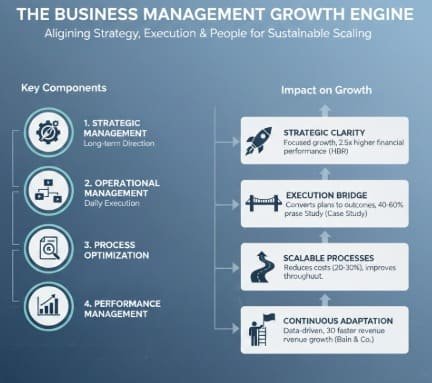
Business management refers to the structured planning, coordination, execution, and control of organizational activities to achieve defined objectives. It integrates:
-
Strategic management for long-term direction
-
Operational management for day-to-day execution
-
Business process improvement to eliminate inefficiencies
-
Performance management to track results and course-correct
Effective business management ensures that growth is not reactive, but intentional and repeatable.
Why Business Management Is Critical for Organizational Growth
1. Strategic Clarity Drives Focused Growth
Growth without direction often results in wasted effort. Strategic management provides clarity on:
-
Where the organization is going
-
Which markets and capabilities matter most
-
How resources should be prioritized
According to a Harvard Business Review study, companies with clearly articulated strategies are 2.5 times more likely to outperform their peers financially.
At Faber Infinite, we have seen organizations achieve faster scale once strategic objectives are translated into actionable operational goals rather than remaining as leadership presentations.
2. Business Management Connects Strategy to Execution
Many organizations have strong strategic plans but weak execution. Business management bridges this gap by:
-
Converting strategy into measurable initiatives
-
Assigning ownership and timelines
-
Tracking progress through performance dashboards
For example, during a manufacturing transformation engagement, Faber Infinite helped align strategic growth targets with shop-floor execution. The result was a 40–60% improvement in productivity within 12 months, without additional capital investment.
This demonstrates how business strategy development, when supported by disciplined management systems, leads to tangible outcomes.
Role of Business Management in Process Optimization
3. Process Excellence Enables Scalable Growth
As organizations grow, unmanaged processes become bottlenecks. Business management emphasizes process optimization by:
-
Identifying non-value-adding activities
-
Reducing cycle times and rework
-
Standardizing best practices
McKinsey reports that effective process improvement can reduce operational costs by 20–30%, while improving service quality.
Through structured business process improvement programs, Faber Infinite has supported organizations in achieving:
-
Higher throughput
-
Reduced operational variability
-
Predictable delivery performance
Growth becomes sustainable only when processes scale faster than complexity.
4. Operational Excellence Strengthens Competitive Advantage
Operational excellence is not about working harder; it is about working systematically. Strong business management embeds:
-
Clear operating rhythms
-
Data-driven decision-making
-
Continuous improvement culture
Organizations that adopt operational excellence frameworks such as Lean and Six Sigma often report 25–50% capacity improvement without expanding physical assets.
This disciplined approach allows leadership teams to focus on growth opportunities rather than firefighting daily issues.
Managing Organizational Change Effectively
5. Business Management Reduces Change Fatigue
One of the most overlooked aspects of growth is change management. Without structure, transformation efforts fail due to resistance and confusion.
Effective business management helps leaders:
-
Communicate change clearly
-
Align teams around common goals
-
Measure adoption, not just implementation
How to manage organizational change effectively depends on leadership consistency, role clarity, and feedback loops. At Faber Infinite, we emphasize practical change models that integrate people, processes, and performance, ensuring change becomes part of daily work rather than a one-time initiative.
Impact of Digital Transformation on Business Management
6. Technology Strengthens, Not Replaces, Management
Digital tools are powerful enablers, but only when guided by strong management principles.
The impact of digital transformation on management includes:
-
Real-time visibility into performance
-
Faster decision cycles
-
Improved coordination across functions
Technologies such as artificial intelligence in management and automation in management support:
-
Demand forecasting
-
Predictive maintenance
-
Workflow automation
However, technology without governance leads to fragmented systems. Business management ensures digital investments support strategic objectives rather than creating complexity.
Role of a Business Management Consultant in Growth
7. Why Organizations Engage Business Management Consultants
A business management consultant brings:
-
External perspective
-
Structured methodologies
-
Experience across industries
At Faber Infinite Consulting, our role extends beyond advisory. We work alongside leadership and teams to:
-
Design practical management systems
-
Improve operational efficiency
-
Build internal capability for continuous improvement
Our consulting engagements focus on process excellence, leadership alignment, and measurable impact, ensuring growth initiatives deliver results that last.
Strategic Planning as a Growth Enabler
8. Strategic Planning Is a Living Process
The strategic planning process for companies must evolve with market dynamics. Effective business management ensures:
-
Regular strategy reviews
-
Alignment between annual plans and long-term goals
-
Early identification of risks and opportunities
According to Bain & Company, organizations that revisit their strategic plans quarterly outperform those that plan annually by 30% in revenue growth.
Strategic planning, when embedded into business management routines, becomes a continuous advantage rather than an annual exercise.
Building a Culture of Continuous Improvement
9. Growth Thrives in Learning Organizations
Sustainable growth depends on how quickly an organization learns and adapts. Business management supports continuous improvement by:
-
Encouraging problem-solving at all levels
-
Using data to guide improvements
-
Recognizing incremental gains
This culture reduces dependency on external interventions and creates self-sustaining growth momentum.
Conclusion: Business Management Is the Growth Engine
Organizational growth is not driven by isolated initiatives or short-term fixes. It is built through disciplined business management, where strategy, operations, people, and technology work in harmony.
Organizations that invest in strong management systems achieve:
-
Higher operational efficiency
-
Better strategic alignment
-
Faster, more predictable growth
At Faber Infinite Consulting, our experience confirms that when business management is treated as a core capability, growth becomes repeatable, measurable, and resilient.
Actionable Takeaways
-
Align strategy with execution through structured management systems
-
Focus on process optimization before adding resources
-
Use technology to enhance visibility and decision-making
-
Build leadership capability to manage change effectively
-
Embed continuous improvement into daily operations
Frequently Asked Questions (FAQs)
1. What is the role of business management in organizational growth?
Business management aligns strategy, processes, and people, ensuring growth initiatives translate into measurable and sustainable results.
2. How does operational excellence support business growth?
Operational excellence improves efficiency, reduces waste, and increases capacity, enabling organizations to scale without proportional cost increases.
3. How can companies manage organizational change effectively?
Clear communication, leadership alignment, performance tracking, and employee involvement are critical to managing change successfully.
4. What is the impact of digital transformation on management practices?
Digital transformation enhances data visibility, speeds up decision-making, and improves coordination when guided by strong management frameworks.
5. When should a company hire a business management consultant?
Organizations benefit from consultants when facing growth plateaus, complex transformations, or the need for structured business process improvement.
Contact us