India is one of the fastest-growing major economies in the world. According to the International Monetary Fund, India continues to remain among the top-growing large economies globally. With rapid digitalization, regulatory shifts, global competition, and evolving workforce expectations, organizational change in India is not a strategic option—it is a survival imperative.
At Faber Infinite Consulting, we have worked with manufacturing plants, logistics operators, FMCG units, and industrial businesses across sectors. One clear pattern emerges: companies that treat change as a structured capability outperform those that treat it as a reaction.
This blog explores the importance of organizational change in Indian companies, backed by experience, research, and proven frameworks.
What Is Organizational Change?
Definition (Crisp Overview)
| Element | Explanation |
| Organizational Change | Structural, cultural, process, or strategic shifts within a company |
| Organizational Change Management | Structured approach to transition individuals, teams, and systems |
| Organizational Change Strategy | Roadmap that aligns people, processes, and technology |
| Change Management Process | Steps followed to implement change successfully |
| Organizational Development | Long-term capability building for sustainable growth |
According to McKinsey & Company, nearly 70% of large-scale transformations fail, often due to lack of structured change management and leadership alignment.
Why Organizational Change Is Important for Indian Businesses
- Competitive Pressure & Global Integration
India is deeply integrated into global supply chains. Whether automotive, pharmaceuticals, textiles, or FMCG—Indian companies compete not just locally, but internationally.
Impact Table
| Market Reality | Why Change Is Necessary |
| Global competition | Improve productivity & cost efficiency |
| Export standards | Upgrade quality & compliance systems |
| Digital adoption | Integrate Industry 4.0 practices |
| ESG expectations | Adopt sustainable operations |
The World Economic Forum emphasizes that digital transformation and agile operating models are critical for emerging market competitiveness.
- Digital Transformation & Industry 4.0
India’s manufacturing push through initiatives like Make in India has accelerated modernization. But installing technology without managing change creates resistance.
From our experience at Faber Infinite Consulting:
A large industrial client invested in automation but saw only 12% output improvement initially. After implementing a structured organizational change strategy—including role redesign, skill upgradation, and KPI alignment—productivity improved by 34% within 9 months.
Key Insight: Technology transformation without cultural change fails.
- Workforce Demographics & Cultural Shift
India has one of the youngest workforces globally. According to World Bank data, India’s working-age population continues to expand.
Young professionals expect:
- Transparent leadership
- Performance-based growth
- Flexible systems
- Digital tools
This makes cultural change in organizations essential.
Organizational Change Examples in India
Below are structured, real-world inspired scenarios (without disclosing client names):
| Industry | Change Trigger | Strategy Applied | Result |
| FMCG Manufacturing | High manpower cost | Time & Motion Study + Lean Redesign | 22% productivity gain |
| Logistics | Delayed dispatch cycles | Process re-engineering | 30% reduction in turnaround time |
| Packaging | Low asset utilization | KPI-driven governance model | 18% capacity improvement |
| Engineering | Layout inefficiency | Lean Facility Design | 25% travel reduction |
These are practical demonstrations of organizational change management in India working effectively.
Key Drivers of Organizational Change in Indian Companies
H3: Economic & Regulatory Changes
- GST reforms
- ESG compliance
- Labour code reforms
H3: Operational Inefficiencies
- Poor layout design
- High rework rates
- Siloed decision-making
H3: Performance Improvement Goals
According to Deloitte research, companies with mature change capabilities are 1.5x more likely to achieve transformation goals.
Organizational Change Strategy: A Structured Framework
At Faber Infinite Consulting, we follow a structured change management process.
Step-by-Step Model
| Step | Focus Area | Purpose |
| 1 | Diagnostic Study | Identify performance gaps |
| 2 | Stakeholder Alignment | Build leadership buy-in |
| 3 | Change Blueprint | Define roadmap |
| 4 | Capability Building | Train workforce |
| 5 | KPI Governance | Sustain improvements |
Organizational Change Challenges in India
| Challenge | Why It Happens | Mitigation |
| Resistance to Change | Fear of job loss | Transparent communication |
| Middle Management Blockage | Loss of control perception | Incentive alignment |
| Cultural Inertia | Legacy mindset | Leadership modeling |
| Skill Gaps | Rapid technology adoption | Structured training programs |
The Boston Consulting Group highlights that behavior change—not strategy design—is the biggest transformation bottleneck.
Importance of Change Management in India’s Growth Story
India’s GDP growth is driven by manufacturing, infrastructure, services, and digital economy expansion. However, growth without operational discipline leads to margin erosion.
Business Transformation in India Requires:
- Lean processes
- Data-driven decisions
- Cross-functional integration
- Strong governance systems
Change management in Indian organizations ensures transformation translates into sustained performance improvement.
Real Experience Insight from Faber Infinite Consulting
In one large-scale industrial transformation, the company believed its issue was low machine efficiency.
Our diagnosis revealed:
- 38% of downtime was due to unclear ownership.
- 17% was linked to unstructured shift handovers.
- Only 9% was actual machine fault.
By redesigning accountability systems and shift governance, output increased without capital investment.
Lesson: Organizational development often yields higher ROI than new CAPEX.
Cultural Change in Organizations: The Hidden Lever
Change becomes permanent only when culture shifts.
Cultural Indicators to Measure
| Indicator | Healthy Organization |
| Meeting Discipline | Data-backed decisions |
| Escalation Process | Clear accountability |
| Performance Reviews | KPI-driven |
| Shopfloor Engagement | Daily review rhythm |
Without cultural change, transformation remains cosmetic.
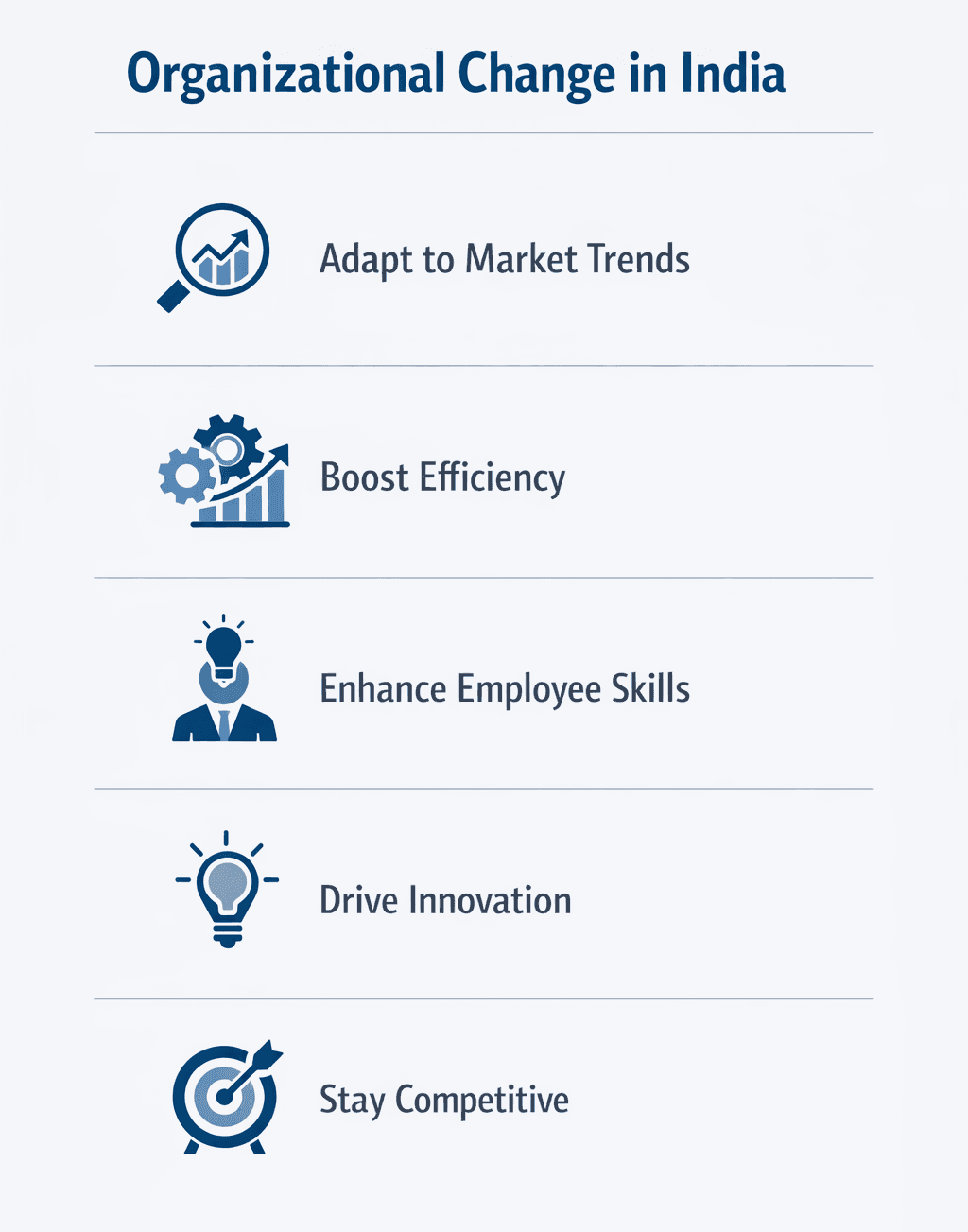
Conclusion: Change Is a Capability, Not an Event
The importance of organizational change in Indian companies lies in one fundamental truth:
Markets evolve faster than internal systems.
Companies that institutionalize organizational change management in India build:
- Agility
- Cost efficiency
- Sustainable growth
- Leadership depth
Actionable Takeaways
| Action | Why It Matters |
| Conduct operational diagnostic | Identify hidden waste |
| Align leadership KPIs | Prevent resistance |
| Invest in skill building | Reduce adoption friction |
| Measure behavior, not just output | Sustain change |
| Build structured change office | Institutionalize transformation |
If your organization is planning growth, modernization, or restructuring, change should be designed—not improvised.
FAQs
- Why is organizational change important for Indian businesses?
Because rapid economic growth, global competition, and digital transformation demand agility and structured change management.
- What are the biggest organizational change challenges in India?
Resistance to change, middle management inertia, skill gaps, and cultural rigidity.
- How can companies implement organizational change successfully?
By following a structured change management process including diagnostics, leadership alignment, training, and KPI governance.
- What is the difference between organizational development and change management?
Organizational development focuses on long-term capability building, while change management focuses on executing specific transitions.
- How long does organizational change take?
Depending on scale, transformations can take 6–24 months. However, cultural embedding may take longer.
If your company is navigating business transformation in India, structured organizational change is the difference between temporary improvement and sustainable performance leadership.