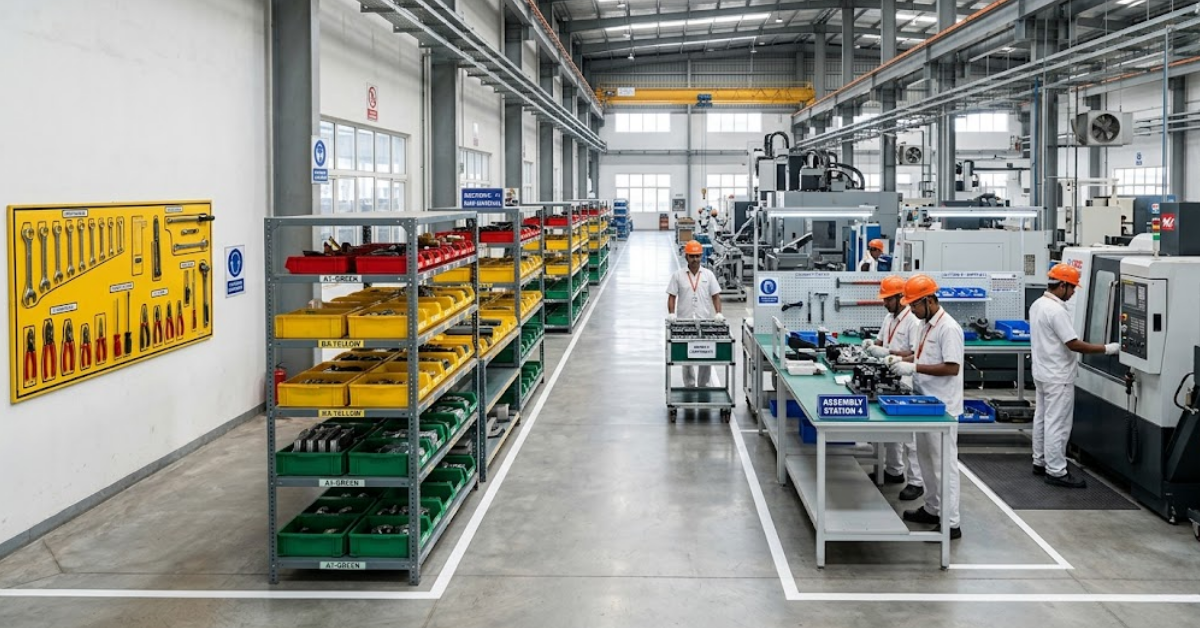
Indian manufacturing and service industries are operating in one of the most competitive and cost-sensitive environments globally. Rising input costs, pressure on margins, quality expectations from global customers, and the need for faster delivery have made process improvement no longer optional—it’s essential.
This is where Lean Six Sigma emerges as a proven, practical, and results-driven methodology. At Faber Infinite Consulting, our on-ground experience across Indian factories, warehouses, corporate offices, and service operations has shown that Lean Six Sigma is not just a theory—it is a business growth engine when implemented correctly.
This blog explains what Lean Six Sigma methodology is, how it works in Indian conditions, real-life examples, benefits, tools, and how Lean Six Sigma consultants in India help organizations achieve measurable results.
What Is Lean Six Sigma Methodology?
| Aspect | Explanation |
|---|---|
| Lean | Focuses on eliminating waste, improving flow, and increasing speed |
| Six Sigma | Focuses on reducing defects, variation, and errors using data |
| Lean Six Sigma | Combines speed + quality for sustainable process improvement |
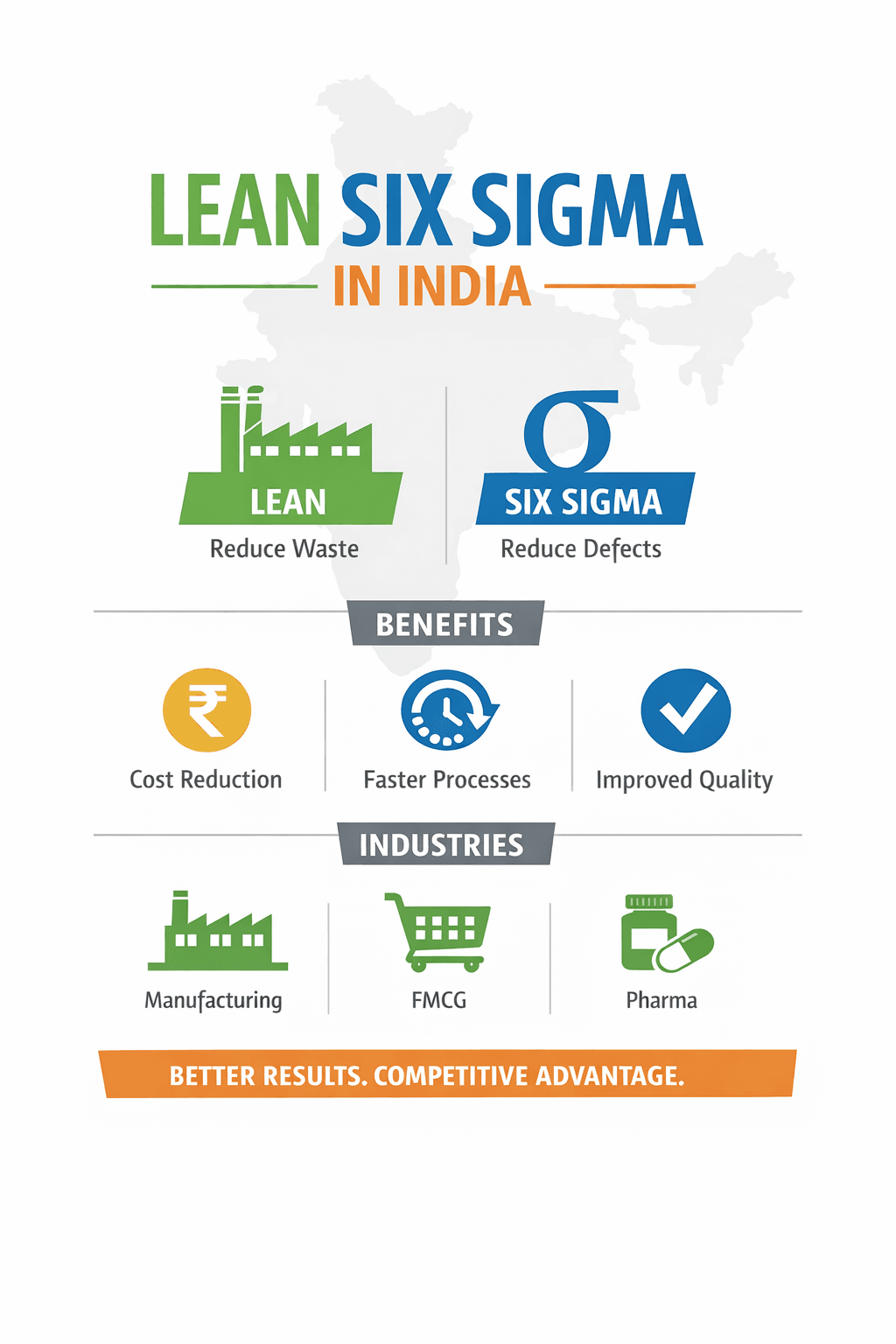
Lean Six Sigma methodology integrates Lean’s waste reduction with Six Sigma’s data-driven defect control, making it ideal for Indian manufacturing and service environments where efficiency and consistency are both critical.
According to ASQ (American Society for Quality), organizations using Lean Six Sigma report up to 25–40% improvement in operational efficiency.
Why Lean Six Sigma Works Especially Well in India
| Indian Business Challenge | Lean Six Sigma Solution |
| High process variation | Standardization & DMAIC |
| Cost pressure | Waste elimination |
| Skill dependency | Process-based working |
| Quality complaints | Root cause analysis |
| Long lead times | Flow & pull systems |
Lean Six Sigma benefits in India are higher because many processes still have visible inefficiencies that can be corrected quickly with structured improvement.
Real-Life Experience: Lean Six Sigma Examples in Indian Companies
Manufacturing Case Example
| Parameter | Before | After Lean Six Sigma |
| Delivery-in-Full | 75% | 94% |
| Lead Time | 28 days | 16 days |
| Defect Rate | High | Reduced by 85% |
At a mid-sized Indian manufacturing plant, Lean Six Sigma manufacturing practices helped stabilize production planning, reduce rework, and improve customer trust—without heavy capital investment.
Service Industry Example
| Area | Improvement Achieved |
| TAT reduction | 30–45% |
| Error reduction | 60% |
| Customer complaints | Reduced significantly |
This proves Lean Six Sigma for business improvement is equally powerful beyond factories.
Lean Six Sigma Tools and Techniques Used
| Tool | Purpose |
| DMAIC | Structured problem solving |
| Value Stream Mapping | Identify waste & delays |
| Root Cause Analysis | Eliminate recurring issues |
| Standard Work | Sustain improvements |
| Control Charts | Maintain performance |
These Lean Six Sigma tools and techniques help Indian organizations move from firefighting to process control.
Role of Lean Six Sigma Consultants in India
| Consultant Role | Business Impact |
| Diagnostic assessment | Clear improvement roadmap |
| Data-driven analysis | Fact-based decisions |
| Change management | Team adoption |
| Capability building | Long-term sustainability |
A professional Lean Six Sigma consultant India understands local constraints—manpower skill mix, compliance needs, and cost sensitivity.
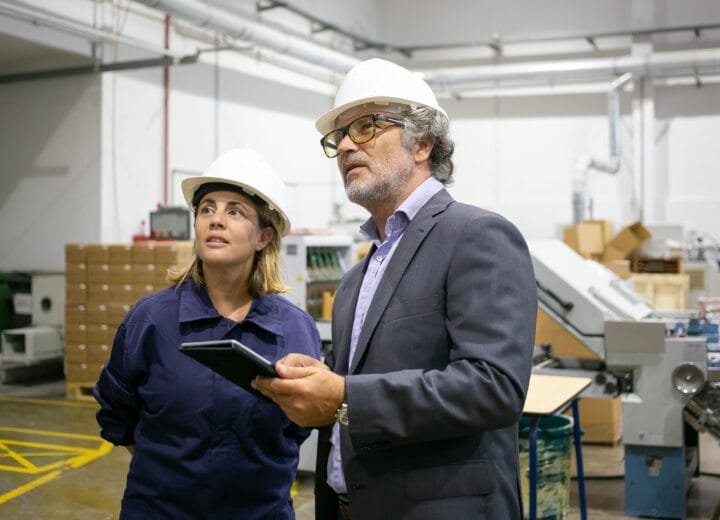
At Faber Infinite Consulting, we act not just as advisors but as process improvement consultants who work alongside teams on the shop floor and in offices.
Lean Six Sigma Consulting Services by Faber Infinite Consulting
| Service Area | Coverage |
| Manufacturing excellence | End-to-end operations |
| Service process improvement | BFSI, shared services, logistics |
| Waste reduction programs | Lean Six Sigma waste reduction in manufacturing |
| Capability building | Yellow, Green & Black Belt support |
| Sustenance systems | Control & governance |
As a Lean Six Sigma consulting company, we align improvement initiatives with business KPIs—not just project metrics.
Lean Six Sigma for Small & Mid-Sized Businesses
Contrary to popular belief, Lean Six Sigma consulting services for small businesses deliver faster ROI because:
| Advantage | Reason |
| Faster decision-making | Less bureaucracy |
| Visible impact | Fewer processes |
| Lower investment | High improvement potential |
This makes Lean Six Sigma highly suitable for Indian MSMEs.
Industry Standards & Authoritative References
| Source | Relevance |
| ASQ | Lean Six Sigma standards |
| ISO 9001 | Process-based quality systems |
| McKinsey & Company | Operational excellence insights |
| Harvard Business Review | Continuous improvement research |
These globally accepted frameworks validate Lean Six Sigma as a trusted improvement methodology.
FAQs: Lean Six Sigma in India
1. What is Lean Six Sigma methodology?
Lean Six Sigma is a structured approach combining waste reduction and defect elimination to improve business performance.
2. Is Lean Six Sigma suitable for Indian companies?
Yes, it is highly effective due to high process variability and cost pressure in Indian industries.
3. What industries benefit from Lean Six Sigma in India?
Manufacturing, FMCG, pharma, logistics, BFSI, shared services, and healthcare.
4. How long does a Lean Six Sigma project take?
Typically 3–6 months depending on scope and complexity.
5. Why hire Lean Six Sigma consultants?
Experienced consultants ensure faster results, correct tool application, and sustainable improvements.
Conclusion: Actionable Takeaways
| Action | Outcome |
| Start with process diagnosis | Clear improvement focus |
| Apply Lean Six Sigma tools | Faster, quality-driven results |
| Engage experts | Sustainable transformation |
Lean Six Sigma is not a cost—it’s an investment in operational excellence. With the right Lean Six Sigma consulting services, Indian businesses can unlock growth, resilience, and long-term competitiveness.
Partner with Faber Infinite Consulting to transform your processes into performance.
Contact Us for Lean Six Sigma