
The industrial landscape in the Kingdom of Saudi Arabia is undergoing a massive transformation. As Vision 2030 drives the nation toward becoming a global manufacturing hub, the complexity of establishing a competitive facility has skyrocketed. Relying on traditional “gut-feeling” setups is no longer viable. Factory planning consultants serve as the architects of operational flow, ensuring that every square meter of a facility contributes directly to the bottom line.
A well-planned factory is more than just four walls and machinery; it is a living organism where materials, information, and people must interact seamlessly. In the Saudi context, where rapid scaling and technological integration (Industry 4.0) are priorities, the role of a consultant is to bridge the gap between architectural shell and operational reality. By focusing on manufacturing consulting and long-term scalability, these experts help firms avoid the “re-work” trap, where a facility must be renovated within two years because it cannot handle increased volume.
How Can Layout Design Consultants in Saudi Arabia Optimize Your Production Flow?
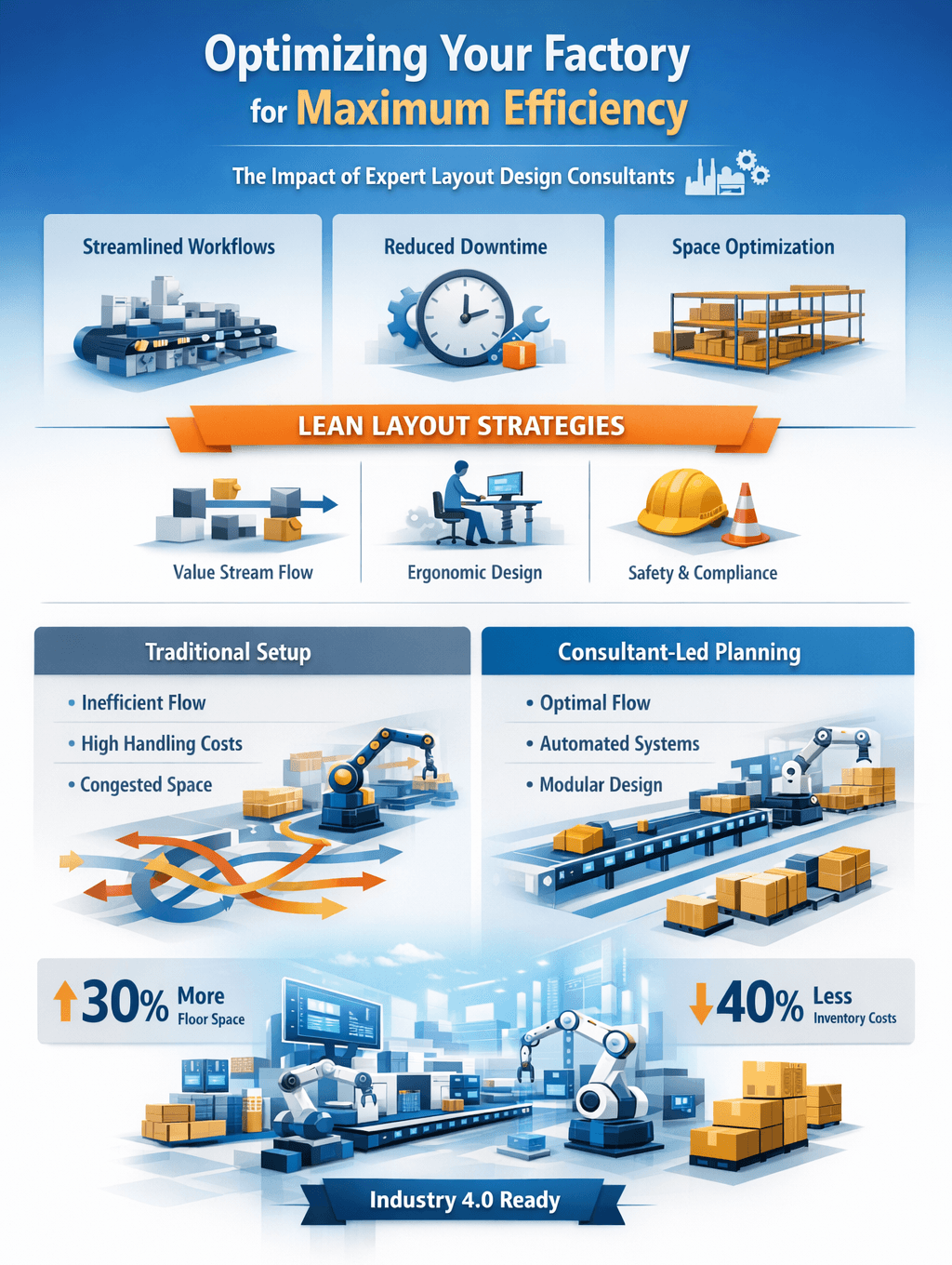
The primary objective of layout design consultants in Saudi Arabia is to eliminate the “hidden wastes” that often plague large-scale manufacturing plants. In many regional facilities, excessive travel distance for materials can account for up to 30% of total operational costs. By applying scientific methodologies, consultants reorganize the shop floor to ensure a unidirectional flow, reducing the “spaghetti effect” of crisscrossing paths.
A strategic layout considers the relationship between different functional zones. For instance, by placing quality control stations directly adjacent to the production line rather than in a separate wing, a facility can reduce inspection lead times by nearly 15%. This level of plant layout planning ensures that bottlenecks are identified and mitigated before the first piece of equipment is even bolted to the floor.
Key Benefits of Optimized Flow:
- Reduced Material Handling: Minimizing the distance a product travels reduces the risk of damage and lowers labor costs.
- Enhanced Visibility: A clean, logical layout allows supervisors to spot issues instantly, fostering a culture of operational excellence.
- Space Utilization: Consultants often recover up to 20% of “lost” floor space simply by optimizing aisle widths and storage configurations.
Why Should You Choose Expert Factory Layout Consultants in KSA for Your Next Project?
Choosing specialized factory layout consultants in KSA provides a competitive edge that generic architectural firms cannot offer. These experts bring a deep understanding of process-driven design. Instead of designing a building and “fitting” the machines inside, they design the process first and wrap the building around it.
In various industrial applications, this “inside-out” approach has proven to increase throughput without increasing the facility’s footprint. For example, by integrating vertical storage solutions and synchronized docking bays, manufacturers have seen a 25% improvement in dock-to-stock timing. Furthermore, these consultants understand the local regulatory environment, ensuring that safety clearances and environmental standards are integrated into the plant layout design from day one.
What Makes Manufacturing Layout Design in Saudi Arabia Essential for Global Competitiveness?
To compete on a global stage, Saudi manufacturers must move toward smart manufacturing. This involves more than just buying robots; it requires a layout that can support automated guided vehicles (AGVs), IoT sensors, and data-driven logistics. Manufacturing layout design in Saudi Arabia is now evolving to include “flexible cells” that can be reconfigured as product demands change.
When a facility is designed with flexibility in mind, the cost of switching production lines can be reduced by 40%. Consultants focus on modular utility drops and standardized workstation footprints. This foresight allows a plant to pivot its output within days rather than months, a critical capability in today’s volatile global market. This agility is a direct result of meticulous manufacturing consulting that prioritizes future-proofing over immediate convenience.
How Do Lean Layout Design Consultants in KSA Eliminate Waste and Boost Profits?
Efficiency is the byproduct of discipline, and lean layout design consultants in KSA are the practitioners of that discipline. The “Lean” philosophy focuses on the elimination of the eight types of waste (Muda), such as overproduction, waiting, and unnecessary motion.
By implementing a “Point-of-Use” storage system, where tools and components are located exactly where they are needed, consultants have helped facilities reduce operator motion by up to 35%. This doesn’t just improve speed; it reduces physical fatigue and enhances safety. Moreover, a lean layout facilitates a “Pull” system, ensuring that work-in-process (WIP) inventory does not clutter the aisles, which can improve overall productivity metrics by 20% or more.
Strategic Advantages of Working with Professional Layout Planners
The intervention of a consultant often leads to significant cost reduction. While the initial investment in consulting may seem high, the ROI is typically realized within the first 12 to 18 months of operation through energy savings, reduced labor hours, and lower inventory holding costs.
| Metric | Traditional Layout | Lean/Consultant-Led Layout |
| Material Travel Distance | High (Circular/Complex) | Low (Linear/U-Shaped) |
| Space Utilization | 60-70% | 85-90% |
| Throughput Time | 100% (Baseline) | 60-75% of Baseline |
| WIP Inventory | High | Low/Controlled |
FAQs
How do layout design consultants improve factory efficiency in KSA?
By analyzing the “Value Stream,” consultants identify non-value-added activities that consume time but add no worth to the product. In many Saudi plants, restructuring the workflow into U-shaped cells has allowed for “multi-machine handling,” where one operator can manage multiple stations, effectively increasing output per head by 15-22%.
How does lean layout design reduce waste in KSA factories?
Lean design targets the “transportation” and “inventory” wastes specifically. By aligning the production sequence with the physical layout, the need for forklifts and manual shifting is minimized. Statistics show that plants utilizing lean layout principles often see a 30% reduction in lead times due to the elimination of bottlenecks and “waiting” waste.
Why is value stream-based layout planning for Saudi manufacturers becoming the standard?
Value stream mapping allows consultants to see the flow of both material and information. In Saudi Arabia’s increasingly digital industrial sector, ensuring that the physical flow matches the digital data flow is vital for smart manufacturing. This holistic view prevents “islands of automation” where one machine is fast, but the rest of the line cannot keep up.
What are the best factory planning strategies for new and existing Saudi plants?
For new plants, the strategy is “Greenfield Optimization,” where the layout is designed for maximum 10-year growth. For existing plants (“Brownfield”), the strategy involves “Brownfield Debottlenecking,” where consultants use simulation software to identify the one or two changes that will yield the highest productivity improvement without a total shutdown.
How do layout design consultants improve productivity in KSA factories?
Productivity is improved through the synchronization of cycles. When the “Takt time” (the rate at which a product must be finished to meet customer demand) is balanced across the layout, the plant operates like a clock. Consultants achieve this by rebalancing workloads and ensuring that high-speed equipment is not hampered by slow manual feeding processes.
What is the role of factory planning consultants in Saudi manufacturing growth?
Beyond just drawing lines on a floor plan, these consultants act as strategic partners in operational excellence. They provide the data-driven justification for capital expenditures, ensure safety compliance, and create an environment where workers can perform at their peak. They are the catalysts for turning “capacity” into “capability.”