The industrial landscape in Egypt is witnessing a historic surge in 2026. According to recent economic data, Egypt’s quarterly Gross Domestic Product (GDP) growth reached 5.3% in the first quarter of the 2025/2026 fiscal year, with the non-oil manufacturing sector exploding at a 14.5% growth rate. With the government targeting EGP 252.8 billion in industrial investments, a 154% increase from previous periods, the pressure to build world-class facilities has never been more intense.
In this high-stakes environment, the physical arrangement of a facility is no longer just a logistical detail; it is a strategic asset. Factory planning consultants act as the architects of this transformation, ensuring that Egypt’s ambitious 2030 industrial vision is built on a foundation of operational excellence and precision.
Why are factory planning consultants in Egypt vital for 2026 industrial targets?
As Egypt scales its manufacturing output to meet the goal of $145 billion in annual exports, the role of factory planning consultants in Egypt has shifted from basic layout drafting to comprehensive system design. The current industrial push, which includes the opening of new industrial complexes and free zones, requires facilities that can handle massive throughput without succumbing to internal inefficiencies.
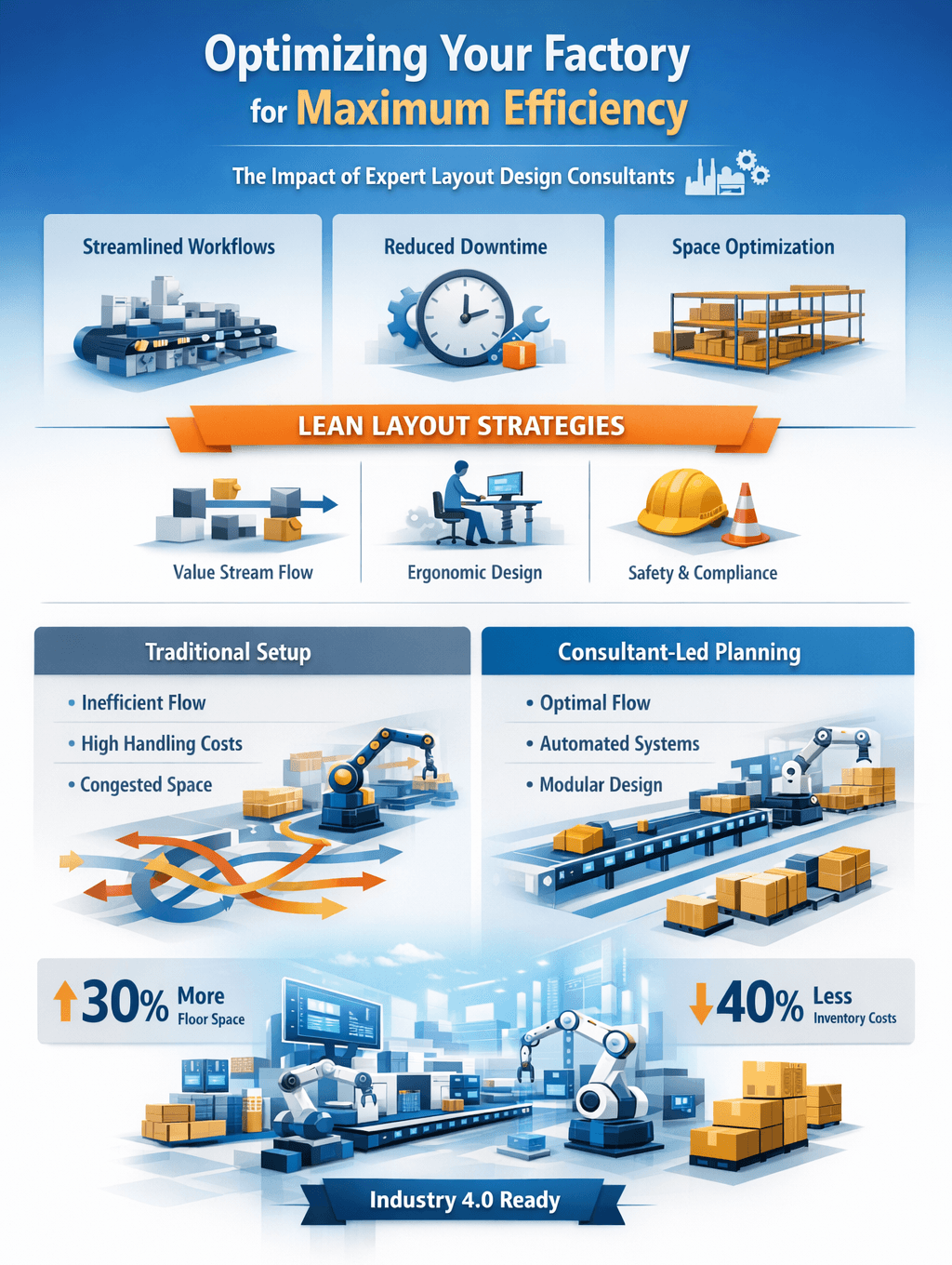
Consultants provide the necessary expertise to navigate these complexities. By integrating financial targets with spatial realities, they ensure that the “spaghetti flows,” convoluted material paths that plague unplanned factories, are replaced by streamlined, logical sequences. Statistics from regional industrial upgrades suggest that professional planning can reduce material handling costs by up to 30%, directly impacting the bottom line of firms operating in Egypt’s competitive trade zones.
How do factory planning services in Egypt optimize high-growth production lines?
The rapid growth in sectors like motor vehicle manufacturing (up 50%) and chemical products (up 44%) in Egypt demands a level of agility that traditional plant setups cannot provide. Factory planning services in Egypt focus on creating “future-proofed” environments. This involves more than just machine placement; it includes the strategic design of utility grids, pedestrian safety zones, and logistics hubs.
Effective planning services utilize advanced simulation tools to test production scenarios before a single brick is laid. This proactive approach prevents the costly “re-layouting” that often follows rapid expansion. By designing for 20% to 30% higher than current capacity requirements, consultants allow Egyptian manufacturers to scale their operations seamlessly as domestic and export demand continues to climb through the late 2020s.
Why should layout design consultants in Egypt be involved in Greenfield projects?
For new “Greenfield” projects in Egypt’s emerging industrial cities, layout design consultants are the key to maximizing Return on Investment (ROI). Starting with a blank canvas allows for the implementation of the most efficient flows, such as the “I-flow” or “U-flow” configurations, which are often impossible to retrofit into older buildings.
Data from the Lean Facility Design framework highlights that getting the layout right from day one can lead to a 17% increase in space utilization. In the context of Egypt’s rising land costs in premium industrial zones like the 10th of Ramadan or 6th of October City, this efficiency is equivalent to gaining thousands of square meters of “free” production space. Consultants ensure that every square centimetre is accounted for, from receiving docks to the final dispatch area.
What makes factory layout consultants in Egypt essential for brownfield modernization?
Many established Egyptian manufacturers are currently facing the challenge of “Brownfield” modernization, updating existing facilities to meet modern standards. Factory layout consultants in Egypt specialize in these high-constraint environments, where existing walls, columns, and utilities limit the possibilities.
By applying Value Stream Mapping (VSM), consultants identify the “hidden factory,” the redundant processes and stagnant inventory that hide in plain sight. In various industrial applications, the reorganization of a floor plan has resulted in a 34% reduction in work-in-progress (WIP) and a 42% improvement in overall productivity. This allows older Egyptian plants to achieve “World Class Manufacturing” (WCM) status without the need for a complete relocation.
How does industrial layout planning in Egypt support the push for green manufacturing?
Sustainability is a cornerstone of the Egypt Vision 2030. Industrial layout planning plays a direct role in reducing a factory’s carbon footprint. Consultants design layouts that group energy-intensive processes, allowing for localized high-efficiency HVAC and filtration systems.
- Waste Reduction: By positioning recycling and scrap collection points at the source of generation, consultants minimize material contamination.
- Energy Efficiency: Strategic planning ensures that natural lighting and ventilation are maximized, reducing the reliance on artificial climate control.
- Logistics Optimization: Reducing the travel distance of heavy forklifts and machinery not only saves time but also significantly lowers energy consumption and emissions.
Why is factory planning and layout design in Egypt the foundation for Industry 4.0?
As Egypt adopts “Smart Cities” and digital infrastructure, the factory floor must be ready for the fourth industrial revolution. Factory planning and layout design in 2026 must account for the integration of IoT sensors, Automated Guided Vehicles (AGVs), and real-time data dashboards.
A layout that is “Industry 4.0 ready” features:
- Robust Connectivity: Strategic placement of networking hardware to avoid “dead zones” caused by heavy machinery.
- Flexible Utilities: Modular power and data drops that allow machines to be moved or upgraded with minimal downtime.
- AGV Corridors: Dedicated, unobstructed paths for automated logistics that do not interfere with human operators.
Consultants ensure that the physical space does not become a bottleneck for the digital transformation that the Egyptian government is actively subsidizing through various industrial tech grants.
How does lean layout design in Egypt accelerate production efficiency?
Lean layout design is about the relentless pursuit of flow. In Egypt’s manufacturing sector, where labor and material costs are a major concern, eliminating “Muda” (waste) is a survival necessity. Consultants focus on the 15-step Lean Facility Design process to ensure that the layout supports a “Pull” system rather than a “Push” system.
By creating cellular manufacturing units, consultants help firms reduce their “lead time,” the time from order to delivery. In a competitive global market, the Egyptian manufacturer who can deliver in three days instead of five wins the contract. Statistics show that lean layouts can reduce total material travel distance by up to 50%, drastically shortening the production cycle and freeing up cash flow that was previously tied up in inventory.
FAQs
How do factory planning consultants improve productivity in Egypt?
Consultants improve productivity by aligning the physical work environment with the sequence of production. By minimizing the time wasted on material handling and waiting, they allow the workforce to focus on value-added activities. In Egyptian facilities, this has been shown to boost output per shift by as much as 20% to 30%.
What characterizes Industry 4.0 factory layout design in Egypt?
It is characterized by flexibility and connectivity. Unlike traditional rigid layouts, Industry 4.0 designs allow for rapid reconfiguration. They incorporate dedicated zones for robotics and ensure that the entire plant is a “connected” environment where every machine can communicate with a central management system.
What are the industrial safety standards for factory planning in Egypt?
Safety is a core component of modern planning. Consultants ensure adherence to international standards like ISO 45001, focusing on the clear separation of pedestrian and vehicle traffic, ergonomic workstation design to prevent repetitive strain, and the strategic placement of emergency exits and fire suppression systems.
How do Egyptian factories improve efficiency through planning?
Many factories in Egypt’s textile, automotive, and food sectors have transformed their operations through strategic planning. By moving away from “departmental” layouts to “product-aligned” flows, they have successfully reduced their operational costs by over 15% annually and increased their capacity to serve export markets.
Conclusion
The modernization of Egypt’s industrial base is a journey toward efficiency, sustainability, and digital integration. By partnering with professional factory planning consultants, Egyptian manufacturers are ensuring that they are not just building factories, but global centres of excellence.