In the current era of Saudi Arabia’s industrial transformation, the physical arrangement of a production facility has evolved from a simple floor plan into a strategic high-performance asset. Factory layout design in Saudi Arabia is no longer just about where a machine is placed; it is about how space, time, and human effort interact to create value. As the Kingdom pushes toward localized manufacturing under Vision 2030, the internal “geography” of a plant determines whether a business will lead the market or succumb to rising operational costs.
Effective plant layout planning serves as the backbone of manufacturing efficiency. When a facility is designed with a logic-driven flow, every movement, whether it is a forklift carrying raw materials or an operator reaching for a tool, is scrutinized and optimized. This scientific approach to spatial organization ensures that the building itself facilitates, rather than hinders, the production process. For Saudi manufacturers, this means creating environments that can handle high volumes while maintaining the flexibility to adapt to shifting market demands. By treating the floor plan as a living tool for cost reduction, companies can ensure that every square meter of their facility is actively contributing to the bottom line.
How Can a Modern Industrial Layout Design in KSA Maximize Output and Reduce Waste?
The primary goal of a sophisticated industrial layout design in KSA is to eliminate the “hidden” drains on profit that occur when materials travel too far or wait too long. Productivity improvement is rarely found in working harder; it is found in designing a system that allows for working smarter. By aligning the physical floor with the actual value stream, manufacturers can transform chaotic environments into synchronized production engines.
Strategic spatial mapping often reveals startling inefficiencies in legacy setups. In many manufacturing environments, a product might travel several kilometers through various stages of production before completion. Professional redesigns based on flow principles have demonstrated that it is possible to achieve a reduction in material flow travel distance by over 65%. This is a critical metric for operational excellence, as every meter of travel saved reduces energy consumption, equipment wear, and labor hours.
Beyond distance, the density of production matters. By optimizing the footprint of equipment and storage areas, manufacturers have successfully reclaimed up to 13.2% of their factory floor space. This reclaimed area represents a significant opportunity for expansion or the introduction of new product lines, eliminating the need for capital-intensive physical building extensions. In fact, such spatial optimizations have been linked to a 62% increase in revenue per square meter, proving that how you use your space is just as important as how much space you have.
Which System Best Fits Your Goals: Process vs Product Layout for Saudi Factories?
One of the most significant decisions a facility manager must make is the fundamental flow architecture. When weighing process vs product layout for Saudi factories, the choice dictates the long-term scalability and cost structure of the operation.
The Dynamics of Process Layout
A process layout is functional by nature. It groups all similar equipment or processes together, such as putting all machining units in one department and all quality testing in another.
- When to use: It is highly effective for low-volume, high-variety production where customization is key.
- The Benefit: It offers immense flexibility and high machine utilization, as equipment is shared across different product lines.
- The Challenge: It often results in complex material handling paths, with parts zigzagging across the floor, which can increase work-in-process (WIP) inventory significantly.
The Speed of Product Layout
A product layout (or line layout) organizes resources according to the sequence of operations for a specific product.
- When to use: This is the gold standard for high-volume, standardized manufacturing where speed is the priority.
- The Benefit: It streamlines the flow, reduces lead times, and simplifies production control.
- The Challenge: It requires a high initial investment and can be less adaptable if the product design changes frequently.
For many new manufacturing plants in Saudi Arabia, the most successful models are hybrid layouts. These use “cellular manufacturing” techniques to group different machines into a single unit to process a specific family of parts. This approach has been shown to result in a 17% enhancement in production capacity by combining the flexibility of a process layout with the high-speed efficiency of a product layout.
Why Is Implementing a Lean Factory Layout in Saudi Arabia Essential for Cost Reduction?
The philosophy of “Lean” is deeply rooted in the relentless pursuit of waste elimination. A lean factory layout in Saudi Arabia addresses waste at its source: the floor plan. By applying Lean Facility Design principles, a manufacturer can often produce more in a smaller footprint than they ever thought possible.
One of the most profound impacts of lean design is seen in production timelines. By minimizing the gaps between processes and reducing the time materials spend sitting in “buffer zones,” manufacturers have achieved a 40% reduction in production throughput time. For instance, production cycles that previously took nine months to complete can be streamlined down to just five months. This speed-to-market is a significant competitive advantage in the Saudi industrial sector.
Lean layouts also focus on “Point-of-Use” storage, which eliminates large, centralized warehouses in favor of small, localized supply points. This strategy can lead to a 30% reduction in storage footprints. Furthermore, the financial health of the company is directly improved through the reduction of tied-up working capital. By maintaining a lean flow with less work-in-process, companies can see up to a 50% reduction in working capital that was previously trapped in stagnant inventory on the floor.
FAQs
How lean layouts reduce waste in KSA factories?
Lean designs target the “Eight Wastes,” specifically transportation and motion. By placing sequential operations in close physical proximity, often in a U-shaped cell, a factory removes the need for long-distance material handling. Data from local industrial optimizations indicates that this can cut material travel distance by more than half, directly lowering overhead and energy costs.
What are the best plant relayout strategies for Saudi manufacturing facilities?
Successful strategies involve a transition from “Functional Silos” to “Flow-Based Cells.” This starts with a material flow audit (often using spaghetti diagrams) to identify backtracking. The relayout then reconfigures equipment to ensure a “one-way” flow. This approach has helped existing plants reclaim up to 13.2% of their floor space for new activities without expanding the building.
How does factory layout design improve productivity in Saudi factories?
Efficiency is gained when the physical environment supports the worker rather than obstructing them. By optimizing the manufacturing plant layout KSA, businesses reduce the time operators spend walking or searching for tools. In practice, this has led to a 62% increase in revenue generated per square meter, as more value-added work is performed in the same amount of time.
How does factory layout impact manufacturing efficiency in KSA?
The impact is structural; a poor layout acts as a permanent tax on every unit produced. Conversely, an optimized layout reduces WIP inventory by 50% and slashes throughput time by 40%. This allows Saudi manufacturers to be more responsive to market changes while keeping their operational costs significantly lower than competitors using traditional, disorganized layouts.
Why is factory layout design for new manufacturing plants in Saudi Arabia critical?
Designing “Lean from Day One” ensures that a facility doesn’t inherit the inefficiencies of the past. New plants using advanced industrial layout design KSA principles can achieve up to a 17% increase in production capacity compared to traditional designs. This ensures that the initial capital expenditure for the facility yields the highest possible long-term return.
Conclusion: Designing for the Future of the Kingdom
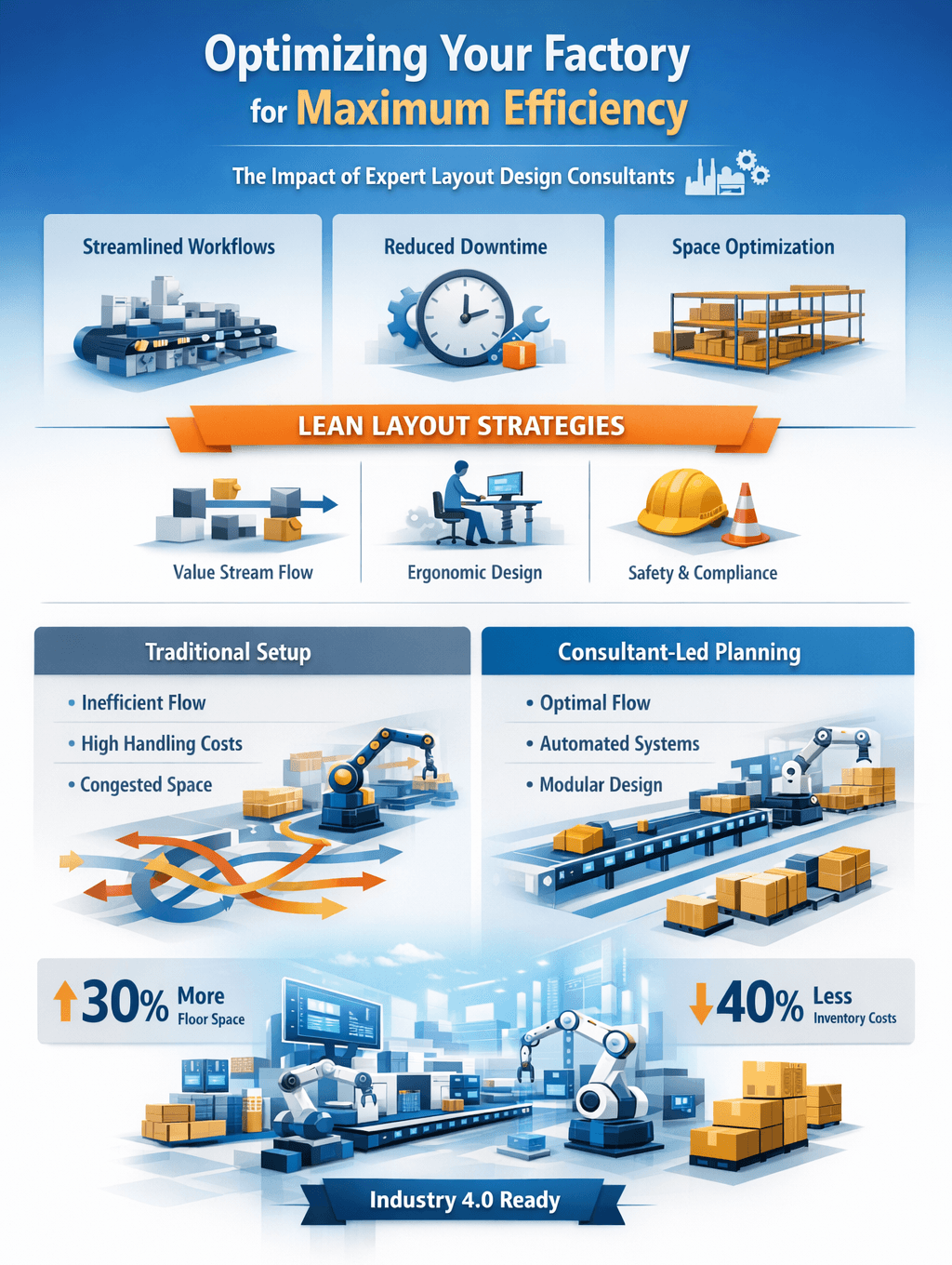
The industrial landscape of Saudi Arabia is becoming increasingly sophisticated. To remain competitive on a global scale, manufacturers must treat their floor space as a precision instrument. By focusing on the nuances of factory layout design in Saudi Arabia and embracing the efficiencies of a lean factory layout in Saudi Arabia, businesses can achieve unprecedented levels of productivity.
The statistics speak for themselves: a 65% reduction in travel, a 40% improvement in speed, and a 50% reduction in trapped capital. Whether you are building from scratch or revitalizing an existing site, the path to operational excellence is built into the floor under your feet.