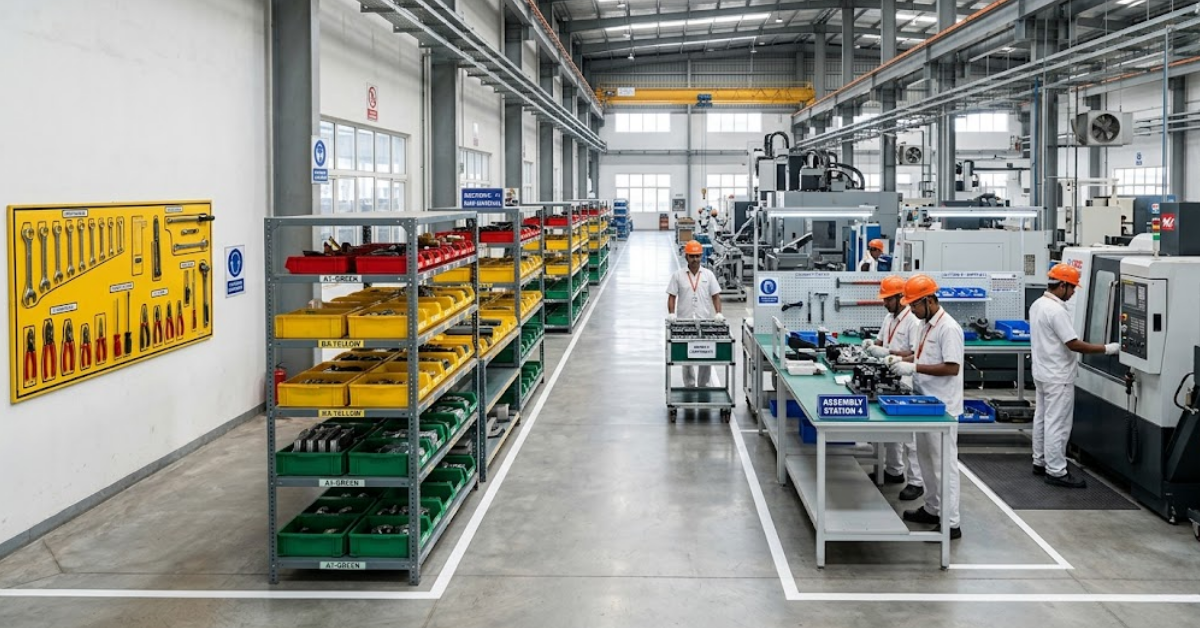
Walk into any manufacturing plant struggling with delays, excess inventory, frequent material movement, or stressed teams, and you’ll often find the same root cause hiding in plain sight: a poorly planned factory layout. Machines may be world‑class and people highly skilled, yet inefficiencies persist because the physical flow of work is broken.
At Faber Infinite Consulting, our on‑ground experience across diverse manufacturing sectors has consistently shown one truth — lean manufacturing succeeds or fails on the strength of factory layout design. When layout decisions align with lean principles and smart factory thinking, manufacturers unlock dramatic gains in productivity, cost reduction, and plant efficiency.
This blog explores how smart factory layout design enables lean manufacturing, blending real‑world experience, proven methodologies, and Industry 4.0 readiness into a practical guide for manufacturers.
Understanding Factory Layout Design in Lean Manufacturing
What Is Factory Layout Design?
Factory layout design refers to the strategic arrangement of machines, workstations, storage areas, material flow paths, and people within a manufacturing facility. Effective manufacturing plant layout design ensures smooth flow, minimal waste, and optimal use of space.
In lean manufacturing, layout is not just about fitting equipment into a building — it is about designing flow.
Why Layout Matters in Lean Manufacturing
Lean manufacturing focuses on eliminating waste (muda), improving flow, and delivering value faster. A poorly designed layout directly creates waste in the form of:
- Excess material movement
- Waiting time between processes
- Overproduction and inventory pile‑ups
- Unnecessary transportation
- Increased handling damage
A smart, lean‑driven industrial factory design addresses these issues at the source.
Smart Factory Layout Design: The Lean Advantage
What Makes a Factory Layout “Smart”?
A smart factory layout combines lean principles with digital readiness and flexibility. It is:
- Flow‑oriented rather than department‑oriented
- Data‑enabled for Industry 4.0 integration
- Designed for scalability and change
- Optimized for people, safety, and ergonomics
Unlike traditional layouts that prioritize equipment utilization, smart layouts prioritize value stream performance.
Lean Layout Types That Drive Efficiency
1. Cellular Layouts
Cellular layouts group machines by product family rather than function. From our consulting experience, cellular layouts typically:
- Reduce material travel by 30–60%
- Cut lead times by 25–50%
- Improve visibility and accountability
These layouts are especially powerful for high‑mix, medium‑volume manufacturing.
2. U‑Shaped Layouts
U‑shaped layouts support one‑piece flow and flexible manpower deployment. Operators can manage multiple processes, improving labor productivity without automation.
3. Line Flow Layouts
Ideal for high‑volume, repetitive manufacturing, line layouts minimize handling and enable takt‑based production.
Choosing the right layout is a critical decision that factory planning consultants help manufacturers make based on product mix, demand variability, and future growth.
Real‑World Experience: Layout Transformation in Action
Case Insight: Improving Plant Efficiency Without Heavy Capex
In one mid‑sized manufacturing facility supported by Faber Infinite Consulting, persistent delivery delays and high WIP levels were hurting customer trust. Management initially assumed automation was the solution.
Our diagnostic revealed a different story.
The existing manufacturing plant layout forced materials to zigzag across the shop floor, crossing paths multiple times. By redesigning the layout using lean flow principles:
- Material movement reduced by over 40%
- Work‑in‑process inventory dropped significantly
- Lead time improved by nearly 30%
- Output increased without adding machines or manpower
This experience reinforces a key lesson: smart factory layout design is often the most cost‑effective planning lever available.
Factory Planning and Industry 4.0: Designing for the Future
Why Industry 4.0 Starts With Layout
Digital technologies such as IoT, real‑time tracking, AGVs, and digital twins require structured, predictable flows. Without the right facility layout planning, Industry 4.0 investments fail to deliver returns.
Smart layouts enable:
- Seamless sensor placement and data capture
- Automated material handling paths
- Digital performance monitoring
- Scalable automation integration
This is why manufacturers increasingly seek factory planning consultants for Industry 4.0 manufacturing.
Data‑Driven Factory Planning
Modern factory planning consulting services leverage:
- Value stream mapping (VSM)
- Spaghetti diagrams
- Simulation and digital layout tools
- Capacity and demand modeling
These tools allow manufacturers to visualize bottlenecks before they occur, improving decision‑making and reducing risk.
Common Factory Planning Mistakes Manufacturers Should Avoid
Even experienced manufacturers fall into predictable layout traps:
1. Designing for Today, Not Tomorrow
Layouts built only for current demand quickly become constraints. Smart layouts include flexibility for product mix changes and growth.
2. Prioritizing Equipment Over Flow
High machine utilization means little if products wait between processes. Lean layouts focus on end‑to‑end flow.
3. Ignoring People and Ergonomics
Poor workstation design leads to fatigue, errors, and safety risks. Human‑centric industrial factory planning improves quality and morale.
4. Skipping Expert Support
Without experienced industrial factory planning consultants, layout decisions are often based on assumptions rather than data.
Factory Planning Solutions for Sustainable Manufacturing
Lean Layouts and Sustainability
Smart factory layouts directly support sustainable manufacturing by:
- Reducing energy consumption through shorter travel paths
- Minimizing material handling and waste
- Optimizing space usage, reducing building expansion
Manufacturers working with factory planning consultants for sustainable manufacturing often see sustainability gains alongside cost reduction.
Cost‑Effective Planning for Small and Mid‑Sized Manufacturers
Contrary to popular belief, factory planning solutions for small manufacturing companies do not require heavy capital investment. Layout optimization is often the highest‑ROI improvement initiative available.
Why Work With Factory Planning Consultants?
Professional factory planning consultants bring structured methodology, cross‑industry experience, and unbiased insight. At Faber Infinite Consulting, our approach integrates:
- Lean manufacturing principles
- Smart factory and Industry 4.0 readiness
- Practical, implementation‑focused design
As a trusted factory layout design company for industrial facilities, we ensure layouts that work on paper — and perform on the shop floor.
Conclusion: Layout Is Strategy, Not Just Design
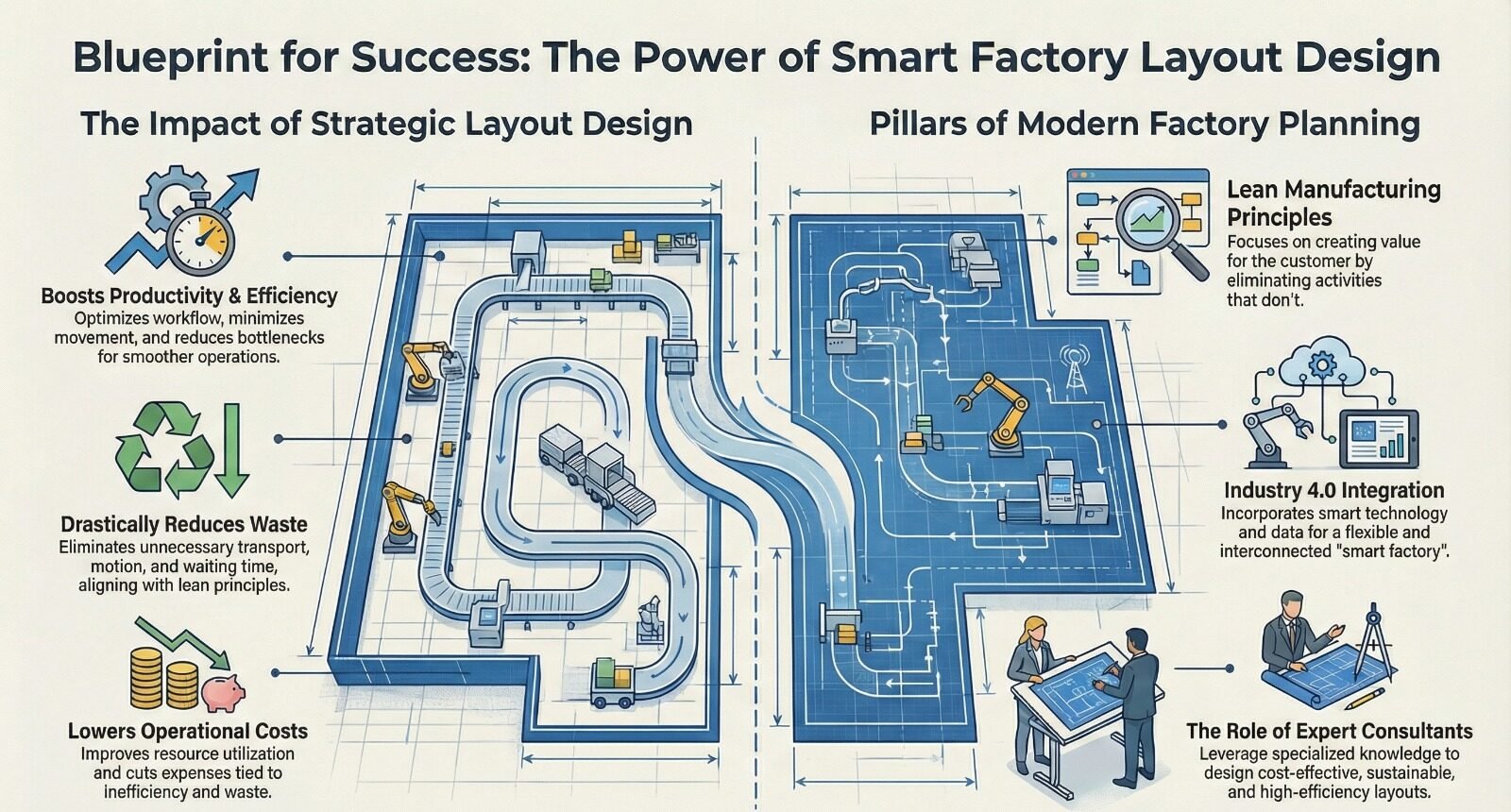
Smart factory layout design is no longer an operational detail — it is a strategic advantage. When aligned with lean manufacturing and future‑ready planning, layout decisions unlock:
- Higher productivity
- Lower manufacturing costs
- Faster lead times
- Sustainable growth
Actionable Takeaways:
- Evaluate your layout through a value‑stream lens
- Eliminate unnecessary movement and waiting
- Design layouts that support flexibility and digital readiness
- Partner with experienced factory planning consultants
Your journey toward lean, efficient, and smart manufacturing starts with how your factory is designed.
FAQs: Factory Layout Design and Lean Manufacturing
1. How factory layout design improves productivity?
A well‑designed layout reduces material movement, waiting time, and handling, enabling smoother flow and faster throughput.
2. What is the role of factory planning consultants?
Factory planning consultants analyze current operations, design optimized layouts, and support implementation using lean and Industry 4.0 principles.
3. What are common factory planning mistakes manufacturers should avoid?
Designing layouts without considering flow, future scalability, ergonomics, and data‑driven analysis are the most common mistakes.
4. Can small manufacturers benefit from smart factory layout design?
Yes. Smart layouts offer cost‑effective planning benefits and often deliver high ROI without large capital investment.
5. How does factory layout support Industry 4.0?
Structured, predictable layouts enable digital tracking, automation, real‑time data capture, and scalable smart manufacturing systems.
Contact us for Lean Manufacturing