Lean Manufacturing provides the principles for improving factory performance, but Lean tools are what turn those principles into measurable operational improvements. Manufacturing consultants use a range of proven methods to help factories identify waste, improve workflows, standardize processes, and solve recurring production problems.
Rather than applying every Lean tool at once, experienced Lean Manufacturing consultants in Egypt assess each manufacturing environment to determine which methods best address specific operational challenges. A factory struggling with workplace organization may benefit from 5S, while one experiencing production bottlenecks may require Value Stream Mapping (VSM) or Root Cause Analysis.
For Egyptian manufacturers facing increasing pressure to improve productivity, control operating costs, and strengthen competitiveness, selecting the right Lean tools is often more important than implementing the largest number of improvement initiatives. The objective is to create practical, sustainable improvements that enhance operational efficiency without adding unnecessary complexity.
Key Takeaways
- Lean tools help manufacturers reduce waste, improve productivity, and strengthen operational performance.
- Different Lean tools address different manufacturing challenges, from workplace organization to process improvement.
- Manufacturing consultants select Lean tools based on a factory’s current processes, business objectives, and operational constraints.
- Combining multiple Lean tools often delivers better long-term results than relying on a single improvement method.
- Successful Lean implementation depends on employee involvement, process discipline, and continuous improvement.
How Manufacturing Consultants Choose Lean Tools
Every factory operates differently. Production processes, product types, equipment, workforce capabilities, and customer requirements all influence which Lean tools are most appropriate.
Rather than following a standard checklist, Lean manufacturing consultants begin by understanding how operations currently perform. They evaluate production workflows, material movement, process variation, quality issues, equipment utilization, and existing performance indicators before recommending improvement methods.
Consultants typically consider factors such as:
- Production bottlenecks
- Workplace organization
- Inventory levels
- Process consistency
- Defect rates
- Employee involvement
- Production lead times
- Business improvement objectives
This assessment helps ensure that Lean tools solve the actual causes of operational inefficiency rather than simply addressing visible symptoms.
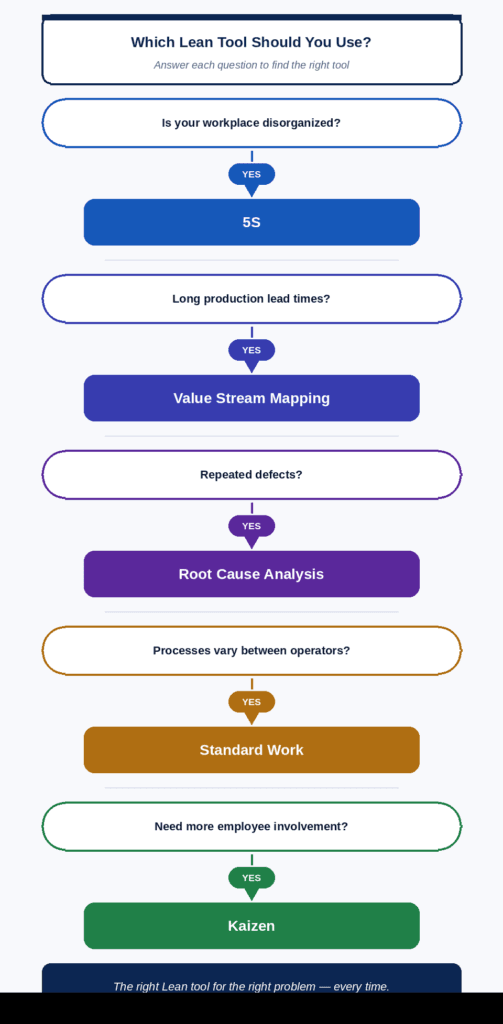
Which Lean Tool Solves Which Manufacturing Problem?
Different operational challenges require different improvement methods.
| Manufacturing Challenge | Recommended Lean Tool |
| Cluttered work areas | 5S |
| Long production lead times | Value Stream Mapping |
| Repeated quality issues | Root Cause Analysis |
| Inconsistent work methods | Standard Work |
| Limited employee involvement | Kaizen |
| Poor process visibility | Value Stream Mapping |
| Frequent process variation | Standard Work |
| Recurring operational problems | Kaizen + Root Cause Analysis |
This structured approach allows manufacturers to prioritize improvements where they will have the greatest operational impact.
5S: Improving Workplace Organization
5S is one of the most widely used Lean tools because it creates the foundation for efficient manufacturing operations. A well-organized workplace reduces wasted movement, improves visibility, and helps employees perform tasks more consistently.
The five elements of 5S are:
- Sort
- Set in Order
- Shine
- Standardize
- Sustain
Together, these practices create organized work environments where tools, materials, and equipment are easier to locate and maintain.
When Consultants Recommend 5S
Manufacturing consultants often recommend 5S when factories experience:
- Excess time searching for tools
- Poor workplace organization
- Inefficient movement between workstations
- Safety concerns
- Difficulty maintaining operational standards
Because 5S produces visible improvements relatively quickly, it is frequently one of the first Lean initiatives introduced during improvement programs.
Benefits of 5S
When implemented effectively, 5S can support:
- Better workplace organization
- Reduced wasted movement
- Improved productivity
- Stronger process discipline
- Faster identification of abnormalities
- Improved safety and housekeeping
- Better employee ownership of work areas
However, 5S is more than a cleaning exercise. Its purpose is to create stable work environments that support consistent manufacturing performance.
Kaizen: Driving Continuous Improvement
Kaizen is a Lean approach that encourages continuous improvement through small, ongoing changes rather than occasional large-scale projects.
Instead of relying solely on management to identify improvements, Kaizen encourages employees throughout the organization to contribute ideas for improving daily operations.
Since operators interact with production processes every day, they often recognize inefficiencies that may not be visible through performance reports alone.
When Consultants Use Kaizen
Lean consultants typically introduce Kaizen when organizations want to:
- Improve employee engagement
- Solve recurring operational problems
- Build a culture of continuous improvement
- Increase problem-solving capability
- Support long-term Lean implementation
Kaizen workshops often bring together employees from different departments to analyze existing processes and identify practical improvements.
Common Kaizen Outcomes
Successful Kaizen initiatives may result in:
- Reduced production delays
- Simplified workflows
- Improved workstation layouts
- Better communication between departments
- Faster problem resolution
- Increased employee participation
Rather than focusing only on major transformation projects, Kaizen encourages organizations to improve continuously through many small, measurable changes.
Value Stream Mapping (VSM): Understanding Process Flow
Value Stream Mapping is a visual analysis tool used to examine how materials and information move through manufacturing processes.
Instead of evaluating individual operations separately, VSM provides a complete view of production flow, making it easier to identify delays, bottlenecks, unnecessary movement, and non-value-added activities.
When Consultants Perform Value Stream Mapping
Manufacturing consultants commonly recommend VSM when factories experience:
- Long production lead times
- Frequent production delays
- Poor coordination between departments
- Excess inventory
- Complex production processes
- Limited visibility into workflow performance
By mapping the current production process, consultants can identify where value is created and where resources are consumed without improving customer outcomes.
Typical Improvement Opportunities
A Value Stream Mapping exercise often identifies opportunities such as:
- Eliminating unnecessary process steps
- Reducing waiting time
- Improving material flow
- Simplifying information movement
- Reducing inventory between operations
- Improving production scheduling
Rather than making assumptions about operational problems, VSM provides data that helps manufacturers prioritize improvement efforts based on actual process performance.
Standard Work: Creating Consistent Manufacturing Processes
Standard Work defines the most effective and reliable method for performing a task safely, efficiently, and consistently. It establishes a baseline for production so that every operator follows the same process, making it easier to maintain quality and identify opportunities for improvement.
Without standardized work methods, employees may perform the same task differently, leading to variations in cycle time, product quality, and resource utilization.
When Consultants Recommend Standard Work
Lean Manufacturing consultants often introduce Standard Work when factories experience:
- Inconsistent production methods
- Quality variations
- Long employee training periods
- Frequent process deviations
- Difficulty maintaining production standards
Standard Work is not intended to restrict employee initiative. Instead, it creates a stable process that can be measured, monitored, and continuously improved through future Lean initiatives.
Benefits of Standard Work
Implementing Standard Work can help manufacturers:
- Improve process consistency
- Reduce variation in production
- Simplify employee training
- Improve quality control
- Support continuous improvement
- Make performance easier to measure
By establishing clear operating procedures, factories create a stronger foundation for sustainable Operational Excellence.
Root Cause Analysis: Solving Problems at Their Source
Many manufacturing problems reoccur because only the visible symptoms are addressed. Root Cause Analysis helps organizations identify the underlying causes of operational issues so that corrective actions prevent the problem from returning.
Rather than asking what happened, Root Cause Analysis focuses on why it happened.
Common Root Cause Analysis Methods
Manufacturing consultants frequently use structured problem-solving techniques such as:
5 Whys
The 5 Whys method involves repeatedly asking “Why?” until the underlying cause of a problem is identified. It is particularly useful for investigating production delays, equipment issues, and recurring quality problems.
Fishbone (Cause-and-Effect) Diagram
A Fishbone Diagram organizes possible causes into categories such as:
- People
- Processes
- Equipment
- Materials
- Environment
- Measurement
This structured approach helps teams evaluate multiple contributing factors before implementing corrective actions.
Benefits of Root Cause Analysis
Effective Root Cause Analysis can help manufacturers:
- Reduce recurring defects
- Improve product quality
- Minimize downtime
- Prevent repeated production disruptions
- Strengthen decision-making
When combined with Standard Work and Kaizen, Root Cause Analysis supports long-term operational improvement rather than temporary fixes.
Which Lean Tool Should Be Implemented First?
There is no universal starting point for Lean implementation. The right tool depends on the factory’s operational challenges and business objectives.
Manufacturing consultants typically prioritize Lean tools based on current conditions rather than applying every method simultaneously.
| Factory Challenge | Recommended Starting Tool |
| Poor workplace organization | 5S |
| Long lead times | Value Stream Mapping |
| High defect rates | Root Cause Analysis |
| Process inconsistency | Standard Work |
| Low employee engagement | Kaizen |
Beginning with the most appropriate Lean tool allows manufacturers to achieve measurable improvements before expanding their Lean initiatives.
Common Mistakes When Implementing Lean Tools
Lean tools are most effective when they are applied systematically and supported by leadership. Manufacturing consultants frequently encounter implementation challenges that limit long-term results.
Common mistakes include:
Treating 5S as a Cleaning Program
5S is designed to improve workplace organization and operational efficiency, not simply housekeeping. Without standardized practices and regular follow-up, improvements often fade over time.
Using Kaizen Without Management Support
Continuous improvement requires active participation from both employees and leadership. Without management commitment, improvement ideas are less likely to be implemented or sustained.
Creating Value Stream Maps Without Action
Mapping a process is only the first step. The real value comes from implementing improvements based on the findings and monitoring performance over time.
Ignoring Performance Metrics
Lean initiatives should be measured using relevant key performance indicators (KPIs), such as productivity, defect rates, lead times, and overall equipment effectiveness (OEE). Without measurable outcomes, it is difficult to evaluate success.
Trying to Implement Every Tool at Once
Introducing multiple Lean tools simultaneously can overwhelm employees and reduce focus. A phased implementation approach often delivers better and more sustainable results.
How Manufacturing Consultants Combine Lean Tools
Lean tools are most effective when they work together as part of a structured improvement program.
A typical Lean improvement journey may follow this sequence:
- Assess current factory performance.
- Map processes using Value Stream Mapping.
- Improve workplace organization with 5S.
- Establish Standard Work to create consistency.
- Use Root Cause Analysis to solve recurring issues.
- Build a culture of continuous improvement through Kaizen.
- Monitor results and repeat the improvement cycle.
This structured approach allows manufacturers to build operational capability over time rather than relying on isolated improvement projects.
Choosing a Lean Manufacturing Consultant in Egypt
Selecting the right Lean manufacturing consultant involves more than choosing someone familiar with Lean terminology. Manufacturers should look for professionals who understand real production environments and can adapt improvement methods to their specific operational needs.
When evaluating consultants, consider factors such as:
- Experience in manufacturing environments
- Knowledge of Lean tools and methodologies
- Structured implementation approach
- Employee training and coaching capabilities
- Performance measurement and continuous improvement support
An experienced consultant can help organizations prioritize improvement opportunities, select the most appropriate Lean tools, and guide implementation in a way that supports long-term operational performance.
Conclusion
Lean tools provide practical methods for improving manufacturing operations, reducing waste, and strengthening operational efficiency. While Lean Manufacturing establishes the overall philosophy, tools such as 5S, Kaizen, Value Stream Mapping, Standard Work, and Root Cause Analysis enable factories to turn improvement objectives into measurable results.
For manufacturers in Egypt, successful Lean implementation is not about applying every available tool. It is about selecting the right methods based on operational challenges, production requirements, and business goals.
By using a structured approach and focusing on continuous improvement, Egyptian factories can improve productivity, reduce waste, strengthen quality, and build more resilient manufacturing operations in an increasingly competitive industrial environment.
Frequently Asked Questions (FAQs)
What are the most commonly used Lean tools?
The most widely used Lean tools include 5S, Kaizen, Value Stream Mapping (VSM), Standard Work, and Root Cause Analysis. Each tool addresses different operational challenges and supports continuous process improvement.
Which Lean tool should a factory implement first?
The best starting point depends on the factory’s current challenges. Many manufacturers begin with 5S to improve workplace organization, while others may prioritize Value Stream Mapping or Root Cause Analysis based on production issues.
How do manufacturing consultants choose Lean tools?
Lean manufacturing consultants evaluate production processes, operational bottlenecks, quality performance, workflow efficiency, and business objectives before recommending the most appropriate improvement tools.
Can multiple Lean tools be used together?
Yes. Lean tools are often combined as part of a structured improvement program. For example, Value Stream Mapping may identify improvement opportunities, 5S can improve workplace organization, Standard Work establishes consistency, and Kaizen supports ongoing continuous improvement.