Egypt’s industrial zones are at a critical inflection point. On paper, the fundamentals look strong: strategic geography connecting Africa, the Middle East, and Europe; government-led industrial expansion; growing foreign investment; and a large labor pool. In reality, many factories inside these zones struggle with low productivity, rising costs, inconsistent quality, and weak scalability. The gap between potential and performance is wide—and it’s not closing on its own.
From our on-ground experience as operational excellence consultants in Egypt, the problem is rarely a lack of ambition or effort. The real issue is outdated operating models colliding with modern competitive pressure. Industrial zones that still rely on manual processes, fragmented decision-making, and reactive management simply cannot compete in a world moving toward Industry 4.0, smart manufacturing, and digital transformation in manufacturing.
This article breaks down the most persistent operational challenges in Egypt’s industrial zones and, more importantly, how businesses can solve them using proven business performance improvement, industrial automation, and IIoT-driven smart factory approaches.
The Reality on the Ground: Key Operational Challenges in Egypt’s Industrial Zones
1. Low Productivity and Inefficient Processes
One of the most common productivity challenges in Egyptian manufacturing is process inefficiency. Many factories operate with:
- Manual production tracking
- Siloed departments (production, maintenance, procurement, finance)
- No real-time visibility into output, downtime, or defects
We’ve seen plants where supervisors rely on handwritten logs that are reviewed days later—long after the damage is done. This reactive setup makes continuous improvement nearly impossible.
Impact:
- Low output per worker
- High rework and scrap rates
- Poor delivery reliability
This is where business process improvement and lean management consulting become essential—not as theory, but as execution.
2. Rising Operational Costs and Weak Cost Control
Energy prices, raw material volatility, and logistics costs are rising. Yet many factories still lack structured cost optimization consulting frameworks. Costs are reviewed monthly, sometimes quarterly, instead of being monitored in real time.
Common issues include:
- No clear cost-per-unit visibility
- Excessive inventory tying up cash
- Unplanned downtime increasing maintenance costs
Without data-driven controls, cost reduction becomes guesswork. Sustainable business performance improvement in Egypt requires transparency at the process level, not just financial summaries.
3. Limited Adoption of Industry 4.0 and Smart Manufacturing
Despite growing awareness, Industry 4.0 adoption across Egypt’s industrial zones remains uneven. Many leaders assume smart manufacturing requires massive capital investment. That assumption is wrong.
In practice, the challenge is not technology—it’s readiness.
Typical gaps:
- Legacy machines not connected via IIoT (Industrial Internet of Things)
- No digital production dashboards
- Lack of internal capability to manage automation projects
This leads to partial, failed, or abandoned digital initiatives.
4. Workforce Capability and Organizational Misalignment
Technology alone does not create a smart factory. People do.
Factories often face:
- Skill gaps in data interpretation and automation
- Resistance to change from middle management
- Undefined ownership of KPIs
As organizational development consultants in Egypt, we frequently see strong operators trapped in weak systems. Without structured organizational development services, even the best tools fail to deliver ROI.
5. Poor Strategic Alignment and Short-Term Thinking
Many manufacturers focus narrowly on daily firefighting instead of long-term business strategy development. There is often no clear roadmap linking:
- Market demand
- Capacity planning
- Capital investment
- Digital transformation initiatives
This disconnect weakens competitiveness and limits scalability—especially for SMEs seeking expansion or market entry.
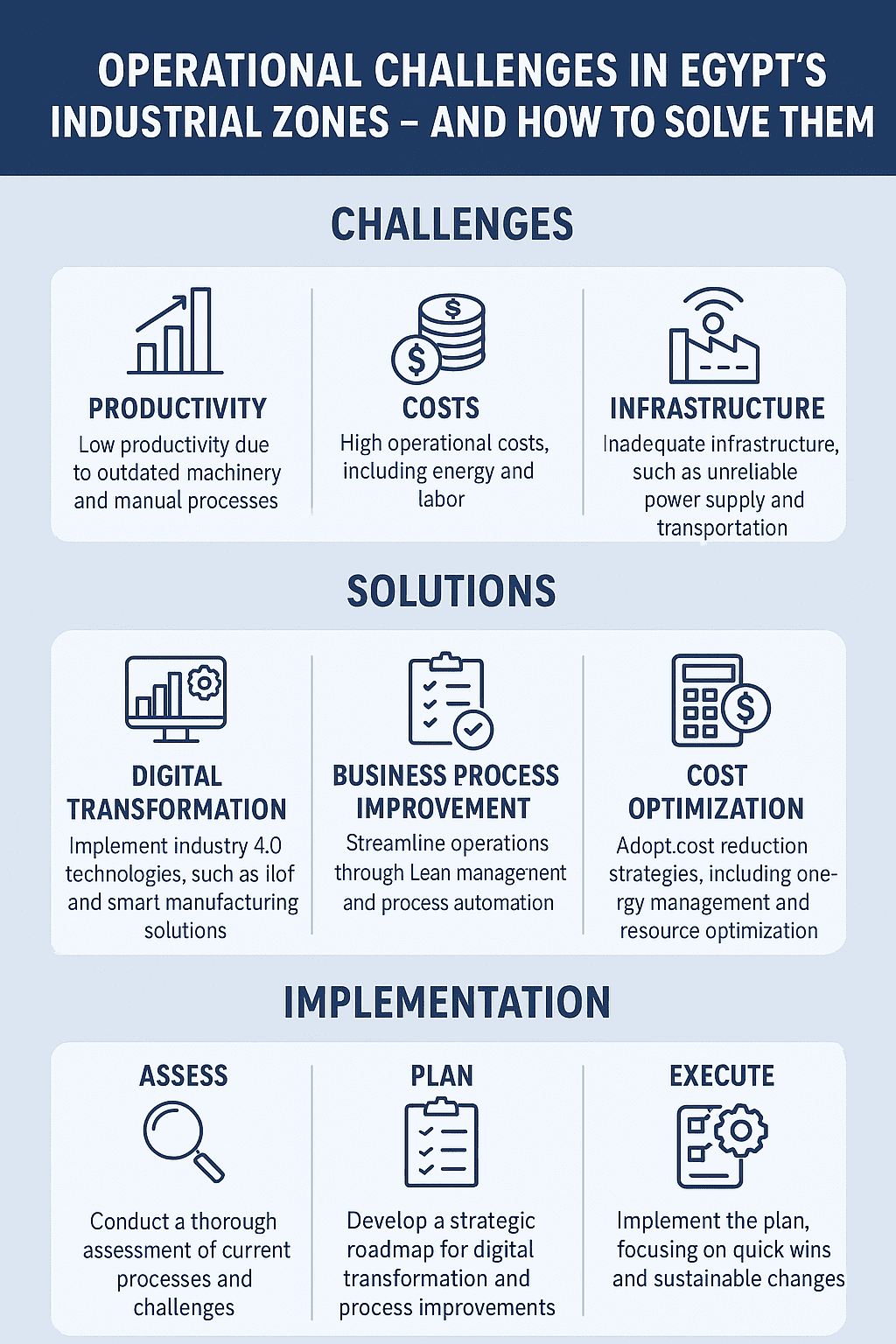
How to Solve These Challenges: A Practical, Proven Approach
1. Start with Operational Excellence, Not Technology
Before automation, businesses need operational discipline. As lean management consultants in Egypt, we recommend:
- Value stream mapping to identify waste
- Standardized work and SOPs
- Clear KPIs for productivity, quality, and cost
This foundation enables measurable factory performance improvement in Egypt and prepares operations for digital tools.
2. Use Digital Transformation Where It Creates Immediate Value
Effective digital transformation consultants don’t sell tools—they solve problems.
High-impact starting points include:
- Real-time production monitoring
- Predictive maintenance using IIoT sensors
- Digital quality tracking
These steps move factories toward industrial automation and manufacturing innovation without excessive capital risk.
3. Build a Smart Factory Roadmap (Phased, Not Big-Bang)
A realistic smart manufacturing roadmap includes:
- Phase 1: Data visibility and process control
- Phase 2: Process automation and integration
- Phase 3: Advanced analytics and AI-driven optimization
This phased approach is especially effective for SMEs using SME consulting services in Egypt.
4. Align People, Structure, and Incentives
Sustainable results require organizational development consulting that:
- Redefines roles around performance ownership
- Upskills teams in digital and analytical thinking
- Aligns incentives with operational KPIs
This turns resistance into accountability.
5. Integrate Strategy with Execution
As strategy consulting experts in Egypt, we emphasize one rule: strategy must live on the shop floor.
That means:
- Linking growth plans to capacity and capability
- Aligning cost reduction strategies with process redesign
- Embedding performance reviews into daily operations
Why Experienced Business Consulting Matters in Egypt
Not all business consulting services in Egypt are equal. Generic frameworks fail when they ignore local realities—regulatory structures, labor dynamics, infrastructure constraints, and supplier ecosystems.
At Faber Infinite Consulting, our experience working inside factories—not just boardrooms—allows us to design solutions that actually work. Our approach blends:
- Expertise in operational excellence and Industry 4.0
- Authoritativeness grounded in global best practices
- Trustworthiness built through measurable, on-site results
Conclusion: Actionable Takeaways for Industrial Leaders
If your factory is operating inside an Egyptian industrial zone, the message is clear:
- Stop treating inefficiency as normal
- Fix processes before buying technology
- Use data to drive decisions, not intuition
- Invest in people alongside automation
- Choose consultants who execute, not just advise
Operational excellence is no longer optional. It is the entry ticket to competitiveness in a digitally driven manufacturing economy.
Frequently Asked Questions (FAQs)
1. What are the biggest productivity challenges in Egyptian manufacturing?
Low process visibility, manual tracking, skill gaps, and weak performance management systems are the most common barriers.
2. How can SMEs afford digital transformation in manufacturing?
By adopting phased, high-ROI solutions such as IIoT-based monitoring and process automation instead of full-scale automation upfront.
3. What does an operational excellence consultant do?
They redesign processes, eliminate waste, implement KPIs, and align people and systems to improve productivity, quality, and cost performance.
4. How do I choose the best business management consultant in Egypt?
Look for proven on-ground experience, sector expertise, measurable case results, and a clear execution roadmap—not just presentations.
5. Is Industry 4.0 relevant for traditional factories?
Yes. Industry 4.0 is about smarter decision-making, not just advanced machinery. Even legacy plants benefit from data visibility and automation.
Contact us for Operational Excellence Consultants in Egypt